Navigating the Borderlands

The most compelling aspect of Borderlands is perhaps how its form reflects Anzaldúa’s identity. While the text is predominantly prose, it also consists of poetry in both Spanish and English. The start of each chapter is an excerpt from a great Hispanic thinker. Gloria Anzaldúa’s magnum opus is fluid, much like her identity. Her ability to create such an unconventional yet striking text is nothing short of remarkable. Anzaldúa narrates her experience as a mestiza living in la frontera—the borderlands. Her style of writing reflects her conscience—it seeks to represent not only those who reside between the U.S. Southwest/Mexican border, but also those who have historically found themselves at a crossroads with regards to their identity. Hence, she states that the borderlands are “physically present wherever two or more cultures edge each other.” Attempting to navigate the multiple identities gives rise to a feeling that is “alien” to her. Borderlands is an attempt to rationalize multiple identities at the same time instead of having to conform to one or the other. The form of the text is reflective of the writer’s dilemma that she so eloquently articulates in multiple languages. She argues that a woman of color “does not feel safe within the life of her Self” as she is alienated from her mother culture and the dominant culture. As a result, the petrified individual is caught between los intersticios—the spaces between the different worlds she inhabits.

The chapter titled “Entering Into the Serpent” builds on the aforementioned identity crisis. Her experience incorporates the impasse of her stigmatized culture and her sexuality as a queer woman. Anzaldúa emphasizes on the role of the supernatural in her Chicano/mexicano identity. Furthermore, she reinterprets the mystical elements that seem to be rejected by society. According to Anzaldúa, organized religion encourages “a split between the body and the soul.” However, she argues that the supernatural is integral to understanding the human condition. She believes that in this day and age, la Virgen de Guadalupe is the most potent religious, political, and cultural image of the Chicano/mexicano identity. Guadalupe, a symbol of hope, unites people of different races, religions, and languages. Guadalupe has been used by the Church to perpetuate institutionalized oppression by subverting the true identities of the three mystical madres: “Guadalupe to make us docile and enduring, la Chingada to make us ashamed of our Indian side, and la Llorona to make us long-suffering people.” However, it has not obscured the meaning for all as the mestizo continue to worship the old entities under the guise of Christian saints. Indigenous spirituality has been preserved under the façade of rationality and continues to be socialized within individuals. White rationality denounced mystical elements by classifying the existence of the “other world” as heathen superstition. For Anzaldúa, la Llorona, the mother who seeks her lost children, symbolizes her reflection on not only her lost homeland, but also the imposition of a subverted identity by the colonizers.

The question of identity is further obfuscated due to Anzaldúa being a queer mestiza. Instead of viewing Guadalupe in accordance with the imposed re-imagination, Anzaldúa chooses to see her for what she is: “the symbol of the dark sexual drive, the chthonic (underworld), the feminine, the serpentine movement of sexuality, of creativity, the basis of all energy and life.” She instead connected herself to Coatlalopeuh, the indigenous manifestation of Guadalupe. In doing so, she embraces her femininity as a queer woman whilst foregoing what is now interpreted as tradition in an attempt to reconcile both her culture and sexuality. She does so by using la facultad—the capacity to see the meaning of deeper realities in surface phenomena. By viewing the connection between the ‘disassociated’ body and spirit, la facultad offers the marginalized a possibility of navigating a world that poses many dangers to them. It is a heuristic method for those who “do not feel psychologically or physically safe.” The premise of the process in Anzaldúa’s experience is embracing the body and negating the traditional aspects of an oppressive religion. By using la facultad, Anzaldúa’s re-imagination of Guadalupe lends her strength and hope. Through her writing, she seeks to not only offer a possibility to the queer Chicano women, but to all those who face intersecting oppressions.
Négritude

At Senghor’s time of writing, colonialism had ossified divisions along the fault lines of race and ethnicity. Keeping this context in mind, is there any value that can be truly seen as universal? Being dismissive of Négritude by seeing it as a particularism does not capture its true essence. According to Senghor, the purpose of Négritude is not to merely affirm as it also focuses on self-confirmation: “it is rooting oneself in oneself.” While Négritude cannot be seen a universal ethic, it still attempts to construct an effort to resist. This aspect of Négritude should not be ridiculed as a struggle against the discourse perpetuated by colonizer can manifest itself in different ways.

Universalism can be interpreted as a universally applicable philosophical concept that entails the creation of an inclusive space that seeks to involve everyone. Senghor, in Négritude, implies that this is his objective is to create “an opening to the world, contact and participation with others.” While his focus is on African culture, he alludes to the transformative qualities of Négritude that the entire world can experience. He claims it to be an ethic that synchronizes itself with the rhythm of life. It can be seen as an ethic that is almost break from the perils of modernity through self-affirmation. However, the origin and manifestation of the ethic is primarily centered on an “African” who possesses the interplay of forces. The claim that Négritude is predicated on a Pan-African racial identity is perhaps Senghor’s own reckoning as there is an underlying assumption that the framework is representative. A fundamental problem with Senghor’s argument is one of categorization. While he is emphasizing the importance of African culture, there is no mention of who specifically this “African” is. There is an assumption of African homogeneity throughout the text which is slightly problematic. By coalescing identities, not only is internal difference amongst the colonized negated, but there is also an implication that colonialism impacted the colonized in a homogenous manner.

At the same time, entirely denouncing Négritude as unrepresentative is an injustice to its ethos and literary framework. The origins of the ethic can be traced to the “colonized intellectual.” Through the revitalization of art, the intention is to claim ownership of the self. If we view Senghor as a “colonized intellectual” who is temporally dislocated, we can see how that dislocation leads to an identity crisis which paves the way for a rather unique form of resistance. Individuals who try to assimilate into the colonizer’s culture suffer from a cognitive bifurcation which Memmi seeks to understand. It is almost as if Memmi’s diagnosis in The Colonizer and the Colonized is the perfect preface to reading Senghor as it allows to assess the impact of cognitive dualism. If we see this dualism as an ailment rather than an attempt to coopt, we can better understand the nature of this resistance instead of dismissing it for its inability to represent. Borrowing from Fanon’s usage of the term, Négritude can be perceived as a “muscular spasm.” It might not be a solution, but it is a self-confirming reaction. However, there is a difference between interpreting it is a reaction and classifying it as reactionary. The term reactionary implies that there might not be any substance within the literary framework. Making such an assumption is rather reductive as Négritude did make an effort to represent even though it cannot be entirely classified as a universalism.

Resilience: Of Alexander Crummell

The story of Alexander Crummell reads like a religious parable that preaches a message based on resilience. Despite the obstacles Crummell faced throughout his journey, he never gave up in the face of adversity. Du Bois conveys the idea that Crummell’s struggles are indicative of what afflicts the African American community. The chapter on Crummell can be seen as the antithesis to Du Bois’ chapter on Booker T. Washington of whom he is critical. Understanding his criticism of Washington is integral to uncovering the meaning behind Crummell’s story as it provides an exemplary model for Black leadership.

Du Bois is critical of Washington’s conciliatory approach toward social change which was premised on pacifying measures. Washington’s “Atlanta Compromise” speech promoted conciliation in the South by giving up the fight for Black civil rights. According to Du Bois, not only does such an approach negate the Black identity, it also suppresses the spirit of “revolt and revenge” which creates an impediment for Black progress. In contrast to Washington’s acquiescence, Crummell reacted differently when faced with a dilemma on his journey. Bishop Onderdonk said to Crummell: “I will receive you into this diocese on one condition: no Negro priest can sit in my church convention, and no Negro church must ask for representation there.” Crummell’s refusal to become complicit is the type of resistance that resonates deeply with Du Bois. Interestingly, Du Bois seeks to glorify an unsung Black hero with an unyielding resolve. Despite Crummell not being renowned, he epitomizes the type of leadership needed by the Black community to achieve greater prosperity.

Another important comparison to make is with John Jones in the chapter titled ‘Of the Coming of John.’ A prominent similarity between Crummell and Jones is that both of them are faced with similar temptations because of their experiences. Unlike Crummell, Jones gives in to these temptations, and eventually perishes in the Valley of the Shadow of Death. In comparison, Crummell astonishingly overcomes the temptations of hate, despair, and doubt. Despite the obstacles, Crummell continued to learn and preach. Du Bois shows that Crummell’s journey is far from a failure—it is a story of uncompromising resilience.

Du Bois argues that despite Crummell’s anonymity, he was an important figure. His story is indicative of the prejudice African Americans have historically faced. Within historical narratives, accounts of Black resilience and strength are obscured. Being able to control your own image is a sign of power. Du Bois argues that to reclaim that power and further the cause of achieving social justice, it is important to resist. Mounting a resistance can take on various forms, as shown by the comparison between Washington and Crummell. Irrespective of its form, this resistance must not be premised on compromises as it would only further entrench the Veil instead of lifting it.

“But Alexander Crummell it gave back. Out of the temptation of Hate, and burned by the fire of Despair, triumphant over Doubt, and steeled by Sacrifice against Humiliation, he turned at last home across the waters, humble and strong, gentle and determined. He bent to all the gibes and prejudices, to all hatred and discrimination, with that rare courtesy which is the armor of pure souls.” – W. E. B. Du Bois

Recognition

Intersectionality is a concept that is premised on recognition.

Crenshaw argues that by trying to understand oppression on a “single-axis” with regard to identity, multidimensional oppression cannot be understood. By extension, intersectional politics allows intersecting oppression to be recognized. Recognition is precisely what doubly oppressed groups do not get. Even historiographers do not account for their perspective.

The effects of such oppression linger on today. The theoretical framework of how discrimination is interpreted needs to change, which makes intersectional politics a necessity as it empowers those who have been silenced. The need for recognition is pertinent because intersecting oppressions continue to exist. Identities tend to be neatly demarcated, but in reality, there is quite often an overlap which empowers certain groups at the expense of others. There are power differentials present in every society which are inherently oppressive.

African American women have been marginalized along the fault lines of race and sex. Liberation movements prioritize the emancipation of a group over others. Hooks argues that these movements in the 20th century, further disenfranchised African American women by negating their identity. For instance, the women’s movement in the late 60s was both racist and sexist in its attitude towards black women. Instead of being inclusive towards all women irrespective of race, the movement was fronted by white women who supported the values imbued by white racial imperialism. Furthermore, black liberation leaders were unwilling to acknowledge the sexist oppression of black women by black men as it would “complicate efforts to resist racism.” As a result, black women were permanently cast to the background. Intersectional politics offer a way of rectifying such mistakes.

Even though social media driven socio-political movements in the contemporary era appear to be inclusive, intersectional politics allows Black women still have to carve out a space to give prominence to their respective grievances. The African American Policy Forum (AAPF), a gender and racial equity think tank, has initiated social media campaigns and published reports to challenge the narrative that victims of institutionalized racism are mostly black men. Black Lives Matter is a social movement initiated after the acquittal of George Zimmerman for the shooting of African American teen Trayvon Martin in 2012. While the movement appeared to be for “all Black lives along the gender spectrum,” in reality, it failed to acknowledge the work of Black women, trans people, and queer people within contemporary movements for racial justice. Furthermore, Treva B. Lindsey criticized Black Lives Matter for promoting a narrative against racial violence which was premised on a Black masculine perspective. In the three years following Black Lives Matter, more than seventy Black women have lost their lives to police violence. For every Trayvon Martin, there has been a Rekia Boyd. In the documentary The Lives of Black Women, Rekia’s brother stated: “They barely talk about women. Why is that? It’s crazy, because you see that even in death, women play the second role.” In response to instances of racial injustice against Black women being forgotten, the AAPF launched two social media campaigns—#BlackGirlsMatter and #SayHerName. In collaboration with the think tank, Crenshaw published a report titled “Black Girls Matter: Pushed Out, Overpoliced, and Underprotected” to illustrate how disciplinary policies negatively impacted Black girls and other girls of color. The aim of the report was to understand “the ways [these girls] experience inhospitable educational environments and to produce recommendations designed to eliminate those inequities.”

Moreover, SayHerName was launched in 2015 after the death of Sandra Bland who died in police custody. Her story was representative of how many Black women were mistreated by the criminal justice system, and how they were disregarded by the wider public. The neglect shown toward Black women has not entirely been a matter of missing facts. Even where women are present in the data, “narratives framing police profiling and lethal force as exclusively male experiences lead researchers, the media, and advocates to exclude them.” The report titled “Say Her Name: Resisting Police Brutality Against Black Women” demonstrates how Black women who are “profiled, beaten, sexually assaulted, and killed by law enforcement officials are conspicuously absent from this frame even when their experiences are identical [to Black men].” Choo and Ferree note that the aim of this campaign was to “meet the locational standard of intersectionality by which the perspectives of the oppressed move from margin to center.” If activism fails to incorporate violence against Black women, they are further marginalized and rendered invisible. In order to prevent these women from being cast into a “zone of nonbeing” in which they question their own identity, activism has to be inclusive in both its ideology and documentation while condemning state-sanctioned violence against Black people.

If intersecting oppressions are not taken into consideration, the condition of certain groups can worsen. For the individual experiencing these multifaceted identities, it can be difficult to process their experiences. Their reality can be wrongfully interpreted as destiny instead of what it actually is—a manifestation of discriminatory norms.

Been Hurt, Been Down Before

“The law is meant to be my servant and not my master, still less my torturer and my murderer. To respect the law, in the context in which the American Negro finds himself, is simply to surrender his self-respect.” – James Baldwin

James Baldwin’s article “A Report from Occupied Territory” and Kendrick Lamar’s album To Pimp a Butterfly are separated by 49 years, yet their messages have evidently disconcerting similarities concerning racial inequality and institutional discrimination experienced by African Americans. In his song Alright, Kendrick is able to align a very personal journey with the broader struggles of the Black experience.

According to Baldwin, the police is designed to “keep the Negro is his place” as exemplified by the case of The Harlem Six. Institutionalized racism continues to severely impact the lives of African Americans. In Baldwin’s time of writing, it reflected the fears and anxieties of white Americans surrounding the African American existence. Due to stereotyping, the Black identity has been made synonymous with crime and violence. This unjust interpretation has pervaded institutions through discourse, the effects of which remain prevalent. Both Baldwin and Kendrick try to reveal the nature of the atrocities committed against their community by virtue of the color of their skin. Despite the passage of time, police brutality and wrongful incarceration remain highly pertinent issues which oppress the Black community.

Wouldn’t you know

We been hurt, been down before

Nigga, when our pride was low

Lookin’ at the world like, “Where do we go?”

Nigga, and we hate po-po

Wanna kill us dead in the street fo sho’

Nigga, I’m at the preacher’s door

My knees gettin’ weak, and my gun might blow

But we gon’ be alright

In the pre-hook of his song Alright, Kendrick achieves universality in his message by choosing to keep the source of the “hurt” ambiguous. These words are sentiments, applicable to any hardship faced by African Americans throughout history and also in the contemporary era. Like Baldwin, he then proceeds to vocalize his frustration with the justice system that disproportionately targets African Americans. When referencing the “preacher’s door,” Kendrick implies that he seeks to counsel of God to set him on the right path in midst of the hardships he faces.

Alright can be interpreted as an extension of Baldwin’s words, as Kendrick himself preaches a message of strength and endurance against racism that is deeply entrenched in American society. Through the pre-hook and chorus, he finds strength and shows solidarity with the Black community, realizing that his personal struggles are not unlike the history of African Americans. Kendrick has remembered that fight is inherent in the Black experience, that progress has and will continue to be made due to the fortitude, strength, and perseverance of his people.

Through God, Kendrick believes there is no adversity too difficult to navigate. He recognizes that the problems faced by him and his community are a shared struggle. He goes on to preach a message of union and displays faith in God’s plan. Like any great anthem, Alright’s chorus is brief, catchy, and extremely versatile. The inflection with which it is performed is infectious—it can be repeated infinitely without tiring. In fact, its message only gets stronger the more it is heard.

Outside the album’s narrative, Alright has been adopted as the unofficial anthem of the Black Lives Matter movement. Beginning in 2012 when an unarmed Black teen Trayvon Martin was killed, the hashtag Black Lives Matter emerged on social media outlets. It became a digital platform where dialogue, frustration, and debate could be expressed around issues of racial profiling and racial inequality in the United States. The phrase would come to represent a national movement whose pursuit was and continues to be racial justice and social awareness. The movement intensified as more and more unarmed Black men and women continued to lose their lives at the hands of the police.

The song’s message of hope through resilience struck a chord with the supporters of the movement, and the chorus has been heard chanted at protests and rallies across the United States. Institutionalized racism continues to be a problem which marginalizes African Americans. The struggle to redefine the African American identity is still ongoing. In a way, Kendrick echoes the words of Baldwin through his poetic expression which has become a chant of hope, solidarity, and defiance. Alright radiates an optimism that showcases the resilience of the Black spirit against racism.

The Blacker the Berry

My project will attempt to bring Pulitzer Prize winning artist Kendrick Lamar’s jazz-infused album To Pimp a Butterfly into conversation with the works of prominent African American authors including W. E. B. Du Bois, James Baldwin, and Ta-Nehisi Coates. Such authors have penned literary masterpieces focused on the issues that continue to deeply affect the African American existence. Kendrick’s music can be interpreted in a similar light despite it being a different form of expression. The commentary done within the project will dissect the following tracks from Kendrick’s third album:

  1. Institutionalized
  2. These Walls
  3. Alright
  4. How Much a Dollar Cost
  5. The Blacker the Berry
  6. i
  7. Mortal Man

The significance of this project lies in the contemporary themes that Kendrick addresses through his music. His poetic expression stands out amongst his peers within hip-hop whose content never seems to digress beyond wealth and fame. The musical composition of To Pimp a Butterfly incorporates elements of funk, jazz, and soul. The lyrics address an array of issues faced by African Americans ranging from socio-economic marginalization to police brutality. Kendrick himself has stated in an interview that his songs seek to capture emotions. Not only does he tell his own story through his music, he also seeks to tell the stories of those around him. Through the influence of his art, Kendrick tries to both represent and empower. Finding the connections between his music and renowned literary works is important to understand both the message he tries to convey and what it means to those who are inspired by him.

I will be submitting this project in the form of a video essay that will suture together his songs, music videos, and interviews to express a visual understanding of Kendrick’s creative process and artistic ambition. The composition and lyrics of his music will be analyzed by drawing comparisons to the works of the aforementioned African American authors to show how the thematic correlations resonate with listeners in this day and age.

Objects

In this piece, I will analyze the extent to which first world feminism can be seen as imperialism. My reflection will focus on the methodological universalisms section of Chandra Mohanty’s article. I will try to engage with Mohanty’s assessment of the methodological problem of ethnocentric universalism in cross-cultural work and how that correlates with third world women being reduced to object status.

Before delving into Mohanty’s critique, it is important to define imperialism as it can hold many connotations. My analysis will interpret imperium as the exercise of power. First world feminist discourse perhaps unintentionally reduces the agency of third world women by implying that they cannot represent themselves. In the context of first world feminism, ‘progress’ cannot be gauged without identifying third world subjects, and it is precisely this identification which results in third world women being viewed as depersonalized objects. What this ‘progress’ denotes is women gradually reclaiming their personhood, but the contradiction is that the first world feminist discourse can be seen as further marginalizing third world women. This can happen due to an imposition of Western standards which comes at the expense of third world women and their individuality.

The problem of ethnocentric universalism can be seen as a methodological issue that results in an uninformed intrusion by first world feminists into the contexts of third world women. Mohanty’s primary contention is predicated on the notion that such discourse is depersonalizing third world women. According to her, a critical assumption is that across classes and cultures, women are somehow socially constituted as a homogenous group. This results in the neglect of cultural or historical specificity which might be an integral component when it comes to understanding the power dynamics in a given society. An example which Mohanty gives to elucidate such generalizations is of Hosken equating the veil with rape, domestic violence, and forced prostitution as a form of sexual control. By reducing the veil to a mere symbol of oppression, a universal fact is constructed which does not take into account the opinion of the individual who might be wearing the veil and what it might mean to her. Not only does first world feminist discourse tend to neglect contextual nuances, but it also imposes a dominant episteme which does not account for the individuality of third world women. It is the process of such imposition which results in third women becoming objects of power. What the issue of ethnocentric universalism can be linked to is the rationale behind the mission civilastrice as it applies a similar temporality on the existence of third world women.

The intent of first world feminism is to expedite emancipation, but the result can be construed as the exacerbated marginalization of third world women.

Obfuscated Culture: The Start of a New Struggle

In this piece, I will be analyzing how Cabral viewed culture in the context of national liberation. Although I agree with how he deemed culture to be a constantly evolving entity, I will attempt to argue that culture in itself was perhaps a significant hindrance in the struggle for liberation. The culture that he was trying to save turned out to be his own reckoning because of divergent class interests. This was because of a plethora of complex horizontal and vertical social structures present within Africa which were evidently acknowledged by Cabral in his speech. The almost incomprehensible cognitive changes that occurred as a result of cultural domination can be linked to the imposition of changes in terms of both geographical demarcations and productive forces. I will be focusing on the impact that the change in the mode of production had on the native population which prevented the emergence of a streamlined mass culture against the oppressor’s culture. An enforced shift from subsistence-based agriculture to monoculture had implications beyond the generation of revenue for metropoles. Cabral perhaps underestimated the extent to which cultural domination had pervaded native culture, turning it into a pale imitation of the colonizers themselves. As a consequence, he also underestimated how much this obscured culture had reified the class divisions that had been constructed by colonialism, making the emergence of a mass culture quite improbable. While he did acknowledge that the creation of a native elite was deliberate on behalf of the colonizers, he unfortunately placed too much faith in the altruistic capacity of his own people which is elucidated when he refers to the process of ‘re-Africanization’ which would involve previously alienated native elites becoming reintegrated into their own culture amidst the struggle for liberation.

Before further delving into a critique of his speech, it is important to be cognizant of the fact that a speech cannot give us a crystallized sense of his convictions and understanding. Keeping this in mind, it can be said that Cabral placed a lot of importance on culture and the role it plays in the development of societies. He understood culture to have a responsibility for assuring the continuity of history which means that it is essentially shaped by the past and shapes both the present and the future. According to him, culture was inextricably linked to the material base of a society – the level of productive forces. What I found particularly percipient was his identification of culture not being uniform in all sectors of society. It is this differentiation which results in the divergence of attitudes amongst social group. It is evident that his understanding drew on Marxist ideals which is further elucidated when we discern what he believes the objective of national liberation should be – to regain control over productive forces. Even though we can assume that regaining control could lead to the cultural domination of the oppressor diminishing, it does not restore your organic culture. This happens because the disruption that occurred due to colonial enterprise, cannot be undone merely by ending colonial control. With the advent of colonization, it is almost as if Cabral is implying that their culture was put in a state of flux, which was not the case. With the passage of time, it was a process of replacing native culture, but rather it was a process of obfuscating it and eventually overriding it.

To deal with this problem, Cabral believed in the efficacy of liberation movements embodying popular culture. As stated earlier, this is his undoing – placing perhaps too much faith in the capacity of individuals to converge on a mutually agreeable way forward which would redefine productive forces to cater to the interest of the majority. Although he is suggesting that cultural degradation occurred because of productive forces being seized by the colonizers, perhaps he should have confronted a fundamental question: what would happen if the same mode of production was to be retained? We cannot blame Cabral for not identifying this issue simply because it is easy for us to make this judgment based on what events transpired. For him, all he sought was a way out for him and his people. We have to give him credit for identifying how oppressors systematically used cultural domination as a political tool designed to effectively subjugate masses and facilitate imperium. Irrespective of which colony we might be looking at, we can identify a recurring pattern of cultural dominance in the modus operandi of the colonizers to influence and alter social dynamics. This is perhaps one of the greatest insights that Cabral gave.

While we can agree with his identification of the systematic use of cultural domination by the colonizers as a method to oppress, his prescription is perhaps undone by two complications: one of misdiagnosis and the other of idealism. While he intends on being critical of colonialization, he might be inadvertently accrediting it because of how he views development to exist on a linear path. If you are to believe that the level of productive forces indicates the stage of development of a society, then you are subconsciously acquiescing to the colonial narrative of natives being inherently inferior and primitive. Cabral envisaged the objective of national liberation to be an attempt to reclaim the process of development of productive forces. Keeping this objective in mind, it can be argued that to reclaim was simply not enough. To reclaim was to inherit. Reclaiming should not have been seen as the end of colonial domination but the beginning of a new struggle – to diminish the influence of deeply entrenched colonial structures which existed under the guise of productive forces. A deficiency in Cabral’s speech pertains to a lack of emphasis on the correlation between the degradation of native culture and the existence of colonial productive forces. What was inherited after liberation were deeply entrenched colonial remnants which were constructed for imperium, not ‘development.’ It is almost as if he is fine with the notion of ‘development’ as long as natives are at the helm. Would that really change anything? Not only did these structures create and reify divisions along the lines of both class and gender, they also resulted in the disruption of a formerly unhindered organic progression. While he did stress on the significance of culture, Cabral failed to realize that his conceptualization of liberation would mark the beginning of a new struggle due to their ‘inheritance.’

I will try to further develop this idea by relating it to two distinct social groups which Cabral highlighted in his speech – the Balante and the Fula, which had a horizonal and vertical social structure respectively. For such structurally opposing cultures to synthesize, you have to keep in mind that their essence could be lost in that process. Furthermore, a vertical social structure would be more adept at recalibrating itself to use the body politic and its productive forces as a tool to promote its interests which would result in a greater importance being ascribed to the protection of that social group’s interests in the post-liberation phase. Perhaps the most glaring contradiction is made evident when he refers to the liberation movement embodying a mass culture which represents majoritarian interests. If it is difficult to find uniformity within your own culture, mass culture would probably be dictated by the prioritization of the interests of a specific social group. This results in the culture of a social group being viewed as inherently superior to other native cultures. The clout that might be gained or lost by a social group would be based on their material reality which was distorted by colonial intervention. This is the inconsistency within Cabral’s identification of mass culture as a means to overturn the oppressor’s culture. If we are to assume that this mass culture was to hypothetically succeed in its endeavor, the resulting productive forces would be shaped in the interest of a specific social group because of the power they would exercise as a byproduct of their material reality. While Cabral did indeed have a nuanced understanding of culture, the emergence of a mass culture which would represent the majority was an idea which was quite utopian keeping in mind how much colonial domination had altered native culture to begin with.

Fragments in Time


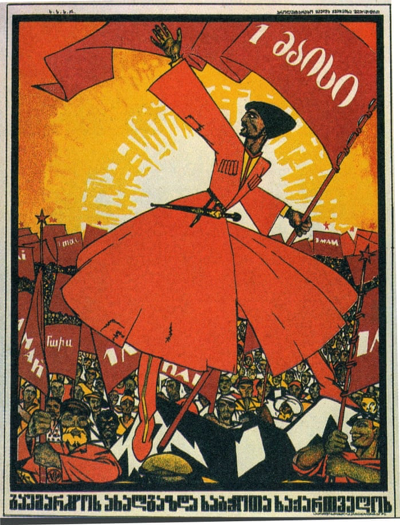
“I too, for the first time, felt in the red flag a symbol of victory over the exploiting system.”

The most striking aspect of this socialist poster is the individual around whom the art is focused. Two things stand out: his garb and the colour of his skin. These prominent features on display are what I will be using to link the poster to the extraordinary life of Dada Amir Haider Khan. This piece evokes a sense of pride that is attached to an individual’s heritage. Dada’s experiences in Moscow can be considered to be an emancipation of a similar ilk. Today we can see that his emancipation was temporary, but that’s precisely not the point. Whilst trying to understand his experiences, we must confine our understanding to the time he spent in Moscow, to get a sense of what that exposure meant to him, not to us. If we consider communist internationalism to be a failed endeavor which channeled elements of tokenism, we are doing a disservice to all those who temporarily regained their individuality in a world in which differences and divisions were rapidly being reified.

There’s an incident over the course of Dada’s university experience which I thought was particularly remarkable. Dada suggested to Comrade Intelginkoff that perhaps the use of one Russian language would be best suited to the interests of internationalism, a parallel being the use of English in the USA. Upon making this suggestion, Dada was criticized for being ultra-leftist. This interaction is what perfectly encapsulates his experience in Moscow. This is what sets you free. A man who had sailed the world twice had finally ended up in a space in which he was not expected to change or alter himself. The university promoted acceptance and tolerance by creating an environment in which you were not discriminated against. In this environment, Dada and his peers from around the world were not robbed of their individuality. Dada can be seen as the vanguard in the poster, representing the South Asian masses and experiencing a break from epistemic domination. This very epistemic domination is what compelled him to undermine the importance of his mother tongue and his identity, the value of was reinstated in this almost utopian spatial imagination that was realized within Moscow. What resulted was both a restoration of pride and a sense of belonging that had been lost since birth, throughout his voyage. His experience in the university was gradually healing the colonial rupture in time that had afflicted many. The body language of the individual in the foreground of the poster implies an existence that is unburdened despite the rupture.

What the poster allows us to imagine is an alternate reality which was very much a possibility, a way out, when Dada was enrolled in the university. This break from time resulted in socio-economic divisions and hierarchies being temporarily negated. While colonial discourse continuously reminded natives that there were intrinsic differences which separated Europe from the rest of the world, socialist reconstruction made an attempt at getting rid of that imposed linearity of time. In this context, language becomes essential component of an individual’s identity. In the background of the poster, we see mobilized masses who can also be perceived to be emancipated. While Dada’s own identity had been healed to a certain degree, this emancipation had eluded his people – the native inhabitants of South Asia. When Dada returned ‘home,’ he was deemed to be a threat to domestic peace and stability. His ‘home,’ instead of being a sanctuary, was plagued by the colonial epistemic framework which did not ascribe any value to native individuality.

Had the ways of communist internationalism prevailed, we perhaps would have viewed Dada as a hero of national liberation. But since it did not happen, his story and his struggles became obscured fragments in time. He dedicated his life to a cause he believed was larger than himself. It’s important to remember his sacrifice. It’s important to remember him.

“So for the first time in my life I began to understand things that had become unknown to me.”

Machinations of the Mind

In the context of Hind Swaraj, representation refers to an untainted existence. Colonialism directly impacted the cognitive abilities of the colonized which meant that it became difficult to reconcile with the ideas of progress that modernity brought. Amidst this cognitive dissonance, to be represented is to perhaps believe with conviction that if the developmental trajectory of the colonized was not altered at the behest of the colonizer, this alternate reality would not have been inferior in any form. Gandhi’s critique of modern civilization revolves around the idea of progress being stimulated by avarice. He alluded to the innate ability human beings have to introspect that has been stripped by the machinations of modern civilization. A crisis of representation occurs with the enforcement of modernity which results in people losing their individuality. The disruption of organic progress separated those who were subjugated from their essence. A coping mechanism in response to this is clinging onto spirituality, as promulgated by Gandhi.

The epistemic framework which began to dominate our thinking subconsciously was that of the colonizer. We replaced those who subjugated us, but the subjugation still persists. With every passing generation, the possibility of being represented is becoming increasingly lost as it is difficult to regain our essence and coexist in a system which values modernity instead of highlighting the devastation it has caused. A lack of representation is highlighted by the kind of discourse we as students are exposed to. Certain paradigms of knowledge are valued more than others which do not originate from the perspective of the oppressed. Even history as a discipline is marred by all that has been lost and not been documented. With the passage of time, representation will continue to become obscured to an even greater extent. We now exist in a time in which it is difficult to fathom what could have been had we been allowed to exist.