Say Her Name

Kimberle Crenshaw begins her talk on ‘the urgency of intersectionality’ by naming eight names of black bodies killed by police brutality in the last two years. The audience only remembers the stories of the first four, all which are stories of males. The stories of black females murdered at the hands of the same violence are not remembered. The Black Lives Movement has somehow left out the black women’s names from wider circulation, they simply do not garner the same kind of attention as the stories of their brothers.

Crenshaw coined the term intersectionality to be able to name this ‘problem without a name’ that afflicted black women. This term allowed for the coloured woman who suffered from the double bind on grounds of being a woman and black to be able to be able to name her oppression. Bell Hooks discusses in depth how womanhood was synonymous with white womanhood and the Black or ‘Negro’ identity was synonymous with black men. Crenshaw uses the metaphor of the intersection between two roads to describe the position of the black female. If she meets an accident on the intersection between the roads of racism and sexism, what road did she have an accident on? Crenshaw argues that it is neither and both; the black female experience falls through the cracks of both movements that aim to liberate her and exists within an overlap.

Judith Butler in ‘Politics of the Performative’ argues that intersectionality in essence is flawed as it turns women’s rights into a a ‘woman’s issue’ rather than critiquing the power nexus that these problems exist within. This is further examined with the example of Rosa Parks’s story and how the agency is not with the person alone and how a movement can be complicit with the very forces it claims to oppose. Rosa Parks’s name is regarded as a prominent female face within the struggle against segregation. This is interesting as this narrative conveniently brushes to the side the women who refused to give up their seats before her.

Claudette Colvin, 1955

Claudette Colvin was a fifteen-year-old high school girl in Montgomery, Alabama who refused to give her seat to a white woman nine months before Rosa Park. Colvin was returning home from school and was sitting in the coloured section. It was required that in the case of crowding in the white seated area that the coloured people leave their seats and move to the back of the bus and stand so no white person would have to stand. The bus driver looked at Colvin signalling that she get up and give her seat to the white woman and Colvin refused to do so. She began to scream ‘it is my constitutional right!’ and was forcibly removed from the bus by two police men. In an interview with ‘Great Big Story’ Colvin looks back on the experience and how she felt ‘Harriet Tubman hands were holdin’ me down one shoulder and Sojourner Truth hands holdin’ me down on the other shoulder.’ Colvin described how despite being terrified, she felt ‘it was time to take a stand for justice.’ Her case was one of the five plaintiffs originally included in the federal court case Browder v. Gayle, to challenge bus segregation in the city.  This case was instrumental in ending bus segregation. However, her name and her story are not remembered as they did not at the time fit the criteria of the NAACP. Colvin was charged for violating seating policy and assault. She was also pregnant out of wedlock by a married man and too young to be the face of a movement. Her story was actively erased and Rosa Park’s name circulated. Parks was a light-skinned, middle-aged, working black woman and the media would interpret her name as that of a resistor, not that of a criminal.

Kimberlee Crenshaw ended her talk by having the audience shout out the names of these black women and bear witness to their stories. Intersectionality is important because you can not address a systematic oppression without spelling out what that oppression is. Judith Butler and her critique reminds us to remember that the overlaps are not as simple as that between sexism and racism in black womanhood. The overlaps are that of class, purity politics, agism and how dark your black skin is. Butler reminds us to not try to gloss over these intricacies and to be careful of the power structures circulated stories operate within. The Black Lives Matter movement is an important, necessary movement given the rampant police brutality and violence. It is necessary to bring an intersectional approach to it and to question what the term ‘Black Lives’ means and if it includes the Black Woman aswell. The ‘Say Her Name’ movement aims to shed a light on this by forcing people to realise that police brutality against women exists in equal proportion. It forces you to think about the erasure of the Black Women and what kinds of Black Women are represented when they are allowed to be represented.

The Carters & The Louvre–I can’t believe we made it

For fifty years, lynching postcards were circulated in the United States. Pictures were taken at the time of the lynching and people bought them as ‘mementos’ from lynchings they had participated in. Lynching the black man was a sport and it was the white man’s word against the black man’s in deciding fate. Participants mailed these postcards to their families boasting the spectacle they had participated in. Long after circulation had been banned, they were carefully collected and passed down generations grouped with family pictures and other fond, nostalgic images.

It was these postcards and this particular photograph that inspired Abel Meeropel to write the poem ‘Strange Fruit’ in 1937. This poem as performed by Nina Simone speaks the uncensored truth of the black person’s reality in slavery days. He is merely an object of amusement, his body is portrayed in the postcard that is celebrated but it is his death, lynching being celebrated, not him. He is the subject of the white man’s art without ever being the dignified subject, creator or consumer of it.

I am now going to examine the ways in which The Carters makes a place of celebration for the black identity in neoclassical art by having black bodies create the art, be the subject and invert the themes of art that excluded them, through their music video ‘Apeshit.’

The Carters rented out the Louvre for this music video and used three millennia worth of art and sculpture to explore themes of black power, erasure, violence and resistance. Throughout the video, they take art and give it a new meaning through the ‘special attitude’ the black body brings to it. Baldwin discusses this idea in his ‘Notes of a Native Son’ when he talks about his own experience win France as he marvelled at the art he saw. He discusses the way the white man turns to these same prestigious museums and structures to trace his lineage and find pride in it and yet the black man simply can not– ‘these were not my creation, they did not contain my history.’ Baldwin says he feels like an ‘Interloper’ as he appreciates western works of art. He resents the white folk and hates them, yet he still appreciates their work. Throughout this video, Beyonce and Jay-Z explore this relationship of black bodies, interlopers, with Western art and challenges what this relationship can and should be. It does so have been depicted, through inclusion and exclusion in art and the way change is here. It echoes themes of James Brown’s black pride, Aretha Franklin’s demand for ‘just a little bit respect’ and Burning Spears’ ‘showing them that we are still alive.’

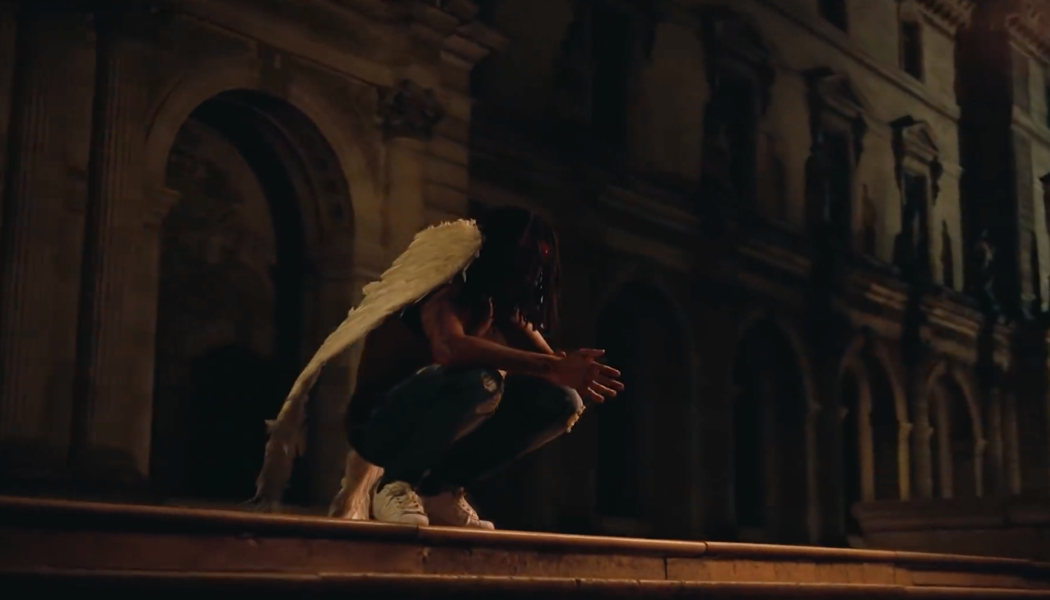
The video starts with the iconic sculpture of ‘The Winged Victory of Samothrace,’ representing the goddess Nike. This sculpture is one of the most celebrated surviving greek hellenistic sculptures and dates back to the 2nd century BC. Nike is the goddess of Victory and by juxtaposing her wings with a young black boy, the video establishes the glory it attributes with the young black man’s body and how it is to be associated with victory and triumph. Beyonce places herself right in front of the statue while demanding ‘gimme my check, put some respect on my check,’ echoing the straight forward, no-filter sentiment that is present in Nina Simone’s ‘Mississippi Goddamn.’ The stairs leading up the statue are covered with different shades of black female bodies, showing how they are literally occupying a pre-dominantly white space and making it their own.

A young black man with wings representing ‘The Winged Victory of Samothrace’

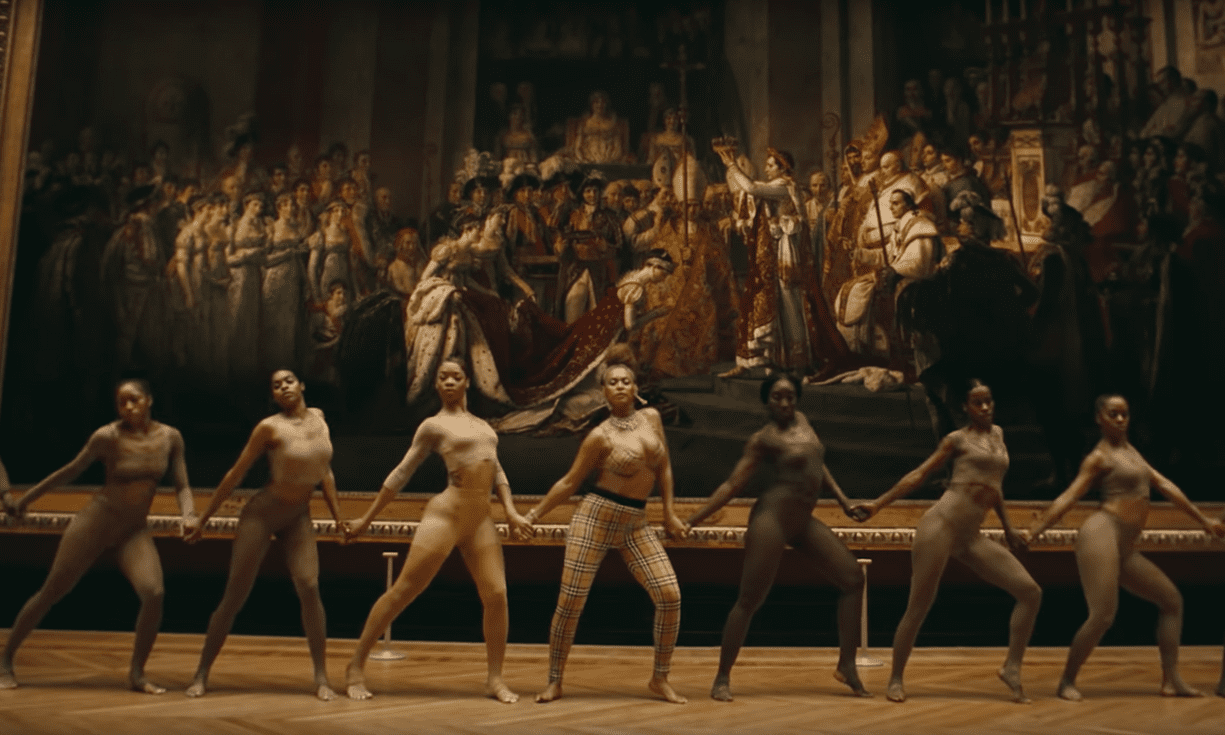
In the following image, Beyonce dances in front of David’s ‘The Consecration of the Emperor Napoleon and the Coronation of Empress Joséphine. Napoleon had this piece commissioned to portray him crowning his wife as a was a way to honour Josephine. Beyonce stands in front of this image of French pomp and conquest and freely dances in tight fitting clothing with women of colour to emphasise how she as a black woman does not adhere to the respectability politics of white women. Beyonce sings about how she has ‘expensive habits’ and she’s ‘living lavish’ just like Jospehine, however, unlike her, she does not kneel down for someone else to crown her.

Beyonce and her dancers in front of Jacques-Louis David’s ‘The Consecration of the Emperor Napoleon and the Coronation of Empress Joséphine,’ 1804

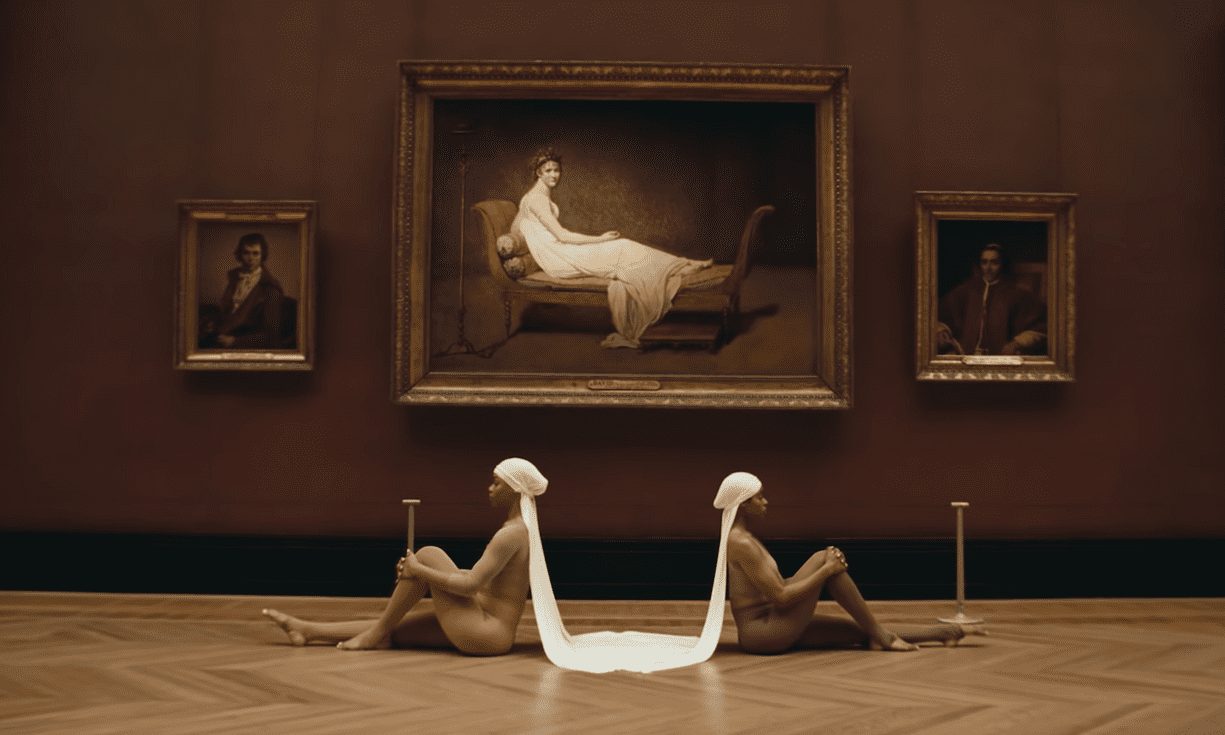
The music video then goes to the following still of two black women sitting on the ground as Davids‘ ‘Portrait of Madame Recamier‘ is elevated in an exalted manner. Madame Recamier was a Parisian socialite and she is depicted coifed in Greek fashion, reclining on a Pompein couch in a severly formal setting, truly serving as the height of French elite and regal status. The two women of colour sitting underneath her become significant as they portray how in reality it was women just like these who were characters surrounding figures like Madame Recamier, and it is these slaves who are left out of the narrative. The song goes silent at this still and lets the viewer contemplate what this means and how black bodies have historically been excluded.

The video also incorporates Gericault’s Raft of Medusa, a painting which is deeply socially and politically conscious. Gericault depicted people who were abandoned deliberately at sea and most of them died. The raft was eventually rescued and at the top of the pyramidical composition is a black man signalling towards a ship. Gericault empathised with the slaves and this work of art portrayed the suffering of the people while depicting them the black as heroic. Jay-Z stands in front of this image and repeats the chorus ‘can’t believe we made it.’ The inclusion of this particular image depicts the deeply hopeful nature of struggle and shows how Aretha Franklin’s ‘its been too hard livin, but I’m afraid to die’ rings true.

Théodore Géricault, ‘The Raft of the Medusa’

Finally, the Apeshit video breaks the constant portrayal of white characters with the ‘Portrait of a Negress’ by Benoist. This painting was made during a brief period of abolition of slavery in French colonies and is the only painting of a black subject without a visible form of white domination within the painting. The woman is titled simply ‘The Negress’ and has her breast exposed, which shows that she probably did not have any control over how she was made to pose. However, despite this, The Carters embrace this image because she is given a portrait and she maintains her regal and poise. Her image takes up the entire screen and no comparisons need to be drawn. Her portrait is hung in a respected place. The Carters sing ‘can’t believe we made it, this is what we’re grateful for’ and one sees how black identity and its relation with art continues to evolve.

Marie-Guillemine Benoist, ‘Portrait of a Negress,’ 1800.

To conclude, I think back again to the poem ‘Strange Fruit’ and Nina Simone’s voice as she re-opens the deep wounds that have been inflicted upon black bodies through slavery. I think back to the post cards that were circulated and to what thoughts may have crosses Lawrence Beitler’s mind as he captured the lynching of Thomas Shipp and Abran Smith. I think about The Carter’s and their ability to rent out the Louvre, an icon that represents the height of white elite culture and I meditate over how they have taken these famous works of art and tried to bring their own ‘special attitude’ in their approach to it. I think about James Baldwin in 1955 writing about feeling like an interloper as he appreciated art in France and I think about how The Carters tie into this long history. I wonder how Baldwin thought these works of art do not contain his history and how The Carters show that they do.

Are we ‘Sisters in Struggle’?

Historically women’s bodies have been used as battlegrounds for men to fight their battles on. Women’s bodies have largely been the target of violence and this is true across time and culture. A woman’s body is an object shackled to the patriarchy, however, all women are not united in their oppression. There are intricacies of race, class, and history at play which cannot be glossed over by a banner of mutual oppression.

The White woman’s emancipation is not the colored women’s emancipation. The White woman lovingly nicknames the colored woman ‘Third World Woman,’ and attempts to engage in discourse for her emancipation without giving her a seat at the table. She lumps all colored women together irrespective of the intricacies of circumstance and develops a vested interest in their liberation. The ‘Third World Woman’ is considered a victim to circumstance, an ‘immature’ woman who can not think for herself. The colored woman is silenced and her own narrative is ignored.

The ‘Third World Woman’ carries chains the White Woman does not. She shoulders the weight of a colonial past where her body has been the grounds upon which conquest has taken place. She has been sexualized, exoticized and symbols from within her context have been turned over to fit the colonizers narrative. The French campaign to colonize Algeria translated into postcards that depicted Algerian women as easy and flirtatious. Colonialism took the symbol of their veil and viewed it through a lens that turned it into an invitation to their accessible bodies surrounded by mystique. Colonialism wrote the colored woman’s story.

The White Woman is a crusader disguised as a savior. She holds banners of ‘We are all Sisters in Struggle’ and she aims to free the ‘Third World Woman,’ from the culture, religion, and men that oppress her. Much like Rostow and his theory on economic growth as a universal, linear process, the White Woman proposes a universal, linear path for achieving emancipation. She wishes to impose her script of emancipation on the colored woman. Much like the work of the colonizer, western feminism attempts to write the narrative of this ‘Third World Woman’

The White Woman sees the colored woman’s veil as a symbol of oppression, she does not care for what context it is grounded within. Mohanty discusses the lens through which the white woman looks at the Muslim women in Saudi Arabia, Iran, Pakistan, India, and Egypt. Western feminism sees they all wear some form of veil and the White Woman equates it to ‘sexual control.’ The coloured women are reduced to a ‘descriptive generalization’. The White woman turns the veil into a symbol of something it may not be, just as the French colonizers did with the Algerian woman’s veil.

First world feminism does not care for the meaning behind instances of observing the veil and how the meaning differs across time and area. It does not care that while there may be physical similarities behind observing a veil, the Iranian middle-class woman observing it in 1979 to show solidarity with working-class women and the woman forced to observe the veil under mandatory Islamic law in contemporary Iran are different. It does not understand why diaspora women in the West are increasingly putting on the hijabs as a means of resistance while women in Iran are taking it off despite the reality of being jailed for it. First world feminism assumes ‘universal applicability’ and its failure to be context specific is a disservice to the struggle for women’s rights.

Iranian Women removing headscarf in protest, 2018
source: https://www.independent.co.uk/news/world/middle-east/iran-woman-hijab-protest-arrest-jailed-prison-shapark-shajarizadeh-headscarf-white-wednesdays-a8439816.html

In conclusion, first world feminism fails to give the pen to the colored woman it so problematically calls the ‘Third World Woman.’ Intersectionality is necessary for a movement aimed at the emancipation of woman and the colored woman must write her own narrative. Western feminism’s crusade-like attempt to define the colored woman’s symbols rings close to the work of colonialism before it. The crusade is a form of neo-colonialism, an attempt to rule through control of ‘hearts and minds’ rather than ‘fire and sword.’

Macaulay’s Children

Your grandfather loves gardening and you spend afternoons watching him walk out into the garden, back bent over with age, cane in hand, to examine his flowers. You remember when you were younger, how terrified you were of being caught picking his flowers. The year is 2019, you think about Cabral’s metaphor of culture being to history what flowers are to plants. The way flowers (culture) carry the capacity and responsibility of ensuring continuity of history. You realize the role language specifically plays in this transmission, you realize how lost language is on you.

The year is 2009, you are a girl with big eyes who lives in a whirlwind of stories. You live in a world of fantasy, surrounded by storybooks, always looking forward to your Creative Writing classes. All your stories are about girls with blue eyes who are always named Matilda or Melanie. It will be years before you question why a Pakistani sounding name never felt appropriate to you, why you never found it worthy to name your protagonists a name that sounded not-European.

The year is 2014, you are an O’level student at an elite private school in Lahore, aspiring to attend a foreign college. You are meticulous and systematic, noting quotations on yellow flashcards just in case need be. You remember shrugging off the quote when you first read it. How it stung but only slightly, not long enough for you to question it. You are now at a point where you pride yourself on your growing collection of English Penguin Classics, you do not think twice about how you never read Urdu outside of the O’level curriculum. The irony of the O’level batch at your school appearing in the examinations with English as a first language and Urdu as a second is lost on you.

‘A single shelf of a good European library was worth the whole native literature of India and Arabia’

The year is 1835. A man from a foreign land decides how a ‘heathen’ people in British India should be educated. Lord T. B. Macaulay circulates a Minute on Education offering reasons why the British government should spend money on the provision of English language education to a people who ‘can’t at present be educated by means of their mother tongue.’ Nothing of value is left in your native tongue and so your people begin to assimilate. At the end of the day ‘imperial domination’ and ‘cultural domination’ are big talk ordinary people are not concerned with. You are more concerned with having a job to keep food on the table. Suddenly, literacy is tied to your proficiency in a language that isn’t yours; you will spend years struggling with the language, promising to send your children to schools where they will learn the right pronunciation for words that still feel strange coming out of your mouth.

The year is 1947, the British depart but cultural domination does not leave with them. In a world of globalization, Macaulay leaves the subcontinent a legacy of preferential treatment of one language over another. Cabral argues that to dominate a nation, you must neutralize and paralyze its culture. Macaulay’s reforms set in motion a series of education reforms that cut culture at its root– language. You are a country of 74 languages yet you prefer Urdu, a language only 7% of the country call their mother tongue. The division between Cabral’s ‘indigenous elite’ and ‘popular masses’ becomes generational with the cultural capital a private school offers over a government. Long after the British’s departure, the English medium schools remain accessible only to the ‘petite bourgeoisie’ who inherited the schools from the British.

The year is 2019, you think about the flowers your grandfather grows, you think about the way the way flowers are to plants what culture is to history, you realize you have picked the flowers without even meaning to. You realize that you are the amalgamation of Macaulay and those after him and their reforms. You are the child that is alienated from its own culture, a coconut, a girl writing stories with protagonists with European names because she harbors resentment for her own people and thinks names like Melanie and Matilda portray superiority. You are the child assimilated into the mentality of the colonizer without ever living in a time of colonial rule. You think of Cabral’s idea of re-conversion or re-Africanisation in his context, you hope to develop a love for gardening like your grandfathers.

Art Breaking Chains

Dada Amir Haider Khan’s ‘Chains to lose –Life and Struggles of a Revolutionary’ provides insight into the way that an individual’s life was impacted living in Moscow during the 1920s. Dada is an Indian man who carries the chains of the Old World; he is burdened by the remnants of colonialism and the conflicts of identity that arise from it and despite having traveled across the stretches of the globe, it is only in Moscow that he breaks from his chains.

During this period, Soviet Art was in its peak stage. The Bolshevik era had established the iconic symbolism of the red star, hammer and sickle and art played a significant role in portraying the optimistic views of Soviet life. Social realism was differentiated from Socialist Realism and all pessimistic or critical commentary was banned. ‘Agit-prop,’ a combination of the Russian word ‘agitatsiia’ (agitation) and propaganda was set up by the Soviet Communist Party in the 1920s and the slogans of the revolution were sung proud and loud, fanning the patriotic fires of the heartland. The posters circulated during this period show the power of art and how a small group of painters shaped the attitudes of a nation of 150 million.

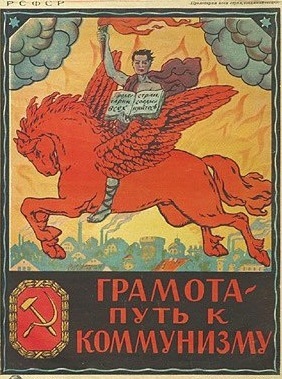
“Literacy is the path to communism.” 1920

The emphasis on literacy as a means of enlightenment was given great emphasis during this period. Dada’s travelogue shows how his time at the ‘University of the People of the East’ was significant not only because he had international exposure but because of the specific approach that the education had. Dada had traveled the world, however, it was only in Moscow that he found himself engaging with a group of people as diverse as this. The students were from a diverse strata of social classes and admission was based on political engagement rather than social background. The university allowed the students to study a wide variety of subjects, from anthropology to political science. It played an emphasis on collective action and combined it with military training. The most significant feature of the university was that it did not expect all students to be taught in the same medium of instruction. This reminds one of the shackles of colonialism and the way it established a hierarchy of language through erasure of native languages and identities. For the first time, Dada Amir was not expected to erase his own mother tongue to assimilate. This poster depicts the way this message was delivered to the people. The poster ‘literacy is the path to communism’ shows a man holding a torch in one hand and a book in the other, while he rides a Peguses above the city and high in the clouds. The torch represents quite literally the light and the book is the means to achieve it. The Pegasus becomes a powerful symbol as the winged horse from Greek mythology combines strength and flight, becoming a sign for power and mobility. The artists use a bright palette of red and yellow to represent the colors of the Soviets. Finally, the poster bears the hammer and sickle emblem, reminding the viewer of who is leading the path of enlightenment. Dada’s account here depicts the way that the message behind this poster rang true and did, in fact, materialize in the universities in the Soviet Union.

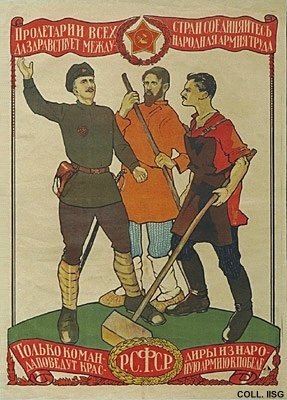
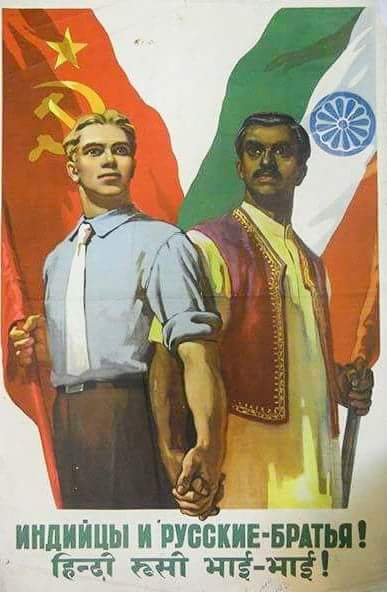
The idea of literacy was not limited just to enlightening the Soviets, there was a central idea of communist internationalism and setting up a network of camaraderie across the globe. Communist International pushed the idea of uniting formerly colonized countries with industrial workers under a new banner. Dada recounts how the university half expected the students to eventually return to their home countries and give back to them the knowledge they have acquired in their time in Moscow. These posters depict the way art was used to embolden the common man and tell him that the soldier, farmer, and worker could all play a role in the way they should be governed. In the poster ‘proletarians of all countries unite,’ three men are depicted in different garb, all with assertive body language and determined faces all at the same level. The ‘Russians and Indians are brothers’ poster has writing in Hindi underneath saying ‘hindi rusi bhai bhai’ showing how one language does not allow for erasure of the other.

The concept of the ‘new woman’ who was no longer subordinated to the man was emerging which can be seen through this poster. Dada’s travelogue discusses how the girls in the Young Communist League did not waste time in ‘frivolous pastimes’ like man hunting. The new woman was to be indistinguishable from her male counterparts, she was an equal contributor to the struggle and the revolution had emancipated her from the shackles of the patriarchy. This poster then becomes an interesting comparison as it shows the woman holding the hammer with the sickle near her feet, she is emboldened and dressed in red, the color of the revolution, as her face tilts towards the sun. Her arm is extended and she occupies space, she is a new woman who is no longer held hostage indoors by the man. She points towards the library, the workers club, a school for adults and the house. The inclusion of the house within this poster becomes significant as it serves as a reminder of how the new woman is not completely free from the chains of motherhood either. The revolution does not forget its mothers behind but attempts to consolidate taking motherhood and the ‘new woman,’ something that can be observed within the contradictions of Dada’s travelogue as well.

To conclude, Dada’s account presents the extent to which the utopia presented by the posters translated into reality. Dada was able to break his shackles with the Old World by being influenced by whatever extent of the utopia existed in Moscow. In Moscow he found the literacy and mobility promised by the Pegasus and the Torch, the acceptance of his mother tongue among colored faces standing on equal ground and the idea of a new kind of womanhood he had not perhaps encountered before. The ideas of communism his education imparted where the kind he felt he owed to take back to India. In a way, the posters and the reach of art did not stay limited to the heartland in Moscow. The messages of the utopia were deeply imparted in the hearts of the people and one can imagine it is the constant exposure to art just like this that would have shaped Dada’s own views. Soviet posters show the role art played in fueling the spread of these ideas and how the circulation of them all over the world broke the chains of those who encountered them.

References:
https://www.tate.org.uk/art/art-terms/s/socialist-realism
https://www.spectator.co.uk/2017/10/how-i-fell-under-the-spell-of-soviet-propaganda-posters-by-fraser-nelson/
https://www.internationalposter.com/country-primers/soviet-vintage-posters/
https://www.mtholyoke.edu/~heale20k/Propaganda/Soviet_Propaganda_Posters.html