Reflections on the Black Radical Tradition

One of the most important thing the Black Radical Tradition has taught me is the need to record our present in an attempt to preserve our past. Despite all the oppression they faced, African Americans in particular were not just great conveyors of cultural expression but also great documenters. Much of the academic work and critical discourse would not have been possible, or would have been extremely lacking, if black Americans had not been able to preserve their music, drama, fashion, and art. Therefore, the onus is on us to make sure that we record our culture in the present day so that in the years to come, future generations can look back on it and reflect.

Another takeaway I had from the Black Radical Tradition was this sense of diversity in thought amidst a sense of the collective. Although a lot of the thinkers and scholars we studied had very different views about how they thought their people should be treated, two things unified them all – firstly, the colour of their skin, and secondly, and perhaps more importantly, the common need to rid themselves of colonial oppression of one sort or another. And in this way, despite what may appear as irreconcilable differences in opinion between thinkers, the shared experience of colonial oppression as a result of being black bound them all together.

More than anything else, however, the Black Radical Tradition has taught me the importance of propagating ‘radical’ ideas and views, no matter how impractical they may seem. For example, a common criticism levelled against any progressive movement in Pakistan is that it is not ‘practical’ or ‘realistic’ enough. Martin Luther King’s dream of the provision of civil rights to black Americans did not seem ‘realistic’ or ‘practical’ when he spoke in Washington in 1963 nor did Kimberlé Crenshaw’s wish for examining the intersectionality of black women’s experiences in 1989. However, these are both ideas, among many others, that we have seen become the norm in the world we live in today. As such, it is not productive to shrug away ‘radical’ ideas that don’t seem ‘practical’ or ‘real-world applicable’ because many of the ideas that were propagated as a part of the Black Radical Tradition were not considered realistic either yet we continue to see their results and outcomes even today.

Indiscrete Oppression

All the Women Are White; All the Blacks Are Men, But Some of Us are Brave.

In Ain’t I A Woman, bell hooks writes: “when black people are talked about the focus tends to be on black men; and when women are talked about the focus tends to be on white women”. In this way, despite black women having to bear what hooks calls the “dual impact of sexist and racist oppression”, it is rare to hear their voices in either feminist or civil rights discourse.

Kimberlé Crenshaw, a civil rights activist and legal scholar, coined the term intersectionality to capture black women’s experiences since traditional feminist ideas and anti-racist policies exclude black women as a result of the overlapping discrimination they have to face. She writes: “Because the intersectional experience is greater than the sum of racism and sexism, any analysis that does not take intersectionality into account cannot sufficiently address the particular manner in which Black women are subordinated.”

She further moves on to state that “the intersectional experience is greater than the sum of racism and sexism”, which ties with the concept of ‘multiple jeopardy’. This term, commonly used by black feminist scholars describes how the culmination of the multiple oppressions and barriers individuals face contribute to a far greater overall oppression. Another, albeit a bit reductive, way of putting this would be to say, for example, that the level of oppression an individual has to face as a result of both sex and race discrimination is equal to 10. Most would argue that a black woman would face an oppression equal to 10+10=20. However, according to an intersectional approach that recognizes that oppression is not discrete and that multiple oppressions build on top of each other, a black woman’s oppression would equal 10*10=100.

The need for intersectional politics can also be seen in the justice system of the United States. For example, as Crenshaw highlights, in the DeGraffenreid vs General Motors case, where black women claimed they were discriminated against, the court stated: “(plaintiffs) should not be allowed to combine statutory remedies to create a new ‘super-remedy’… this lawsuit must be examined to see if it states a cause of action for race discrimination, sex discrimination, or alternatively either, but not a combination of both.” In this way, although the jury recognized that those women might have been victims of race or sex discrimination, it completely invalidated the experiences of black women as being “multiply-burdened”.

Crenshaw states that “the boundaries of sex and race discrimination doctrine are defined respectively by white women’s and Black men’s experiences” and that “Black women are protected only to the extent that their experiences coincide with those of either of the two groups.” In instances like this, intersectional politics becomes important because it is the only way to capture the multiple, unique oppressions an individual faces, and in a world that is now further oppressing on the basis of sexuality, nationality, religion, and socioeconomic status as well, such a resource becomes absolutely necessary.

Forked Identities

Borderlands/La Frontera by Gloria E. Anzaldúa, paints a very vivid image of life at the border between the United States and Mexico. It enables the reader to appreciate the strict imposition of a border crossing between the two countries, one that has been marked by conflict and violence, which almost serves as a reminder of the differences between the two states and peoples, as a “place of contradictions”. However, she masterfully reconciles these differences and explains how they form a new identity, or perhaps new identities, how even in this borderland, there is are possibilities for one to express themselves.

What is perhaps more striking about this text is the its unique structure, which can be said to be an accurate reflection of Anzaldúa’s thoughts – unorganized, scattered, and constantly switching between different identities. This can be characterized by her repeatedly switching the language of the book between English and Spanish, which makes the reader (even if they possess command over both languages) uncomfortable. But that is exactly how one feels in the borderland – uncomfortable and uneasy. The constant shifting between these two languages in people’s everyday lives leads to an identity crisis. In this way, the book replicates the discomfort experienced in La Frontera. Instead of treating this discomfort as something negative, the residents of the borderland decided to embrace it. Because they did not identify with the language spoken by the people on either side of the border, Anzaldúa and other border people decided to combine them to form their own “forked tongue, a variation of two languages”. She writes: “…for a people who cannot entirely identify with either standard  Spanish nor standard English, what recourse is left to them but to create their own language?”

This “place of contradictions” also manifests itself at a personal level with Anzaldúa recognizing the importance of restoring harmony between conflicting identities. She writes:

The new mestiza copes by developing a tolerance for contradictions, a tolerance for ambiguity. She learns to be an Indian in Mexican culture, to be Mexican from an Anglo point of view. She learns to juggle cultures .. She has a plural personality, she operates in a pluralistic mode – nothing is thrust out, the good the bad and the ugly, nothing rejected, nothing abandoned. Not only does she sustain contradictions, she turns the ambivalence into something else.

Tired of Living, Scared of Dying

The song Ol’ Man River, the first version of which was recorded in 1927 as part of the musical titled Show Boat, juxtaposes the endless flow of the Mississippi River with the struggles and hardships experienced by black Americans.

He must know somethin’
But don't say nothin’
He just keeps rollin'
He keeps on rollin' along
He don't plant tators
He don't plant cotton
Them that plants them
Is soon forgotten

Oscar Hammerstein – the man who wrote the song

Perhaps one of the most surprising facts about this song is that it was written by a white man. This is important to note because of some of the language used, which makes it seem as if the lyricist has gone through the experience of slavery themselves.

You and me
We sweat and strain
Body all aching
And wracked with pain
I get weary
And sick of tryin'
Am tired of livin'
And scared of dyin'

This reminds me of our discussion on CLR James and the first chapter of The Black Jacobins, which offers a very detailed descriptive account of what it was like to be on a slave ship, despite him never having been on one himself. This raises questions of who should have the agency to comment on or describe experiences individuals haven’t gone through themselves, or in the case of Show Boat (which was both written and produced by white men, and based on a book by a white woman), to ‘appropriate’ black struggle for profit.

Theater, music, and other forms of art have played a very significant role in African Americans’ struggle for desegregation and the repealment of the Jim Crows laws. Show Boat, being the first racially integrated play (where both black and white actors appeared on stage together) ever performed in America and also being the first Broadway musical to depict an interracial marriage, is often considered an important production for the black movement. Despite its many critics, some of whom have valid concerns (such as Nourbese Philip’s claim that the play appropriates black music for the profit of the very people who oppressed blacks), Alan Berg’s description of the musical score being “a tremendous expression of the ethics of tolerance and compassion” is not inaccurate. Covers of the song Ol’ Man River by influential white artists, particularly by Frank Sinatra, enabled the message of the song (and the struggles of the African Americans) to get across to large white audiences it might not have been able to reach otherwise.

Jules Bledsoe – the artist who first recorded the song
The five renditions of the song that I listened to (which just happen to be across five decades) are as follows:
Jules Bledsoe - 1927 https://www.youtube.com/watch?v=Mawj2HbZ3EA
Paul Robeson - 1936 https://www.youtube.com/watch?v=eh9WayN7R-s
Frank Sinatra - 1946 https://www.youtube.com/watch?v=xTnw_MmVptQ
William Warfield - 1951 https://www.youtube.com/watch?v=pSzYRo9j7YM (my personal favorite)
The Temptations - 1967 https://www.youtube.com/watch?v=JynlddDl-X4

From the Restoration Era to the Civil Rights Movement – A Journey through the Blues

“The blues is an impulse to keep the painful details and episodes of a brutal experience alive in one’s aching consciousness, to finger its jagged grain, and to transcend it, not by the consolation of philosophy but by squeezing from it a near-tragic, near-comic lyricism. As a form, the blues is an autobiographical chronicle of personal catastrophe expressed lyrically.”
-Ralph Elison

For my final project, I will be tracing the history and development of blues music as an art form in conjunction with the African American fight for civil rights, while also highlighting how it has been turned on its head and used by the colonizer against those that produced it.

It’s important to study the blues for two reasons. Firstly, for a large part of the century, blues music was the only mode of expression for most African Americans. With political representation non-existent and their social standing too low to go into disciplines such as academia and journalism, a large number of black Americans conveyed their feelings and emotions through the blues. This was extremely influential in the eventual enactment of the Civil Rights Act of 1964, and with artists like Gary Clark Jr. and Shemekia Copeland still rocking, continues to be influential as the African American community continues its journey through the process of decolonization. Secondly, ironically enough, in the cultural appropriation of the blues, we see the colonization of an art form largely founded for the purposes of decolonization. Don’t get me wrong, it is completely normal to be influenced by other artists – that’s literally what inspires most new ones to make music. However, plagiarising (and sometimes, even completely stealing) older black musicians’ songs and passing them off as your own to make millions in profit without acknowledging or paying them a royalty (case in point: Elvis Presley), is not. In this way, in addition to being a very significant decolonial aesthetic, it wouldn’t be inaccurate to say that the blues has been a colonial aesthetic as well.

You can’t fully appreciate a project on any art form without experiencing it firsthand, so I will be adding audio files of some iconic blues songs (and whatever lyrical analysis I can offer on them) to support my claims, strengthen my arguments, and to preserve the emotion with which they were produced (which is impossible to match in writing about them). Moreover, if I am able to find any that is worth adding, I will also include interview footage of notable blues artists. My final project will take the form of a paper with these multimedia resources. However, if I do find that to be too difficult to manage, I might make a documentary of sorts in addition to what I have written.


The White Woman’s Burden

Soon after its publishing in 1899, Rudyard Kipling’s poem titled ‘The White Man’s Burden’ become a symbol for imperialism – it represented the alleged ‘duty’ of the white man to manage the affairs of the ‘less developed’ non-white man. Even today, we see Western states acting on this ‘burden’, a very recent example being the US intervention of Afghanistan, a reason for which was the need to liberate Afghan women. In recent times, what has become perhaps even more common, is The White Woman’s Burden – the Western feminist’s obligation to impose her own ideals of freedom and liberty on the female populations of the Third World.

Chandra Mohanty, in her article on feminist scholarship and colonial discourses, highlights the limitations in Western feminism’s view of the women of the Third World as “a homogenous ‘powerless’ group”, “archetypal victims”, and “objects who defend themselves”. In characterizing the entire female populations of these countries as passive victims to marginalization by males, First World feminists seem to completely disregard the possibility of native women actively opposing and reforming oppressive conditions and negate the efforts made by women’s right activists in the Third World.

I would like to suggest that the feminist writings I analyze here discursively colonize the material and historical heterogeneities of the lives of women in the Third World, thereby producing/representing a composite, singular “Third World woman” -an image that appears arbitrarily constructed but nevertheless carries with it the authorizing signature of Western humanist discourse.

As highlighted by Mohanty above, another mistake that Western feminism also sometimes makes is to use the term “Third World Women” to characterize any and all women that do not live in a developed Westernized country. In dividing the women of the world into two such groups (Us and Them), the Western feminism starts to think of one group as having all the freedoms and liberties that they deem desirable, and the other as lacking them. It then feels the need to impose these freedoms and liberties on all those that they think do not possess them. For example, Western feminism generally criticizes the Muslim veil as a form of oppression for the women wearing it. While there is no doubt in the fact that in certain instances, women are forced to cover themselves up, however, to make the generalization that this is the case all of the time would be inaccurate.

As her ‘burden’ continues to weigh down on her back, what the white woman must realize is that women of the Third World never really asked her to take that burden in the first place and that they want to develop their own ideals of freedom and liberty on their own terms.


Reconversion of Minds

One of the major tools European colonisers used to develop and sustain their authority in Africa was the bifurcation of society into the ‘culturally superior’ elite and the ‘culturally inferior’ masses. Cabral identifies the roots behind this division, and highlights the significance of overcoming it for any liberation movement to be successful. In this piece, I will be commenting on the importance of the “reconversion of minds”, which Cabral also calls “re-africanisation”, for a liberation movement, and whether or not this reconversion was permanent or only existed for the purposes of independence.

Cabral points out that one of the major reasons colonizers were able to dominate such a large number of people for such a long time was the “creation of a social abyss between an indigenous elite and the popular masses”. Mainly in urban (but sometimes, also peasant) settings, this occurred when the petite bourgeoisie “assimilates the mentality of the coloniser, considering themselves culturally superior to the people they belong to”. The “colonized intellectuals”, as Cabral refers to them, then had no motive to drive out the coloniser since they felt no threat to what they now considered their own culture. In rural areas, the coloniser “assures the political and social privileges of the ruling class over the popular masses by means of the repressive machinery of colonial administration”. By doing so, they were able to heavily influence (perhaps even control) the elite group of society with “cultural authority” over the popular masses, therefore explaining why some European states were able to maintain control over their colonies despite never having no more than a few thousand of their own people there.

However large the apparent differences between the assimilated elite and the popular masses may have seemed, “non-converted individuals…armed with their learning, their scientific or technical knowledge, and without losing their class prejudices, could ascend to the highest ranks of the liberation movement”. It is important to note, however, their motives behind this involvement. Theses “non-converted people” considered this “the only viable means of succeeding in eliminating colonial oppression of their own class and re-establishing the same complete political and cultural domination over the people-and in the process exploiting to their own advantage, the sacrifices of the people”. Therefore, the intentions behind such individuals’ contribution towards the liberation movement were usually not pure. This becomes evident at the time independence is achieved, when the people who were previously victim to colonial dominance become victims to dominance at the hands of their African rulers.

For Cabral, any liberation movement should aim for “a convergence of the levels of culture of the various social categories which can be deployed for the struggle, and to transform them into a single national cultural force which acts as the basis and the foundation of the armed struggle”. In order to do this, the division between the elite and the popular masses, created (or widened) by colonial powers, needs to be shattered. To say that this single national cultural force still exists today would be inaccurate. Despite having gained ‘flag sovereignty’ decades before, many African nations continue to display signs of the cultural divisions brought about and enlarged by their colonists. Rwanda, for example, despite having officially gained independence in 1962, continued to display signs of huge cultural division between the Tutsis and the Hutus, which culminated in the Rwandan Genocide of 1994. More recently, scholars have highlighted how African elites and their contribution towards neo-colonialism have carried on the persecution of the popular masses. Therefore, if the dreams of Cabral, and many others like him, are to be achieved, there is still a need for the reconversion of minds, for re-africanisation, and for the convergence of different social cultures into a single united one.

The Fatherland of the World’s Proletariat

“Long live the Soviet Union, the fatherland of the world’s proletariat”, 1921

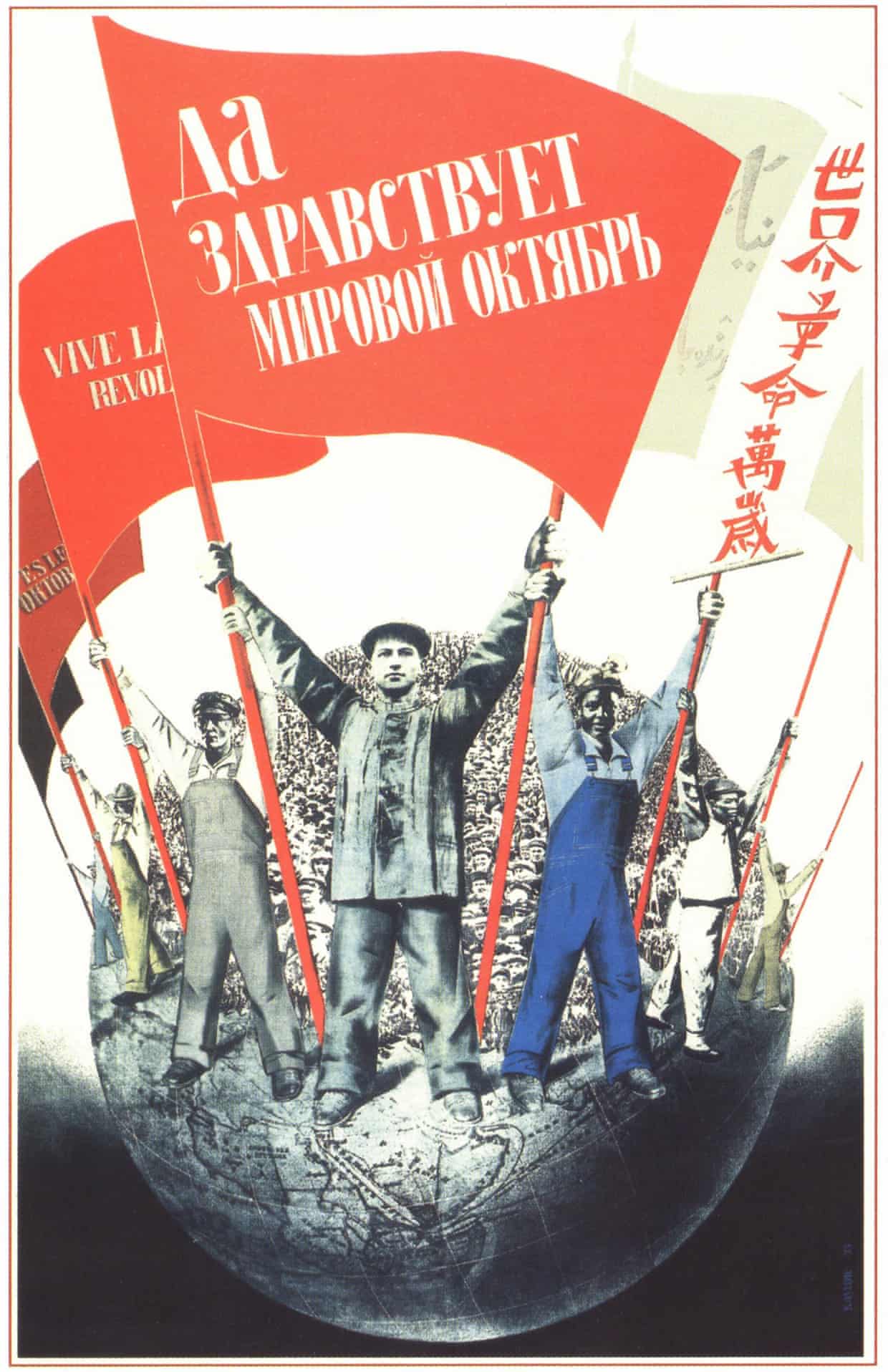
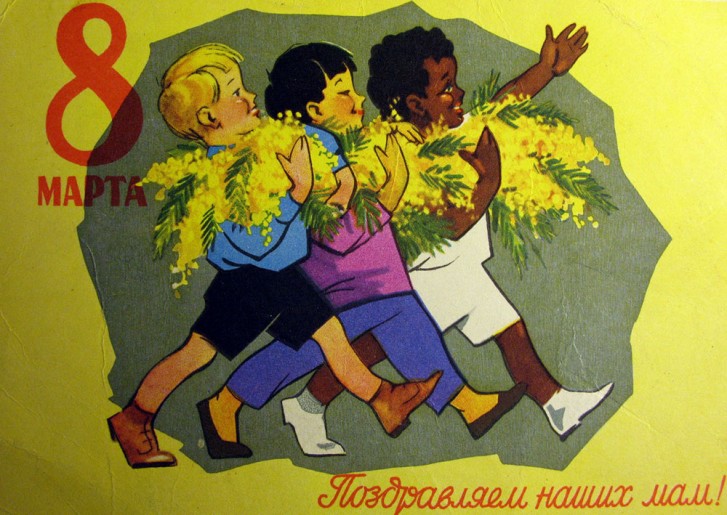
Perhaps the most important feature of the colonized world was a sense of division – the notion of the superior colonizer and the inferior ‘other’. In both posters published during the Soviet era and the memoirs of Dada Amir Haider Khan, this categorization seems to be absent in the Soviet union. Ideas of egalitarianism seem to transcend those of nationality, race, and language.

“All hail the world October revolution!”, 1933

The posters never depict communist revolution as being something that is being imposed on a group of people. Instead, they show the local proletariat overthrowing their colonial masters and revolutionising on their own terms. To assist this, the medium of instruction in the the University of the Peoples of the East was not the same for all students. Instead, they were taught in their local languages, so that they could understand (and perhaps, when they went back to their home countries, teach) important histories and concepts better. In this way, no one language was put on a pedestal and thought of as superior to the rest (which was the case in European colonialism). The main point of focus on communist ideals, and not Soviet culture or language.

The diversity in nationality and race that Soviet posters represent is talked about in Dada’s memoirs as well. Having travelled around the entire world twice, he had not encountered levels of diversity quite as high as he did in Moscow. In addition to the multitude of nationalities and races he came into contact with, Dada also mentions the intellectual diversity present in the Soviet Union. People from all parts of the world, with different levels of education and lived experiences found themselves studying together in what can be called a ‘melting-pot’ of different cultures. This goes to show that the Communist Party was not only indiscriminate in terms to nationality and race but was also not elitist and did not privilege students that were more educated than others, another example of the egalitarianism that the posters imply.

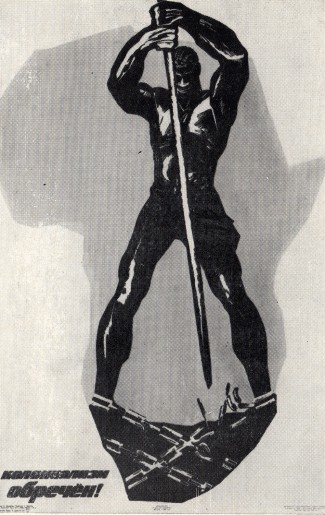
“For the solidarity of women of the world!”, 1973

Another instance of equality shown in the Soivet Union that is not present in most other parts of the world is the absence of sexual hierarchies. A number of Soviet posters depict women as being very important contributors to any revolution rather than as just spectators to men’s struggles. Dada also talks about how the female students at the university were virtually indistinguishable from the male ones and were only focused on purposeful activities instead of wasting time on “frivolous” pursuits like other women did at the time.

It is reasonable to consider the ideas put forth by Social Realism and Dada in his memoirs with spoonfuls of salt, given the former’s role as an art form dedicated to propagating pro-Soviet beliefs and the latter’s affinity for and linkage to the communist ideology. Moreover, given the fact that Dada spent almost all his time in Moscow, and mostly under the watch of some sort of Communist Party officials, perhaps the image he paints of the country as being extremely egalitarian and non-prejudiced is not representative of the internal inequality and persecution that exists amongst its territories.

In summary, the lessons he took away from his approximately 2 year stay in Soviet Russia were critical to Dada’s contributions to the Indian national liberation movement. While it did not exactly end up the way the Soviet Union envisioned it would, India’s escape from the ‘waiting room of history’ was the realization of anti-colonial Soviet posters published decades before.

Whose language?

A few months ago, as I was searching for potential courses to take in spring semester, I came across one named Explorations in Urdu Language and Literature. As someone who regrets the fact that they don’t have nearly as good a command on the Urdu language as they would like to have, this course seemed like a perfect fit for me. One thing about it particularly stood out – the fact that name of the instructor seemed European, not Pakistani.

Some further research revealed that said instructor was American and very well qualified, with a PhD in Linguistic Anthropology and advanced proficiency in multiple South Asian languages (including Urdu). There is no doubt in the fact that such a scholar has a much greater command over and expertise of Urdu language and literature than I (someone who hasn’t formally studied these disciplines past the eleventh grade) do. However, perhaps her prowess does not match that of native scholars of Urdu – those that have not only studied the language extensively from an academic perspective but have also been born and bred into it. 

Ever since the colonization of India by the British, we have privileged Western knowledge over our own. Dadabhai Naoroji, in his book titled Poverty and un-British rule in India, writes of English education’s “great, noble, elevating, and civilizing literature and advanced science”. Even when the discipline in question was intrinsically Indian, the idea of a white man teaching it has always seemed very intriguing. An example of this is Alfred Woolner, a professor of Sanskrit at Punjab University in the early 20th century. It is not an unreasonable assumption to make that there existed Indians scholars at the time who could have filled this role, but it was obviously the ‘white man’ and his knowledge that was given preference.

Statue of Alfred Woolner outside Punjab University, Old Campus, Mall Road, Lahore. Credit: Tahir Iqbal

The issue isn’t that someone from the West learns (and in turn, teaches) Urdu. In fact, doing so would lead to a spread of language and culture that most people would consider favourable. However, to be a non-native, regardless of your command over the language, and teach native speakers their own language speaks volumes about the intellectual superiority (hegemony even) we have given to the West. To put things into perspective, to me at least, the idea that a Pakistan or an Indian could teach undergraduate courses in English at Oxford or Princeton (or any university in the UK or the US, for that matter) seems unfathomable.

Issues pertaining to language are rightly considered one of the more important remnants of colonialism. An example would be the widely held idea that proficiency in English serves as a measure of intelligence and social standing in Pakistan. However, the fact that we still give our ‘colonial masters’ an influence even over our own languages proves that there is still much left to decolonize.

Note: This piece does not intend to criticize or disrespect the instructor in question, but instead aims to serve as a commentary on the agency over the languages, history, and cultures of states that are going through the process of decolonization.