The ‘European’, white, logical, rational, civilized, liberal, male, was everything that the rest of the world was not. This image came from a myth model which defined the European in relation (opposition) to the ‘Other’, the ‘Native’. Therefore, European colonizers understood their thought process in opposition to the thought process of the indigenous people and since they regarded themselves as logical, rational and civil, this automatically rendered the thoughts and actions of the natives as illogical, irrational and savage. Hence the myth of the European was constructed in terms opposing the myth of the native. Colonialism relies on this idea of inherent and essential difference and so, can be seen as not only as a form of civilizational dominance and economic extraction but as an epistemic conquest which impacted the colonized beyond the economic and material level.
We find that the crew aboard the ships voyaging to places like Polynesia and the Americas consisted of men from various occupations and fields of study, like scientists, artists and anthropologists along with sailors and their captains. These men were engaged in gathering information about the natives and the production of knowledge which directly gave them the power to represent the people and land who were the subject of their study. Ethnographies, diaries, accounts of the Europeans were the only sources of information which presented the image of the native, as irrational, pre-logical, too caught up in ritual, passive and overly determined by signs, back in Europe and consequently the rest of the world and it is against this image that the image of the European was reaffirmed.
What is considered a pragmatic response differs between people and it is this difference which classified the native as the other. The act of knowledge production, gave the colonizers the power to determine which belief and knowledge system to privilege at the expense of the other. This epistemic conquest placed the European above the native. Therefore, the image of the savage is constructed based on the assumptions of the Europeans, de-personalization of the indigenous people and is through the European lens. So when voyagers like Cook describe themselves as gods in the natives’ eyes or their lives being governed solely by signs and ritual, they are presenting their own interpretation of the natives’ actions which ends up representing them- rather misrepresenting them.
The image presented by the Europeans, through their knowledge production along with the absence of native sources, is then taken up by academia and scholarship which continues to propagate the European bias and misrepresentation due to which the voice of the indigenous people is silenced and the European self-image continues to be strengthened at its expense.
The age of Empire saw the
establishment of a new moral and social order. An understanding of the sort of
violence that comes with colonization and imperialism is incomplete without an
understanding of the epistemic conquest that took place, resulting in the
colonizer gaining a monopoly over knowledge, and its varying forms, and the
development of a constructed framework within which our understanding of what
constitutes as superior and inferior knowledge is grounded. This construction
is the reason that Naraoji can make his confident claim to gratitude with
regard to the implementation of English education in India, because he too
operates within this created universe.
Naraoji’s text is a perfect
illustration of the sort of violence that has been referred to, and the
corresponding crisis of representation that emerges from it. He talks about the
many benefits that British rule has brought to India, mentioning its “humane
influence” and the “civilizing” quality that English education carries. These
assumptions stem from constructed notions of a non-European other, one that is
essentially stuck in ritual, stuck in the past; stagnant, and without the
ability to evolve. It is an Other that requires this “elevating, civilizing”
power that the colonizer has claimed for himself. It is therefore an other that
is in need of outside intervention, and here rests a justification for
non-divergent representation.
Naraoji also speaks about the
establishment of law and order as another one of the benefits of British rule. He
does not expound upon how this system of law and order sought simply to
solidify colonial rule It changed
conceptions of space by making it more rigid and fixed. Less fluid conceptions
of space meant stricter control and supervision. The Criminal Tribes Act of
1871 was one of the measures taken in order to otherize and ostracize a
specific type of lifestyle – the nomadic peasant was difficult to monitor and
control and therefore was to be “criminalized”. The number of people that fell
under the umbrella of criminal increasingly rose; effectively anyone who
divulged from the existing order became criminal, while the Others were the
Civilized. This civilizing trait attached to colonial rule, therefore, can
better be understood as the enforcement of an entire framework that centers on
the West, with the rest of the world seen only in relation to it.
There is a very clear
acceptance to the claim and legitimacy of Empire, which shines through in
Naraoji’s text. This is logic that argues that the primary issue is that of
intention; were the aims of Empire “faithfully and conscientiously fulfilled”,
the issue would be resolved. It ignores, however, the fundamental and
inevitable problem of representation that unfolds within such a system. This
problem cannot be solved through changes in approach or through new figureheads.
It is a problem that is rooted in the imposition of a constructed reality onto
the “non-civilized”, a problem that stems from that very construction and the
unquestioned assumptions that are inherent within it.
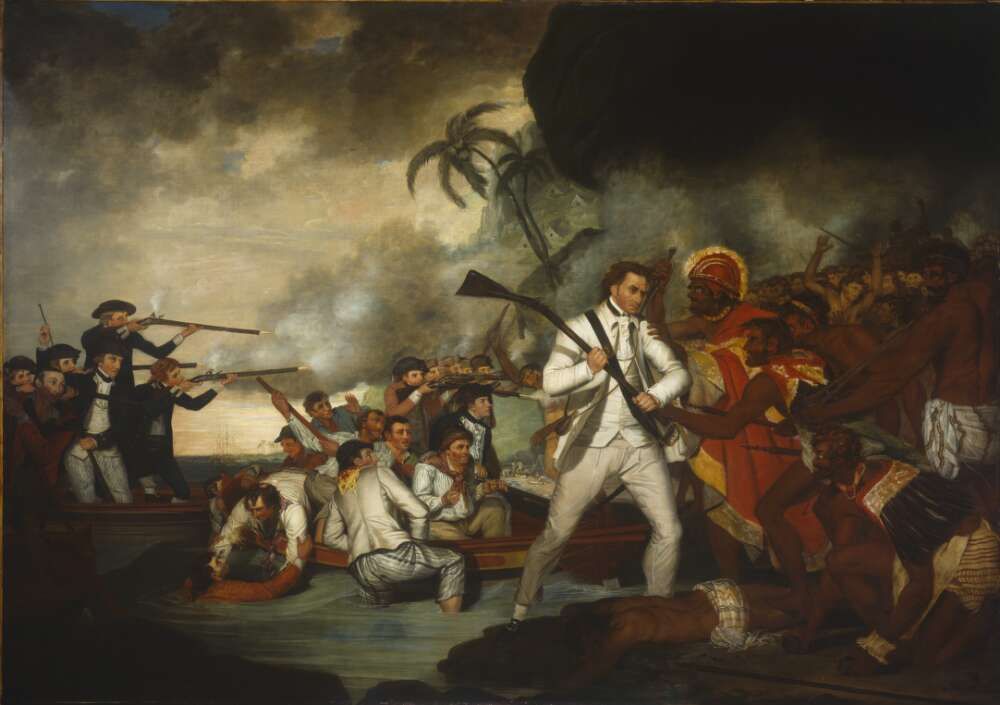
George Carter, ‘Death of Captain James Cook’, 1783, now at the Bernice P. Bishop Museum in Hawaii.
In The Apotheosis of Captain Cook, Obeyesekere challenges the notion presented as fact in all accounted histories and documentaries of Hawaii and of Cook’s voyages, of Cook being perceived and welcomed by the Hawaiian natives as the returning Hawaiian god Lono. Obeyesekere expresses doubt over the idea that Polynesian natives would deify a European foreigner, and endeavors to prove that this widely accepted idea was merely a construct of the European imagination, dubbing this phenomenon ‘European myth-making’. The representation of European explorers and discoverers in art and in writing as god-like figures is not a new occurrence; an example being the almost century old bronze statue of Columbus situated in Central Park’s Literary Walk in New York City, which is described to have a very godlike, almost deiform, feel to it. Historical accounts often seem to perpetuate the idea that native peoples saw the arrival of European foreigners as the return of their own mythic gods. Popular media seems to reinforce the same idea; in the 1992 film, 1492: Conquest of Paradise, we hear Columbus’s character say, “Because of our appearance, we have been mistaken for gods, and are treated accordingly.” A well-known example of European apotheosis, mentioned by Obeyesekere, is that of Hernán Cortés, who according to documenters, was mistaken by Mexican natives to be the Toltec demigod Quetzalcoatl. Whether these writings and depictions speak any truth about native perceptions of European foreigners, or whether these are simply European presumptions attributed to natives they know little to nothing about, is something Obeyesekere sets out to answer, but it leaves us with a question about the way Europeans, and the natives of the lands they conquer, are represented.
Referencing
Todorov’s The Conquest of America, Obeyesekere
describes how European explorers are often depicted in contrast to an ‘Other’; where
this Other is the ‘savage’ or ‘uncivilized’ native population. Naturally,
little effort is made by European explorers to understand the intricacies of the
native cultures they encounter, and instead, they end up superimposing their
own ethnocentric interpretations of native behaviors unto the native peoples;
many of which could be largely incorrect assumptions. When writing about these expeditions,
the primary source referred to by historians are the travel logs of the
European explorers themselves, and hence, it is not uncommon for the uninformed
and biased views held by these explorers to slip into the texts and contribute
to popular misconception. When Todorov references quotes from Spanish texts
describing the brutality towards the Aztecs, he is by default contributing to promoting
the stereotypic Otherness of the Aztecs. There is yet another contrast between
the way Europeans and natives are represented; that is, the complete lack of
individuality attributed to native populations. Inhabitants of the conquered
lands are often depicted not as individuals, but as ‘merely the constitutive
element of that other totality’. In both Bernal Diaz’s writings, which Todorov used
as a reference point for his own work, as well as Beaglehole’s accounts of Cook’s
voyages, which is the main source Obeyesekere consistently refers to, the
Aztecs and the Polynesians respectively are only ever referred to as a
collective whole, with almost no mention of the individuals making up that
whole. This depersonalization is in stark contrast to the way Europeans in
these stories are always named and granted individuality, instead of being
grouped by religion and caste.
There
is the persistent view held by these European explorers, that they are the ‘white
civilizers’ who are to rescue the ‘savage barbarians’ from their animal-like
ways. The word ‘barbarian’ is so often used to describe natives in the firsthand
accounts of these explorers, that it contributes to popular misconceptions held
regarding native peoples, and adds to the European-created myth referred to as the
‘savage mind’. Even Cook’s choice of words in the mapping and relabeling of the
islands’ localities reaffirm the natives’ savage culture.
Part of the reason why native cultures and perceptions are so susceptible to misrepresentation is that anthropologists are the ‘outsiders,’ and in trying to interpret native cultures and beliefs, discrepancies become difficult to eliminate. Even while exercising caution, there is always uncertainty as to whether the anthropologists’ conclusions about native peoples are in truth or misconceived. As Obeyesekere points out about the Hawaiian perception of Cook as the god Lono, even the nature of divinity, as thought of by native groups, differs from popular Western conceptions of divinity. The problem lies in the fact that these native ‘uncivilized’ groups cannot represent themselves; they need to be represented. Hence, there is bound to be some degree of misunderstanding.
Focusing his efforts on the documentation of Cook’s voyages and his onshore as well as offshore personality, as recorded by members of his crew, Obeyesekere reveals that much of the information about Cook’s conduct towards his crew members and towards the native people, particularly that of his third and final voyage, is left out of the history books. The severe lack of context and missing information contributes to misrepresentations of the native people and of the Europeans. For example, it is not mentioned that European ships circled the Hawaiian islands for seven weeks before landing, which could help to explain the way the natives reacted to the arrival of the Europeans. It is also not mentioned the irrational measures Cook resorted to, such as plundering and destruction, in response to thievery on the islands; nor is it mentioned the odd punishments Cook reserved for his crew members who refused to eat walrus flesh out of disgust. Cook’s increasingly violent and erratic behavior, as well as what his crew members, including Beaglehole, perceived as the weakening of his grasp on reality, is completely unheard of when one reads about these voyages from secondary source documentations. Instead he is seen as a great navigator and decent human being with ‘a real feeling for human rights and decencies’.
On every 26th of January cars, streets and buildings will be covered in national flags all over Australia. People will gather for barbecues, sports events and concerts to “celebrate” being Australian. Australia Day as the official national holiday of Australia is marking the day Captain Arthur Phillip arrived at Port Jackson in New South Wales in 1788 and raised the British flag at Sydney Cove. This was 18 years after Captain James Cook claimed to discover the eastern half of today’s Australia in the name of the British Crown. This historical day and these two historical figures are shaping a certain understanding of the history of Australia which is putting a European perspective into the centre of story telling of what Australia is and being an Australian means. This perspective does not just neglect the existence of aboriginal history and culture before the “discovery” and settlement of Australia by the British but is also trivializing the brutal actions against the indigenous population throughout the past centuries until today.
Gananath Obeyesekere is demonstrating in The Apotheosis of Captain Cook – European Mythmaking in the Pacific that the narrative around Cook as the “true open-minded scientist without preconceptions” and therefore a humanist image of Cook is rooted in the European imagination and construction of “the self” in contrast to “the other”. Cook has often been portrayed as the idealistic representative of enlightenment who’s actions were based on rational thought and science which is put in contrasting comparison to the construction of the “irrational native” or the “prelogical savage” who is acting on the grounds of spirituality and myths. By the definition of Obeyesekere that a myth is “a sacred story about gods and founding ancestors or stories about ancestral heroes” one can argue that the image of Cook as well as Phillip as “the ancestral heroes” of today’s Australia can also be seen as a paradigmatic myth which is the basis for the symbolic performance of Australia Day today. Beside questioning the constructed rational self of the European he also states that “preliterate societies can and do act rationally in terms of their own cultural values” but that the colonial and imperial act of deciding what is considered of value stays with the oppressor.
Protesters at the Invasion Day rally in Melbourne 2018
The struggle of
which voices are heard and which perspectives are seen as valuable is
a struggle that is not set in the past but continues and can be seen
in the debate around Australia Day every year. The right of having a
history that is “celebrated” stays solely with European
history or one could also say with the European myth. Therefore
Australia Day does not just show European mythmaking but also a
crisis of representation of what is seen as “the non-European”.
For the aboriginal community this day symbolizes oppression, murder
and suffering and is more often referred to as Invasion Day or
Survival Day to put the indigenous perspective in the centre of
recalling history. Even people who argue that Australia Day is not so
much focusing on the historical event it is based on but is trying to
embrace the cultural diversity of the present and is therefore a day
that tries to connect rather than divide are neglecting and not
recognizing the painful implications that it has for the indigenous
population. While trying to be well intentioned this interpretation
of Australia Day is pretending that the past is isolated from the
present while the aboriginal community is continuously confronted
with lack of representation and recognition.
Voices of resistance
have always been there but are just given more space for expression
and attention within the past few years which is shown by the
annually growing Invasion Day rally all over Australia. While some
protesters and activists are calling for changing the date of the
national holiday to a date which is inclusive and sensitive towards
indigenous history, culture and experience others are questioning the
concept of a national holiday as a whole.
Beside these different views everybody who is taking part in the protests from aboriginal as well as non-aboriginal communities are demanding that the 26th of January should in the future not be a day of celebration but of remembrance of loss and suffering and a reminder that the brutal past has not been acknowledged and the equal representation of indigenous perspectives has not been reached yet.
Reflex.
When one hears “South Africa”, mental images of lush green hills, vineyards and,
most significantly, the voyage of Bartolomeu Dias passes through one’s mind. It
is not the indigenous people of South Africa, or the fact that its inhabitation
dates back many millennials. It is not the horrors of the Apartheid regime or
the struggle of Nelson Mandela and his people. No. It is the scenery and the ‘magical’
story of its discovery without the implications that one thinks of. The state’s
monopoly over historical narratives is one major reason for the glossing over
of the true story of South Africa that transcends its significance in the pages
of history as a British colony. This legacy from the colonial era is steeped
deep into education and the arts in all forms. To Chumani Maxwele, South Africa
had still a long way to go in terms of complete emancipation. To him, the statue
of Cecil Rhodes in the University of Cape Town represented not just bigotry but
a tragic and unjust history of the people of South Africa. The desecration was
more than just a protest, it was a sign that South Africa was overdue from
behind the Union Jack curtain.
The statue right in the middle of an educational
institution in South Africa meant more than it would have any other place. The epistemic
takeover of the British in South Africa from their days as colonial masters crept
into the present as well. If it had not been for the “born free” generation, these
seemingly insignificant signs would have gone on unnoticed. The hush hush
conducted by the preceding generation with regards to the horrors of the
Apartheid rule meant well but implied a continued existence for the South
African people under intellectual, if not physical, slavery which would amount
to the same thing in the long run. So, when the born free’s broke free of one
shackle, it was only natural for them to not only turn on the ‘immortalized’
Cecil Rhodes representing all white masters, but on their parents as well for
the delay in this realization. The election of Nelson Mandela in 1994 after the
countrywide enfranchisement of indigenous South Africans was merely the
beginning and perhaps a means to an end which one would envision after lying
crushed beneath the colonial jackboot for centuries.
Khoisan (indigenous to South Africa) men making fire
They have inhabited the region for more than a hundred thousand years
The subsequent movement that took off after Maxwele’s
desecration of the Cecil Rhodes statue at his college in Cape Town was prudent,
to say the least. The presence of foreign domination influencing every act of
his people, shaping their future and shaping their past had to stop in order to
pave the way for the true representation of South Africans, in every sphere of
life, for the entire world to see. It was meant to change aforementioned reflex
musings regarding South Africa. To show the native South Africans, this time without
the white influences in their lives, culture, historical narratives and
intellectual forums.
Certain features of colonial governance seem to be common across the board whether it is French, Belgian, Spanish or in Nigeria’s case, British. These features include ignorance of local culture and norms, divide and rule and economic extraction. This piece however will focus mainly on the aspect of representation in colonial Nigeria through the lens of Wale Soyinka’s “Death and the King’s Horseman”.
Representation may be understood in both legal and informal/social terms. Wale Soyinka’s play contains both these elements even though they may not seem explicitly obvious. As soon as the play opens, we are introduced to Elesin, the deceased king’s chief horseman, entering a marketplace where he has a public dialogue with Iyajola. Wale Soyinka labels Iyaloja as the “Mother of the market” and this is evident as she is the only one confronting Elesin among the flock of people gathered around to chant and praise the horseman as he prepares for a ritualistic suicide to join the king in the afterlife. Now the first instance of public representation stems from Iyaloja’s character herself as she is the only one who seems to be communicating with Elesin on behalf of the people gathered at large. These people strongly believe in their rituals and Iyaloja seems to represent those very traditions at well. She constantly reminds Elesin of his duty while praising him at the same time. When Elesin asks for a young woman who was already married to Iyaloja’s son, she sends her forth without even asking the woman if she wanted to do so. Hence, representational tyranny seems to exist even among the woman in the text. But question is whether it is safe to consider it a “tyranny” when the people generally conform to the belief system as they fear the catastrophic results of failing to do so. So maybe the culture justifies the “tyranny” itself.
Furthermore, there is extreme lack of representation in Simon Pilkings residence as well. Throughout the play his only source of information regarding the civilians seems to be Sergeant Amusa. Amusa is a policeman who despite his conversion to Christianity still sticks to certain former beliefs, for instance, attaching misfortune to the clothes of the deceased. Also, even though what Simon Pilkings orders goes against his traditions, he still obeys obediently. Therefore, Simon Pilkings is extremely detached from the people he rules over and fails to comprehend the role rituals played among the society he administered. As we move further up the hierarchy, local representation seems to vanish all together. For example, when the Prince visits Simon’s district he attends a ball which seems to be highly exclusive as only the administrative government including Simon are invited. So taking that into consideration, representational tyranny is evident at both the center and above as the Prince’s only source of information are the ignorant officers themselves.
In conclusion, lack of representation in colonial governments and failure to take local contexts into consideration is a theme one can take away from Wale Soyinka’s play even though it revolves more around the latter.
The white man’s relationship with its subjects has always been marked by an unfettered paternalism which constituted a need to impose its own perceptions and understandings of the world onto the people it subjugated. This imposition, however, led to confusion and misrecognition and an eventual dilution of the native culture. The violence thus became not only physical and territorial, but also spiritual and epistemological. Wole Soyinka’s play Death and the King’s Horseman shows this violence and lack of representation of the natives by an overpowering imposition of the white man’s worldview onto them.
The first instance where this is prominent is when the white couple Jane and Pilkings dress up in the costume of death which holds greater meaning to Sergeant Amusa than they recognise. When he is afraid to talk to them because of their masks, he is mocked and misunderstood and scolded for being superstitious despite being an office in His Majesty’s Government. Amusa has tried to integrate himself into white culture which a lot of people would do to better their circumstances but this has reduced to him becoming a type: he is expected to be rational because of his associations with the white and disregard any cultural traditions as Jane and Pilkings wear his feared egungun as costumes. His reality is thus twisted and forced to suit the white man.
Another event of this lack of representation is central to the play. It is the impending suicide of Elesin Oba due to a native custom. Pilkings’ obsessive paternalism leads to him interfering in the matter despite warnings by others that he won’t be able to stop the custom and that he shouldn’t. He is the saviour, however, and he wants the people to know that he knows better for them than their pagan cultures do and thus he cannot let anyone take their life on his watch. He does not understand the complexities that involve such a custom; doesn’t see how revered Elesin Oba is by his people which was shown in the first scene. Instead, he proudly reminisces about the time he interfered with Olunda, Elesin Oba’s son and how he ‘literally had to help the boy escape from close confinement and load him onto the next boat’. The imagery of entrapment and release renders Olunda and his father passive and projects Pilkings superior conception of freedom onto their relationship. While Olunda is grateful for the opportunity he is given to study medicine in England, by the end we see that when it comes to assuming his assimilation into the white culture, Pilkings was again proven wrong and assumed that he would disregard his native identity altogether for a greater, white one. Although Pilkings arrests Elesin Oba and confines him in order to ‘protect’ him which brings the chief shame that nothing in his life can now undo, both the father and son take their life at the end which proves that Pilkings paternalism was misunderstood and off grounded. However, for the natives, it led to an unnecessary death, a death that they could not respect or celebrate because it wasn’t just Elesin Oba who died but also Olunda.
Death and the King’s Horseman is a poignant example of a scenario in the colonies where the natives were not given a chance to celebrate their own identity and instead, in the name of protections and a better vision of life, they were made to do things alien to them. It also represents that there were natives who did try to integrate themselves into the white culture but how their remained things that were central to their identity which the white man tried hard to eliminate to no avail. In the end, it is an example of their superior yet misguided projections onto their colonies of the global south.


 Decoloniality and Decolonization