Strange Fruit

Southern trees bearing strange fruit/Blood on the leaves and blood at the roots/Black bodies swinging in the southern breeze/Strange fruit hanging from the poplar trees

Pastoral scene of the gallant south/Them big bulging eyes and the twisted mouth/Scent of magnolia, clean and fresh/Then the sudden smell of burning flesh

Here is fruit for the crows to pluck/For the rain to gather, for the wind to suck/For the sun to rot, for the leaves to drop/Here is a strange and bitter crop

When Nina Simone sings, it is a lament for the South – a South that has allowed horror to root itself into the earth. One thousand, nine hundred and thirty reported lynchings is the total  – slavery and violence, man’s cruelty to man, is now part of the South’s geography. The poem describes it so poignantly how nature, unable to comprehend such violence, is forced to accommodate such horror – to stand as a witness, to do all that it can do to what is left of the violence – the dead body. Nature is the only force that can look at so sick, so dead a thing hanging on a tree, and consider it some “strange fruit”. It’s a consequence of ignorance – lynching is not part of nature’s vocabulary. We, who have various words for various kinds of violence are not like her. Nature calls it by what she knows; a fruit – so strange, so bitter, something that doesn’t fit. It will attend to it, regardless of it’s difference – absorb it into the earth, let the elements merge them into one – the rain will gather it, the crows will eat from it. To us readers, listeners – who know, who are cursed to know the reality, the truth, we are ashamed by the haunting simplicity and perhaps, innocence of the description of the bodies, and the horror in the juxtaposition. We have defiled so beautiful a world – so much so that the scent of magnolias can exist alongside the smell of burning flesh.

I read up on who wrote the song to understand the poem better. Abel Metropole, a Russian Jewish immigrant to the Bronx, was a literature teacher who saw, one day in the news, a picture. A lynching in Marion, Alabama, that picture of Thomas Shipp and Abram Smith, both teenagers, hanging off the branches of a wide tree, their necks snapped, their eyes closed. That picture. They were dragged from jail and murdered by a wild, white mob, who, all together, are in the picture, too. Metropole, I sense through his poem, was struck by the sight of those boys who were hung, saw how the trees were made to carry the burden, the weight, of their bodies, and so, wrote this poem. And now, I understand why. He chose nature as his vantage point to look at the sight because nature is the only humane element in the picture itself. 

The alternative are those who committed the violence. They are who I always focus on when I see the picture. What frightens me are those wild eyes, those smiling faces, who stand, relaxed, proud, below the hanging bodies, as though the sight is routine, as though they were captured strolling down the street. So lax, to casual, so matter of fact are they! What do they see? What do they think they’re doing? Men and women, together, they’re even wearing hats! One man points, resolute, at the figures above him, eyes dead into the camera, telling me, “This is who we are – this is we have done!” What is it you are trying to tell me, you – with your resolute finger? Why are you proud, you monster, you’re parading around death! To bear witness through poetry, I would not choose such figures as my vantage point.

Metropole is proof that men of heart, men who recognized the atrocity, existed at the time. His work is a profound act of empathy – that not only understands what kind of violence has been wrought, but seeks to tell it in a manner that adds beauty into the world – that depicts the lament, the moral outrage of the earth and those whose hearts are still in tune with it. Nina’s voice takes what Metropole created a step further – she turns it into a prayer, a mantra for healing, with her low, rich voice – a black woman’s voice, nature herself – deeply sorrowful, uncomprehending, but attending to her task. She sings to speak of the violence, but to also remind us that nature, that earth, is on the side of those who cannot comprehend the violence man creates, to heal those who are victims to it. 


Redemption Song

Considered one of his seminal works, Bob Marley’s ‘Redemption Song,’ stands out amongst his other notable creations not just for its deviation from the usual themes of spirituality, love and remembrance that prevail in his earlier and most recognizable works, but also, and more importantly, for the peculiarity of its composition. Interestingly, the song shows no sign of the reggae style that is present in nearly all of his other music. Nor does it feature percussion or any accompaniment; rather, it is a stripped down solo acoustic recording, consisting only of his singing and strumming of an acoustic guitar, largely reminiscent of the sound and style of another Bob: Bob Dylan. Having returned to this song and to his music only now, years after my first listen, this was the first thought that came to my mind. Why did he choose for this song in particular a composition so stripped down and so unlike his usual style? A deeper reading into the song’s words, to which the lack of accompaniment shed an even greater light, may help in answering this question.

Old pirates, yes, they rob I
Sold I to the merchant ships
Minutes after they took I
From the bottomless pit

The opening lyrics to the song, depicted above, are unmistakable in their reference to the abduction of African people into slavery. Robbed of their culture, sovereignty and their families, they were taken from the ‘bottomless pit’- referring to Africa in its entirety and to its abundance of peoples, cultures and resources. He goes on:

Bob Marley in 1980

But my hand was made strong
By the hand of the Almighty
We forward in this generation
Triumphantly

Marley’s references to God are numerous and scattered throughout his music, but here he makes mention of ‘the Almighty’ to assert the new-found pride and strength that the Black spirit has gained, and is in the process of achieving. It is a line alluding to Black power, endurance and pride, and the progressive strides that they have made in recent times as a result of their own efforts and demonstrations- the end of slavery, and the civil rights movement-, with their final goal being total freedom from subjugation. Then comes the chorus:

Won’t you help to sing
These songs of freedom?
Cause all I ever have
Redemption songs
Redemption songs

When he talks of these ‘songs of freedom’, Marley is essentially asking the listener to join his cause; that is, the fight against racism, mental slavery and subjugation, with his goal being the emancipation and redemption of the Black race, and by extension, the emancipation of all those who have been subject to oppression or subjugation of any kind. The ‘songs of freedom,’ I believe, are a reference to this cause- the cause is all ‘I’ (or rather, ‘we’) have. Then come the most eminent lines of the song:

Emancipate yourselves from mental slavery
None but ourselves can free our minds!

These lines were, in fact, derived from a speech delivered by Marcus Garvey in Sydney, Nova Scotia in 1937 titled ‘The Work That Has Been Done.’ The exact line from the speech is as follows:


“We are going to emancipate ourselves from mental slavery because whilst others might free the body, none but ourselves can free the mind.” -Marcus Garvey

“We are going to emancipate ourselves from mental slavery because whilst others might free the body, none but ourselves can free the mind.”

To understand better what Marley means when he talks about redemption and this concept of mental slavery, one can refer back to the same 1937 speech, from which the following lines (albeit, re-ordered) have been taken:

“God has given you intelligence to take care of you… When God made you He made you the masters of the world, not serfs and slaves, but your mind must be developed intelligently… We are looking for the redemption and the freedom of our homeland.”
“The white man is still doing research work with his mind. It has taken him to the bowels of the earth to extract what nature placed there for him. On that same intelligence he has gone into Heaven.”

In the same way that Garvey sees the potential in the Black race for achieving everything that the white race has, Marley is urging the listener to realize that emancipation is within reach, and can come about through the consciousness of one’s self and one’s circumstance. Mental slavery, according to Marley, is the real obstacle that stands in the way of progress; the fundamental slavery from which one must free oneself.

How long shall they kill our prophets
While we stand aside and look?

The prophets being alluded to in this line are the black prophets involved in the struggle against oppression. Malcolm X and Martin Luther King are two notable examples, both of which who were singled out by the establishment and martyred by assassins, because of the threat they posed to unjust institutionalized power. Marley urges those who are listening to not let their sacrifices go in vain- that we should take up their struggle as our own, rather than passively stand by. Some readings of this line even consider Jesus to be one of the prophets that Marley is referring to.

Yes, some say it’s just a part of it
We’ve got to fulfill the book

I interpreted this line as the acceptance of, and internalization of oppression that some oppressed groups tend to give in to, believing in a divine master plan and a ‘promised’ redemption in the afterlife. It could also be referring to those who remain passive in their own oppression, delaying action until they receive a sign from some divine origin.

The song then goes back into the chorus once more, before ending on the words:

All I ever have
Redemption songs
These songs of freedom
Songs of freedom

The song has since been esteemed as ‘one of the songs that changed the world,’ and over 30 renditions of this song have been recorded since its release in 1980. It’s message of freedom, protest and positive change ring true and relevant to this day, exemplified by its prevalence in, and association with contemporary social movements and campaigns.

“I carried Bob Marley’s Redemption Song to every meeting I had with a politician, prime minister, or president. It was for me a prophetic utterance or as Bob would say ‘the small ax that could fell the big tree.’ The song reminded me that freedom always comes with a cost, but for those who would prepare to pay it, maybe ‘emancipation from mental slavery’ would be our reward.”

While writing this, I realized which Bob Dylan song I was reminded of upon hearing Marley’s Redemption Song. It was The Times They Are A-Changin’. Interestingly enough, both songs are about the progressive nature of time and a changing socio-political environment. Released against the backdrop of the Civil Rights movement, Dylan’s song refers consistently to the changing nature of race relations, and the positive change that a new generation is taking upon itself to bring about- the same way that Marley sings about moving forward (triumphantly) in this generation. As hypnotic and sombre as Dylan’s music tends to be, this particular song is hopeful in its allusion to the inevitability of positive change; for Marley, this change is manifest as emancipation and redemption. Both Dylan and Marley, one could say, are prophets of the same message.

MLK, Rigoberto and the Question of Violence

“My mother died in terrible agony. When my mother died, the soldiers stood over her and urinated in her mouth; even after she was dead!” – Rigoberto Menchu

I was first introduced to the realities of coloured folks through Rigoberto. She was my guide who led me into the lives of the colonized people, who have been long oppressed by the colonizers. These people were individuals like us who had a family with whom they could share their happiness and sorrows. The colonizers stripped her people off of any fragment of joy and hope they could latch onto. She wasn’t asking much. Her demand was simple: to be given her due rights.  And as simple as this request was, it was very easily dismissed entirely and brutally.

It is this brutal dismissal of rights that have always called the individuals to rise up against the justices. When the pain inflicted becomes unbearable, those with the prophetic gaze extend their hand to take the victims out of their oppressed lives. Martin Luther King was also doing just that.

He understood the grievances of his people. He witnessed his black folk suffer at the hands of the white man. He knew what it feels “when you see vicious mobs lynch your mothers and fathers at will and drown your sisters and brothers at whim; when you see hate filled policemen curse, kick brutalize and even kill your black brothers and sister with impunity.” And he was equally aware “that this community (of white men) has consistently refused to negotiate.

And yet, I still wonder how can MLK answer to this suffering be non-violence alone. Yes, the starting point should always be non-violence but history is a testament how the white has multiple times failed to pay heed to peaceful protests.

In a non-violent campaign, according to MLK, there are four steps namely “collection of the facts to determine whether injustices are alive, negotiation, self-purification, and direct action. “  For any successful campaign towards having your voice heard, I believe there is another step to MLK’s prescription and that is of violence.

I can not help but bring in Frantz Fanon who believed that the colonial rule is the, “is the bringer of violence into the home and into the mind of the native. Fanon did acknowledge that an individual is not inherently driven by it. It is not his intrinsic quality and that there are stages to it. However, a stage comes when violence becomes an essential condition. There is no choice but to speak the language of violence.

Dismissing violence, MLK believes that there are “amazing potentialities for goodness” in human nature. And  we must deal peacefully to reach the opponent’s heart. But what good can be done to a heart that has hardened to the point that it refuses to acknowledge another person as human and grant his due rights. There may be potentialities for goodness, but it is useless if the enemies are not receptive to this goodness.

MLK is aware of this brutal reality. But perhaps this reality has not touched him the way it touched and affected people like Rigoberto. Her mother was raped multiple times. Her face was disfigured, cut and infected with worms. She was left to die under open air. Her brother was burnt alive. Her family’s body became the site for the display of the colonizers agony. Sure, the time in which MLK has lived is not colonized the way Rigoberto and Fanon’s world was. But, for me at least, their worlds might have changed but the reality has not changed. The black folks were suffering. And they are still suffering. They have a history that has scarred their lives deeply. And even though it may appear that their enemies will not burn them alive, but the potentiality is still there. Just like there is potentiality for goodness, there is possibility of evil too. The trauma is still there. And it is primarily because of this trauma, that I believe that we must not completely disregard violence. It should certainly be the last stage of any campaign. But it should be part of the campaign. I wonder if MLK would have the courage to look Rigoberto in the eye and tell her that non violence alone was the solution all this time.

“I remember you was conflicted, Misusing your influence. Sometimes I did the same..”

An imagined representation of 2PAC conversing with a young Kendrick Lamar

Kendrick Lamar’s “To Pimp a Butterfly” has been widely recognized as one of the most impactful albums of the 21st century, across all genres. In 2017, Harvard University immortalized the album in its library archives along with Lauryn Hill and A Tribe Called Quest. The album addresses the African American experience with, arguably, unparalleled detail. It is unanimously considered as Kendrick’s magnum opus because of the creativity with which Kendrick incorporates themes of racism, police brutality, slavery, taxes, Uncle Sam, drug peddling, gang violence and most importantly his inner demons.

However, the album eventually leads to the very question of self-love and perseverance. A question which is often raised within our course as well. One of the most prominent tracks on the album “Alright” talks about this very dilemma. Preceded by the track “U” where a drunk Kendrick seems to be at his lowest, addressing his shortcomings and deep rooted hypocrisies as a person, it flows perfectly into Alright:

“I’m at the preacher’s door,
My knees gettin’ weak and my gun might blow but we gon’ be alright”

Image result for kendrick alright poster

The track is mainly about having a constant sense of hope amidst all the violence and adversity. Its lyricism is unapologetic and witty but also constantly refers to being on God’s good side.

“My rights, my wrongs are right till I’m right with God”

Kendrick also talks about how despite being at the top of the game he can clearly see through the “evil” also referred to as “Lucy” (Lucifer) in the album, a character that Kendrick himself plays. The lyrics suggest that no matter what circumstances African Americans find themselves, they should always be hopeful things working in their favor in the end as a reward for all the challenges they persevered through. For Kendrick, one can achieve that level of perseverance through constant faith in God and by developing the ability to distinguish the good from evil. A message he presents in an extremely creative manner without even slightly coming across as preachy.

Language Through Music

One of the reasons why the songs in the playlist are so iconic is their use of language to capture feelings so emotively and powerfully. Language, as understood by both James Baldwin and Toni Morrison possesses the power to be a measure life and also create order from the disorder of life. Looking through the lens of both Morrison and Baldwin, there is overarching debate found within these songs. Despite spanning across different genres, the language used within these texts point to the struggle between how things are and how they are ought to be seen. This is done through three broad emotions: hope, anger, and pride.

The earlier songs of black protest songs evoking hope such as “Go Down Moses”, “Change Will Come”, “We Shall Overcome” and “Glory” use more general, abstract language. The phrases in them rely on biblical references and invocations of a rough life but the will to dream of a better future. We may not know what happens after overcoming racism, what the world looks like when change comes, or what happens when black people are free. Perhaps Baldwin is right, in that there is so much written on the pain and suffering of the African-American that prevents nuances and chances of possibility are ignored. Similarly, in her Tower of Babel anecdote, Morrison points out that the through the failure to incorporate or to articulate in other languages, the Babylonians could not consider the possibility that heaven lay beneath their feet.

In this way, songs of general hope do not allow for the language of anger. But the songs of anger address a valid problem: the black man is not free even after all the progress of the civil rights movement. In this instance, music is used to express frustration of unfulfilled promises. This is particular to more recent songs such as “This is America”, “Changes” and “Alright”, but even dates as far back as “Mississippi Goddam” and “Strange Fruit”. Unlike first group who used vague language, these songs are more comfortable naming instances of injustice. By naming them, describing them in detail with feelings of anger and disgust, they seek to rise above them just as Baldwin had done (as opposed to simply accepting their lot). The feelings which they expressed are not dissimilar to Morrison’s anecdote about empty hands. As opposed to mocking the older generation, the newer artists may genuinely demand answers from their elders in order to seek a wisdom they need, and they feel are being withheld from them by virtue of their age.

But, just as Morrison and Baldwin’s words say, there is room for language to be broad enough to articulate an array of sentiments and experiences in the creation of a distinct identity. One way to reconcile with how things are and how they should be is to see what is common to both: the shared history and struggle. From “Say it Loud”, “Respect” to “Redemption Song” moving into the present with “We are Here”, “Formation”, “The Revolution Will Not Be Televised”.  The language used in these are combinations of Ebonics, colloquialisms or even shared references which fuse together to the creation of a black identity. This act, in Morrison’s words, is a radical act because it fully utilizes language as a system, a controllable living being and an avenue for agency. Baldwin takes this further when he explains that through hurt and help, one creates a distinct artistic voice in an indifferent world. For him as an artist, he needed to know the historical context, the traditions of black expression – in short, he needed to unlock the Negro within him to be a good writer. And he can do that through language itself and the accumulation of language as a story.

There can be significant overlap between these three categories and neither a hierarchy of quality; each person would interpret a song differently. Like Morrison’s bird, language is in the hands of the people whether they use it to express the dream of a better future, frustrations with progress or simply their unique identity. Baldwin and Morrison understand the potential and malleability of language in expressing the wide range of emotions regarding the civil rights struggle, and they encourage us to do the same with our experiences. They teach us that through language “the way things are” can be infused with “the way things are supposed to be seen and vice versa.

The Carters & The Louvre–I can’t believe we made it

For fifty years, lynching postcards were circulated in the United States. Pictures were taken at the time of the lynching and people bought them as ‘mementos’ from lynchings they had participated in. Lynching the black man was a sport and it was the white man’s word against the black man’s in deciding fate. Participants mailed these postcards to their families boasting the spectacle they had participated in. Long after circulation had been banned, they were carefully collected and passed down generations grouped with family pictures and other fond, nostalgic images.

It was these postcards and this particular photograph that inspired Abel Meeropel to write the poem ‘Strange Fruit’ in 1937. This poem as performed by Nina Simone speaks the uncensored truth of the black person’s reality in slavery days. He is merely an object of amusement, his body is portrayed in the postcard that is celebrated but it is his death, lynching being celebrated, not him. He is the subject of the white man’s art without ever being the dignified subject, creator or consumer of it.

I am now going to examine the ways in which The Carters makes a place of celebration for the black identity in neoclassical art by having black bodies create the art, be the subject and invert the themes of art that excluded them, through their music video ‘Apeshit.’

The Carters rented out the Louvre for this music video and used three millennia worth of art and sculpture to explore themes of black power, erasure, violence and resistance. Throughout the video, they take art and give it a new meaning through the ‘special attitude’ the black body brings to it. Baldwin discusses this idea in his ‘Notes of a Native Son’ when he talks about his own experience win France as he marvelled at the art he saw. He discusses the way the white man turns to these same prestigious museums and structures to trace his lineage and find pride in it and yet the black man simply can not– ‘these were not my creation, they did not contain my history.’ Baldwin says he feels like an ‘Interloper’ as he appreciates western works of art. He resents the white folk and hates them, yet he still appreciates their work. Throughout this video, Beyonce and Jay-Z explore this relationship of black bodies, interlopers, with Western art and challenges what this relationship can and should be. It does so have been depicted, through inclusion and exclusion in art and the way change is here. It echoes themes of James Brown’s black pride, Aretha Franklin’s demand for ‘just a little bit respect’ and Burning Spears’ ‘showing them that we are still alive.’

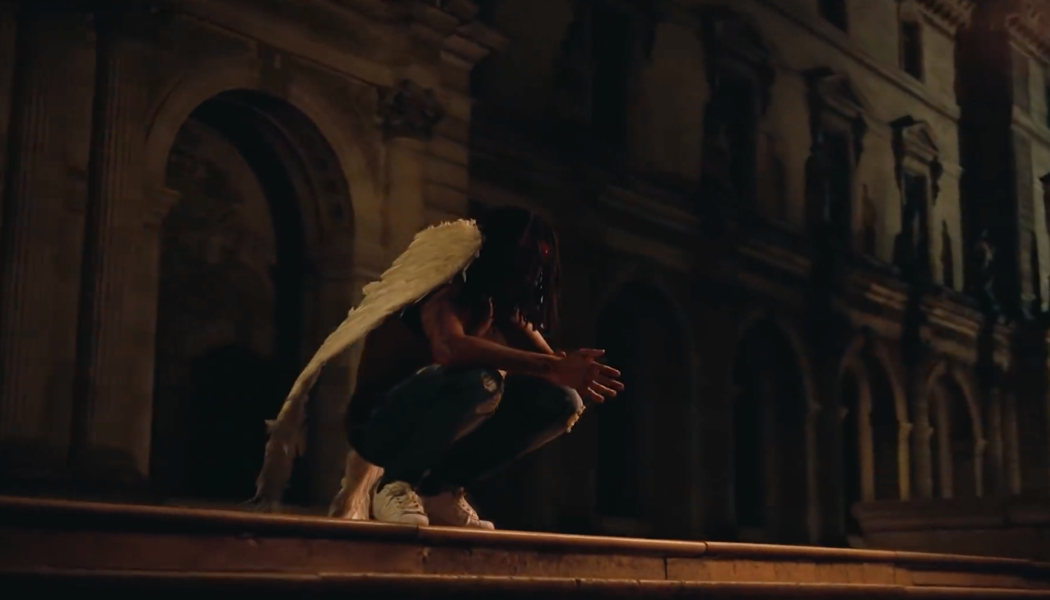
The video starts with the iconic sculpture of ‘The Winged Victory of Samothrace,’ representing the goddess Nike. This sculpture is one of the most celebrated surviving greek hellenistic sculptures and dates back to the 2nd century BC. Nike is the goddess of Victory and by juxtaposing her wings with a young black boy, the video establishes the glory it attributes with the young black man’s body and how it is to be associated with victory and triumph. Beyonce places herself right in front of the statue while demanding ‘gimme my check, put some respect on my check,’ echoing the straight forward, no-filter sentiment that is present in Nina Simone’s ‘Mississippi Goddamn.’ The stairs leading up the statue are covered with different shades of black female bodies, showing how they are literally occupying a pre-dominantly white space and making it their own.

A young black man with wings representing ‘The Winged Victory of Samothrace’

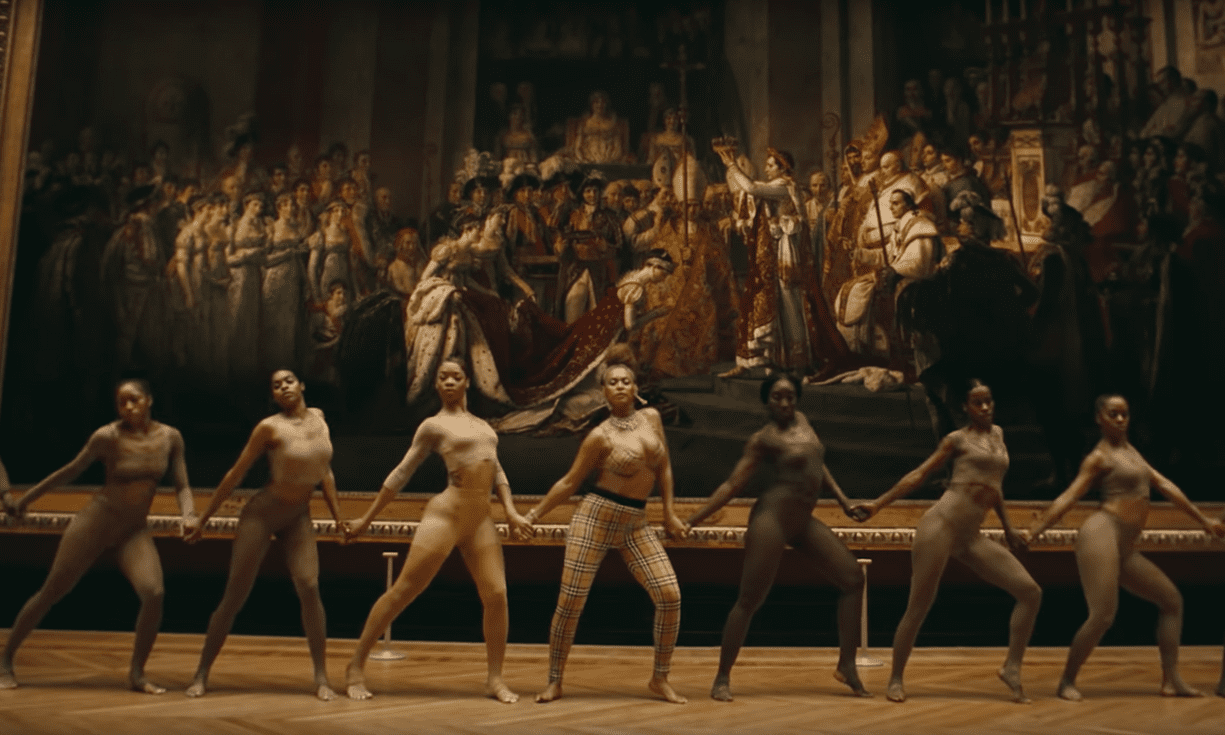
In the following image, Beyonce dances in front of David’s ‘The Consecration of the Emperor Napoleon and the Coronation of Empress Joséphine. Napoleon had this piece commissioned to portray him crowning his wife as a was a way to honour Josephine. Beyonce stands in front of this image of French pomp and conquest and freely dances in tight fitting clothing with women of colour to emphasise how she as a black woman does not adhere to the respectability politics of white women. Beyonce sings about how she has ‘expensive habits’ and she’s ‘living lavish’ just like Jospehine, however, unlike her, she does not kneel down for someone else to crown her.

Beyonce and her dancers in front of Jacques-Louis David’s ‘The Consecration of the Emperor Napoleon and the Coronation of Empress Joséphine,’ 1804

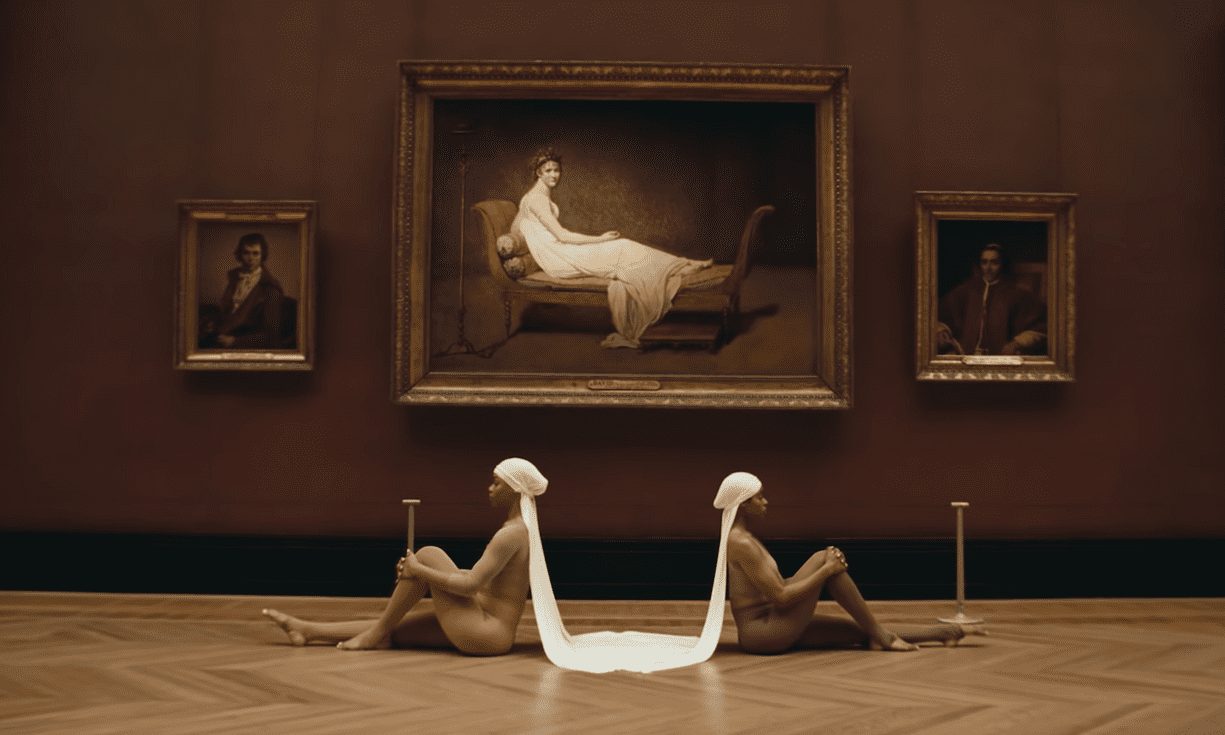
The music video then goes to the following still of two black women sitting on the ground as Davids‘ ‘Portrait of Madame Recamier‘ is elevated in an exalted manner. Madame Recamier was a Parisian socialite and she is depicted coifed in Greek fashion, reclining on a Pompein couch in a severly formal setting, truly serving as the height of French elite and regal status. The two women of colour sitting underneath her become significant as they portray how in reality it was women just like these who were characters surrounding figures like Madame Recamier, and it is these slaves who are left out of the narrative. The song goes silent at this still and lets the viewer contemplate what this means and how black bodies have historically been excluded.

The video also incorporates Gericault’s Raft of Medusa, a painting which is deeply socially and politically conscious. Gericault depicted people who were abandoned deliberately at sea and most of them died. The raft was eventually rescued and at the top of the pyramidical composition is a black man signalling towards a ship. Gericault empathised with the slaves and this work of art portrayed the suffering of the people while depicting them the black as heroic. Jay-Z stands in front of this image and repeats the chorus ‘can’t believe we made it.’ The inclusion of this particular image depicts the deeply hopeful nature of struggle and shows how Aretha Franklin’s ‘its been too hard livin, but I’m afraid to die’ rings true.

Théodore Géricault, ‘The Raft of the Medusa’

Finally, the Apeshit video breaks the constant portrayal of white characters with the ‘Portrait of a Negress’ by Benoist. This painting was made during a brief period of abolition of slavery in French colonies and is the only painting of a black subject without a visible form of white domination within the painting. The woman is titled simply ‘The Negress’ and has her breast exposed, which shows that she probably did not have any control over how she was made to pose. However, despite this, The Carters embrace this image because she is given a portrait and she maintains her regal and poise. Her image takes up the entire screen and no comparisons need to be drawn. Her portrait is hung in a respected place. The Carters sing ‘can’t believe we made it, this is what we’re grateful for’ and one sees how black identity and its relation with art continues to evolve.

Marie-Guillemine Benoist, ‘Portrait of a Negress,’ 1800.

To conclude, I think back again to the poem ‘Strange Fruit’ and Nina Simone’s voice as she re-opens the deep wounds that have been inflicted upon black bodies through slavery. I think back to the post cards that were circulated and to what thoughts may have crosses Lawrence Beitler’s mind as he captured the lynching of Thomas Shipp and Abran Smith. I think about The Carter’s and their ability to rent out the Louvre, an icon that represents the height of white elite culture and I meditate over how they have taken these famous works of art and tried to bring their own ‘special attitude’ in their approach to it. I think about James Baldwin in 1955 writing about feeling like an interloper as he appreciated art in France and I think about how The Carters tie into this long history. I wonder how Baldwin thought these works of art do not contain his history and how The Carters show that they do.

On the boat or on the shore

History with a capital H, as we know it today, is world history. But the world is the white man’s. It is exclusionary and laden with hidden silences; towards the black man. In other words, if the world is to be understood as that on the boat, and the shore, History with a capital H is the history of those on the shore, and not on the boat.

Because Toni Morrison, C.L.R James, and Malcolm X write and speak the history of those on the boat, they can be used to identify and heal the erasures and silences within History. Toni Morrison urges one to read not only as a reader, but also a writer. C.L.R James inverts the idea of the beginning of History, and urges one to see their history through their own memory. Malcolm X condemns the creation of the Uncle Tom-like docile Negro, and urges to see black history in black resistance movements. In doing so, each of the three want their audience to look through the DuBoisian veil, and with a prophetic gaze, such that they see things as they are, and not how they seem to be. To write is to become, and these figures re-wrote history to become what they wanted themselves to be, and not what the white man had told them they were. They saw through the veil. They saw what was other than the common sense. They saw the black man’s truth, unrefracted through whiteness.

But can history have a prophetic gaze? To explain, can it see through the veil? Can it heal the scars of the oppressed? Can it be life-affirming to the silenced? The answer is in affirmative, and lies in Toni Morrison and C.L.R James’ way of reading and writing history.

Toni Morrison insists upon reading as a writer because the latter has an added degree of alertness and responsibility. A writer is mindful of the processes that led to the final production of the piece; previous citations and archives, positionality of the writer in the world, and choice of language. As a result, the writer-like reader is able to identify and question the erasures, and hear the silences by reading against the grain of History. Then, history becomes accommodating and inclusive, and makes space for the marginalized.

As for C.L.R James, he insists upon writing in a way that challenges the European linearity and causality of History. In doing so, he suggests the power of beginnings of stories. It matters where and when a historian begins a story because it determines the outcome and implications of the story. For example, as opposed to History’s treatment of the Haiti Revolution to be a bi-product of the French Revolution, C.L.R. James begins it with the inception of slavery in West Indies. This allows him to transform Haiti from being a shadow of Europe to agents of their history. Then, history becomes prophetic because it sees time and memory that is otherwise un-seeable.

The choice rests with the historians. Whether they want to be on the shore or on the boat? Whether they want to begin writing from when the boat landed on the shore or before the boat arrived on the native land? Whether they want to write black history as the history of Uncle Tom or Malcolm X? If history is to perform the function that Toni Morrison, C.L.R James, and Malcolm X hoped it would, the choices should be the latter. Then, history can have a prophetic gaze. It can bring an end to oppression. It can heal and complete those that have been ruptured and lost. Otherwise, it will function as a tool in the hands of the oppressor to sustain and legitimize its oppression.


Any place is better than here

“We swear to destroy the whites and all that they possess; let us die rather than fail to keep this vow.”

It was this intelligence that refused to be crushed and the potential of this intelligence frightened the white colonist and plantation owner to the core. CLR James argues that regardless of whatever torture of humiliation the slaves at the plantations were subjected to, the master was unable to completely subdue him, the master was unable to kill his potential. Malcolm X is coming from the same tradition.

“If someone came to the field negro and said, “lets separate, lets run”, he didn’t say “Where we going?” He’d say, “Any place is better than here.””

I think what both of them are saying are that the field negro never completely gave up on attaining their subjecthood. CLR James mentions in quite some detail how the slaves used poison methodically to combat the master. If one of the masters robbed a slave’s wife, the husband would poison him. Most children of slaves that were born on the plantations were poisoned to keep the slave population low but also to rid the children of the terrible fate. This methodic use of poison was a way for the slaves to take some sort of control of their lives which again goes to show that they never fully became slaves.

Malcolm is speaking with this tradition of resistance in mind when he mocks the integrationists as uncle toms. How can you speak of love and integration with the white man when the oppressor even refuses to acknowledge your gory past, the blood of which is on his hands? And how can you speak of this “integration” when the white and refuses even to acknowledge this burden of history that you always carry as black people? When you have a history and present marred with brutality and murder, why do you want to rub shoulders with the white man? How is being “peaceful” even an option in face of such blatant hate?

“Blood running down all your jaw and you don’t know what’s happening. Because someone taught you to suffer-peacefully.”  

This sums it up perfectly. The black man owes nothing to the white man, and the black man is certainly not obliged to suffer “peacefully” for the sake of white validation. Malcolm says that “our religion teaches us to be intelligent. Be peaceful, be courteous, obey the law, but if someone puts their hand on you, send him to the cemetery”. He goes on to say that is a good religion and that is the force of his truth which refuses to subdue itself to the power that has murdered, oppressed and exploited the black man for centuries. Malcolm says he is a field negro and the black masses are field negroes and the forces of his truth ties in perfectly with the slaves in the West Indies who refused to let the master kill their intelligence. Despite the use of every form of torture and oppression, the master was unable to pacify the “wicked” slave and he kept on singing, hymning, yelling, “any place is better than here.”

Harlem through its visuals

I aim to create my project on the Harlem Renaissance from 1910s to the end of 1930s and more specifically the visual artworks of that movement. Since this is a time period before the larger struggle for decolonization in the international world, it stands as a cultural and artistic predecessor of the later movements. The movement is also unique in that it takes a mix of the American and African culture to create something distinctive in its intellectual expression. The time period, which was merely a few years later the abolishment of slavery in America and the rampant exercise of the Jim Crow laws, attempted to create an identity of the black man which was not in relation to its slave past and which made the mark of the black man known on the international forum. It was a new manifestation of black consciousness and showed the black aesthetic to the world. Although, the Harlem Renaissance is a massive cultural and academic movement which is multi-dimensional, I intend to, by focusing on visual art, understand the meaning and affect it had on black identity, representation and their position in the world.

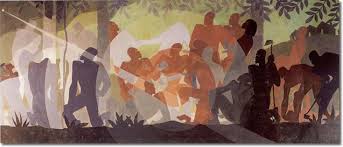
I’m particularly interested in the visual art of that movement is that apart from the many other things it sought to convey, it ‘represented’ the black identity in the eyes of the black population. People could see themselves in the paintings which showcased both the American culture along with their history and the influence Africa has on them. For example, the painting by Archibald John Motley Jr. known as ‘Saturday Night Street Scene’ shows the mix of people enjoying a night at the club having forgotten their differences amongst themselves. This is just a rudimentary example of the type of life and hope the paintings emanated. Along with this, like the paintings of Aaron Douglas, one sees the history of the life of the African-American in his slave days which sought to redeem the history of struggle of the black man. One such painting is his ‘Aspects of Negro life: From slavery to Reconstruction.’

Aaron Douglas

The form that my project will take is that of a report with commentary on selected works by the artists mentioned above and others as well. I will attempt to make the commentary holistic in the sense that it represents the different themes radiated from the art. In doing so, I might overlap into the Surrealist tradition because in that time, Surrealism sought to create art which was not conventional, which meant that it found space in the black illustration of identity in the mainstream world of art.

A turning of the tide

The way CLR James  Malcolm X address the histories of black people marks a turning of the tide as they both move away from the linear white man’s story about discovering the new world. They shed light onto resilience, resistance and revolt in the African American diaspora and the West Indies.The purpose it serves is that it changes where history is located and situated.

By choosing a point of origin for history and telling it from an angle that isn’t told is in itself revolutionary. In addition, telling the history of a revolution with its intricacies is what is present in  both Malcolm X’s speeches as well as CLR James account of the slave ship. His account over turns the way white history has been written. It attempts to heal the damage done by the histories already written. It does so by beginning history with an event that tells the history that has been erased, of the Haitian revolution. It challenges the notion of european time in this way. It also holds the French, Spanish and British culpable of their acts of brutality.  CLR James referred to their mission of conquering and civilising as “the other requirements of higher civilisation” which brought doom to the black people.

One of the major themes that ran across both texts was the idea of those who were better off than the other slaves, the house slaves and the field slaves, and how the house slaves were obedient and there identification with the masters whereas on the other hand the field slaves had to bear the brunt of the perfected measures of coercion by the masters. They were the first to run and death became a means of escape for them be it jumping off the slave ship or poisoning their children. They both referred to how “Uncle Toms” were created who were given some of the privileges and how these Uncle Toms becomes the spokesmen for them.

The purpose of Malcolm’s speech is to inspire and to incite resistance and to warn against these leaders who don’t represent the masses. His speeches too served as an alternate form of history that is located in the experiences of the African Americans. He narrates different incidents and refers to different figures within the political struggle and refers to how blackness was weakened because whiteness was inserted into it. Malcolm X, is very direct and criticises the politics of the politicians that were sellouts. CLR James, on the other hand by tracing the revolution in Haiti and then addressing the Cuban revolution seeks to trace a history of the slaves that were forced to migrate and their loss which goes uncaptured by deeming them barbarous and backward in the narratives and accounts of missionaries and other archives from the time.   


Both in their own forms, and in different ways seek to challenge the linear telos of a “European” history and how it is usually told, where it is situated, and who tells the story.