To place a field of scholarship as broad as the Black Radical Tradition within a certain category of philosophy is, in my opinion, a major simplification. Weve observed how it deeply penetrates, or in some cases forms the very foundation, of not just politics and literature but also black art, music, sports and religion. It shapes perception of the self and the other at a communal level.
One of the main things one can draw from this tradition is the sense of the collective. All of the personalities we discussed appealed to the factor that unified all Africans irrespective of locality, class or age i.e the color of their skin. By doing so there is a sense of uniformity that is created regarding the decolonial experience, arts, expression, perspective and most importantly, the obstacles they face in a white dominated world. The tradition establishes that the grievances of the black community in America, England or any black diaspora is the grievance felt across Africa as a whole and vice versa. Joy is shared and celebrated in a similar manner.
The Black Radical Tradition is a movement for global emancipation. It is grounded upon the ability of “speaking truth to power” by going beyond one’s own national boundaries. In doing so it attempts to undertake the extremely arduous task of naming the oppression. For the tradition, it is not important to be specific to time and place, in fact there is a sense of timelessness throughout, however what’s common is the history of dehumanization and slavery. It forms the basis of the tradition. The tradition stresses upon the institutionalization of racism (which draws from the days of slavery) as having penetrated all spheres of society including sports (e.g: we learned that through Ali, Clive Lloyd). In return the tradition has repeatedly attempted to go beyond the realm of reality and engage in surrealist literature through the likes of Cesaire etc. In doing so the tradition can attach its own meaning to the world it lives in and go beyond what Christina Sharpe calls living “in the no’s”.
There is also constant hearkening back to a glorified past in the tradition. Marcus Garvey went as far as to start a shipping service to Africa, to return back to the original “property of Africans”. African personalities that were part of the Radical Tradition e.g: Nkrumah have constantly referred to a past where communal societies of Africans existed in harmony. It is not surprising that a major chunk of the Black Radical scholarship aligns with Marxist thinking e.g: Fanon.
Lastly, one of the major takeaways would be the unfortunate absence of Black women from this tradition. Bell Hooks talks about how “womanhood” was not seen as an important part of black identity. While the tradition constantly debated over assimilation or segregation, violence or non violence, it neglected sexism and emancipation of women in the process.
In conclusion, while the tradition has been thoroughly romanticized on the surface level and has played a central role in the movement towards an egalitarian society, it is important to think of the Black prophets as sinners, not saints. Only then can one objectively engage with their unmatched contributions to this movement against oppression.
“Non-violence
is the relentless pursuit of truthful ends through moral means.” The means must
be as pure as the ends because the argument is that if the means are corrupted
so are the ends. Fanon asked all the colonized people of the world to envision
a new world which is unlike the European model for if Europe is to be taken as
the model, the world that will be created will be in Europe’s image. The image of
death, destruction and disease; all for the sake of profit. Oppressive means
will never produce a just end. I don’t know much about the philosophy of
non-violence or MLK’s and Gandhi’s politics for that matter, but it is,
perhaps, possible to place both of them within the framework that Fanon was
talking out.
The
oppressor can never be defeated with the oppressor’s own tools and the only way
we have understood colonization and the African American experience is through
the language of violence. The oppressor is created in the process of colonial
violence and we have understood oppression, in itself, to be anti-human. In
that sense, non-violence, is a strategy of the oppressed to expose the
anti-humanness of such a system to the oppressed and the oppressor. Within the
philosophy of non-violence, of what little I understand, there is also the
argument that the oppressed redeems himself and his humanity by differentiating
between himself and the oppressor and gaining a sense of moral superiority and
that is perhaps all the oppressed can afford to have too. There is also the
idea of how the oppressed can be free from fear because through non-violence they
know that they have nothing to fear for it is only pain.
My problem with the idea of non-violence and the claim that the oppressed can redeem himself through this moral superiority from the oppressor is that it, perhaps, downplays on the antagonism that the oppressed feels towards the oppressor. Fanon argues that whenever the colonist calls the colonized “savage”, “inhuman”, he roars with laughter for he knows that is untrue. Despite the colonist’s efforts to destroy and reduce the colonized to the status of a thing, the colonized knows he’s human for he despises the colonizer, he despises his oppression for he knows “this ain’t it.” Fanon’s argument is that when this idea comes to the collective consciousness, the colonized know they can break their shackles. The oppressed know that they are human, precisely because they loathe their oppression.
Pain and violence are all they have known since infancy. The moral framework, the objective framework is defined by their negation, then what are “moral means” for the oppressed? If one’s entire life is a trajectory of violence, and “morality”, itself legitimizes that violence, then perhaps the only answer is smashing that very morality through the violence it legitimizes. But then again, perhaps, another way of smashing that morality is through creating one’s own morality but that “morality” itself is a reaction to the framework already in place for the existence of the oppressed is a product of the violence of the oppressor, so in other words there is no way to free yourself of the oppressor for your existence itself reeks of the violence of the oppressor. And that is where Fanon comes in and says that the whole house must be burned down if there is to be any redemption.
Another question that bothers me when it comes to non-violence is the gender question. Society operates by legitimizing violence against the bodies of women. If women are to resist by this strategy of non-violence, do they continue to let themselves be exposed and abused by the unique forms of violence that they are subject to for the “means” must be as pure as the end? That does not resonate with me, at least, at all. I understand that for MLK and Gandhi, against the oppressive, racist nation state and colonial regime, there was no other way of confrontation possible, and non-violence was a political necessity for it was impossible to carve Malcolm’s black nation in the US but non-violence as a philosophy and ethical movement, from my limited knowledge at least, I am not convinced with.
History with a capital H, as we know it today, is world history. But the world is the white man’s. It is exclusionary and laden with hidden silences; towards the black man. In other words, if the world is to be understood as that on the boat, and the shore, History with a capital H is the history of those on the shore, and not on the boat.
Because Toni Morrison, C.L.R James, and Malcolm X write and speak the history of those on the boat, they can be used to identify and heal the erasures and silences within History. Toni Morrison urges one to read not only as a reader, but also a writer. C.L.R James inverts the idea of the beginning of History, and urges one to see their history through their own memory. Malcolm X condemns the creation of the Uncle Tom-like docile Negro, and urges to see black history in black resistance movements. In doing so, each of the three want their audience to look through the DuBoisian veil, and with a prophetic gaze, such that they see things as they are, and not how they seem to be. To write is to become, and these figures re-wrote history to become what they wanted themselves to be, and not what the white man had told them they were. They saw through the veil. They saw what was other than the common sense. They saw the black man’s truth, unrefracted through whiteness.
But can history have a prophetic gaze? To explain, can it see through the veil? Can it heal the scars of the oppressed? Can it be life-affirming to the silenced? The answer is in affirmative, and lies in Toni Morrison and C.L.R James’ way of reading and writing history.
Toni Morrison insists upon reading as a writer because the latter has an added degree of alertness and responsibility. A writer is mindful of the processes that led to the final production of the piece; previous citations and archives, positionality of the writer in the world, and choice of language. As a result, the writer-like reader is able to identify and question the erasures, and hear the silences by reading against the grain of History. Then, history becomes accommodating and inclusive, and makes space for the marginalized.
As for C.L.R James, he insists upon writing in a way that challenges the European linearity and causality of History. In doing so, he suggests the power of beginnings of stories. It matters where and when a historian begins a story because it determines the outcome and implications of the story. For example, as opposed to History’s treatment of the Haiti Revolution to be a bi-product of the French Revolution, C.L.R. James begins it with the inception of slavery in West Indies. This allows him to transform Haiti from being a shadow of Europe to agents of their history. Then, history becomes prophetic because it sees time and memory that is otherwise un-seeable.
The choice rests with the historians. Whether they want to be on the shore or on the boat? Whether they want to begin writing from when the boat landed on the shore or before the boat arrived on the native land? Whether they want to write black history as the history of Uncle Tom or Malcolm X? If history is to perform the function that Toni Morrison, C.L.R James, and Malcolm X hoped it would, the choices should be the latter. Then, history can have a prophetic gaze. It can bring an end to oppression. It can heal and complete those that have been ruptured and lost. Otherwise, it will function as a tool in the hands of the oppressor to sustain and legitimize its oppression.
Both C. L. R. James and Malcolm were revolutionaries of their time and in many ways similar in their goals. Before them, historical narrative was taken over by the white man. They began the practice of writing histories very different from what was the norm. They rewrote the singular, linear idea that the white man discovered the world and instead talked about how that world already existed and was inhabited by people of its own. The goal was to revise history, to mark different events as important and change where history begins from.
Both their writings analyse the intricacies of revolution and provide a very new take to them. C. L. R. James rejecting to view the Haitian revolution as a mere footnote of the French revolution was beyond revolutionary in his time. It challenges the widely accepted colonial notions. Rejecting the Western view and white supremacy was a remarkable feat. He wanted to allow the Africans to see themselves in a different light for once and to have the ability to create their own identity.
Whenever Malcolm X spoke his speeches also served as an alternative way to look at the world, a new take on history, much like James, through the experiences of the black people. He takes on a very assertive and reactionary approach pointing out political figures and criticising everything he believed to be wrong. He never held back. His speeches had a sense of urgency to invoke resistance within the African American community. He openly recognises the experiences of black people within America as separate from the widespread whitewashed narrative. He wants the Africans to form an identity of their own, separate from the American identity as their experiences diverge from those of the white Americans.
But both writers similarly talk about the creation of “Uncle Toms” who were complacent and never complained. These types of people were made the figureheads of the African community leading to a stagnation o their condition. Both of them wanted desperately to change this situation. They wanted to help the Africans realise their potential and to own up to their glorious pasts, the ones which were not written in the language of the West. They wanted to change who wrote history, how it was written and who deemed what events were of significance.
“My work requires me to think about how free I can be as an African-American woman writer in my genderized, sexualized, wholly racialized world. to think about (and wrestle with) the full implications of my situation leads me to consider what happens when other writers work in a highly and historically racialized society.”
Toni Morrison eradicates, with one concise sentence, the notion that literature (and presumably all forms of knowledge) exist independently of context. To think about, and more importantly, to write about humanity in some vain attempt at objectivity is not only unethical, it is quite simply impossible.
To deny an entire faction of humanity their rightful place in history, their right of culturally, historically situated expression, under the pretense of “universalism” is not just unethical, not just impossible but entirely tyrannical in the effective denial of humanity that it proliferates.
For Toni Morrison to state, clearly, the different facets of her identity that contribute to her construction of the world, threatens the monopoly that the white male has over the propagation of a singular construction of the world, a singular “knowledge”; a knowledge that has been celebrated for its supposed objectivity because the writers of that literature have been afforded the privilege of objectivity. For Toni Morrison to do the same as a “woman”, a “writer” and an “African-American’ would quite simply be a denial of her own truth. For in America, where her presence as a non-white non-male being is unaccounted for, it is her duty to represent herself in a world that refuses to do so.
Morrison makes it clear when she implores the reader to think as a writer, through the lens of their own personal experience, in creating a world that others like them can recognize. A world that goes beyond Uncle Toms and Bens and Joes; a world that recognizes the diversity that flourishes in a post colonial America, because to write is to create a world, potentially from the ground up. A world that the reader, being a non-male, non-white and even non-American should be able to situate themselves within, not one that is inherently exclusionist through the erasure of differences.
This “work” that Morrison talks about is the burden that plagues the writer; the burden to “think” truly, unfettered by the expectations of the kind of knowledge one is expected to produce; the burden of accountability. To write is to be held accountable for what you put out into the world, for the language you use, the characters you portray, the things you include and the things you omit.
The “implications” of writing certain things and not others must then be at the forefront of the author’s mind when they write, because this is no inconsequential task; it informs the reader whether or not there is space for someone like them outside their own homes, in the greater scheme of things
“Instead of airing our differences in public,
we have to realize we’re all the same family.”
I loved reading Malcolm X’s
autobiography. His words carry an insistency. Its almost as if he needs to be believed,
and upon reading Alex Haley’s foreword it is clear that this is the case. It is
Haley who finds himself in the position of coercing details regarding the
events of Malcolm’s life out of him. They do not flow on their own. This is the
Malcolm I was first exposed to. I understood him, I admired him, but I didn’t realize
quite how magnetic his personality was.
Then I heard him speak. I
felt an urgency throbbing like an undercurrent beneath his words. It didn’t seem
like an impromptu speech, but it is precisely this quality of being an “off-the-cuff
chat” that makes what Malcolm has to say so appealing. He speaks to the people
not at them, and this can be heard through the laughter and shouts of approval when
he says something that has an especial resonance. When he talks about the field
negro and the house negro he does not separate himself from his argument. In fact,
his words form an embrace into which his listeners are gathered. He is the “same
man” as those in front of him are— he is under no pretense as to who he really
is. He is “man enough to tell” it as he thinks it is and this attitude is carried
forward into his narration of his own life.
Yet, Malcolm X is also
more than just a man. He is an idea. While reading his speeches I couldn’t help
but remember one of my favorite stories growing up, The Velveteen Rabbit. I won’t go into the particulars of the plot,
but one particular sentence kept replaying in my head as I listened to Malcolm
X speak:
“Once you are Real you can’t become unreal again. It lasts for always.”
Whether he imagined
himself into being or not, Malcolm X was real. And that is a quality that makes
him “last for always”.
“Who are you? You don’t know? Don’t tell me ‘negro’, that’s nothing. What were you before the white man named you a negro? And where were you? What did you have? What was yours?”
Malcolm X
“The difference between the civil rights
movement of 1954-68 and the Black Power movement, was that the civil rights movement
sought equality with whites- and was a middle class movement. The Black Power
movement assumed equality, of person,
and merely sought the opportunity to express that equality by saying, ‘We are a
proud people. We don’t need you to tell us that. Our kinky hair is glorious,
our black skin is something we’re proud of, and we are who we are.’”
Disillusioned by the Civil Rights movement’s
inability to instigate real social change and inspired by the ideas of Malcolm
X, the early 1960s witnessed the birth of The Black Power Movement, a political
and social movement that advocated racial pride, self-sufficiency and equality
for all people of Black and African descent. The movement, which gave rise to its
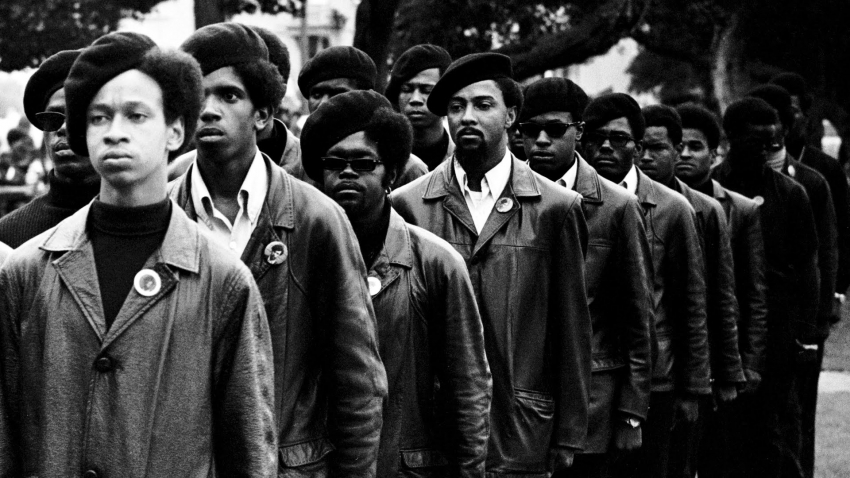
own associated Black militant group, the Black Panthers, represented the demanding
voice of a younger generation that had given up on Martin Luther King’s
nonviolence rhetoric, in a refusal to remain complacent in their own oppression.
It was no longer integration into the existing white-centered social structure that
Afro-Americans wanted; it was self-determination and self-fulfillment on the
grounds of racial pride, with the creation of political and cultural
institutions run by Afro-Americans for Afro-Americans
being the first and foremost goal in the agenda.
This goal, as the first demand in the
Black Panther Party’s Ten-Point Program is expressed as follows: ‘We want the
power to determine the destiny of our black community. We believe that Black
People will not be free until we are able to determine our own destiny.’ At the
time this manifesto was drafted, there were only 50 Black elected officials in
the country, which included local seats like school boards. This first point was
the Panthers’ attempt to increase Black representation and the inclusion of
Black politicians in the country’s political affairs. On the political
philosophy of Black nationalism, a philosophy that largely influenced the Black
Power movement, Malcolm X had this to say:
“We must control the politics and the politicians of our community. They must no longer take orders from outside forces. We will organize, and sweep out of office all Negro politicians who are puppets for the outside forces.”
From ‘A Declaration of Independence’
The Black Panthers, Vanguard of the Revolution
The agenda also accounted for independence with regard to the economy, stating ‘We want an end to the robbery by the capitalists of our black and oppressed communities.’ According to a study by the U.S. Census Bureau, unemployment and poverty rates for Blacks, in 1966, were double those of whites, with 42% of Blacks living below the poverty line, unable to secure even basic necessities. The Panthers’ sought to eliminate the income gaps between Blacks and whites, and to allow Black store-owners, struggling from a lack of capital, the right to operate in their own communities without the threat of competition from white-owned multi-million dollar companies.
“Why should white people be running all the stores in our community? Why should white people be running the banks of our community! Why should the economy of our community be in the hands of the white man? Why? If a black man can’t move his store into a white community, you tell me why a white man should move his store into a black community.”
From ‘The Ballot or the Bullet’
“It is legal and lawful to own a shotgun or a rifle. We believe in obeying the law.” -Malcolm X
The fifth point in the manifesto,
regarding education, states, ‘We want education that teaches us our true
history and our role in the present day society. We
believe in an educational system that will give our people a knowledge of self.
If a man does not have knowledge of himself and his position in society and the
world, then he has little chance to relate to anything else.’ To link this back
to CLR James’ The Black Jacobins, a
re-evaluation of the standard way of teaching history was in order; moving away
from the general trend of writing about Black history as always in relation to
whites, instead of in relation to their own history, to their own personhood. This
placed an emphasis on the importance of racial pride- something which was instilled
through teachings in Black Americans from a young age, where children as young
as five were taught to refuse the label of ‘American negro’ and embrace the title
of ‘African American’.
“We cannot think of uniting with others, until after we have first united among ourselves. We cannot think of being acceptable to others until we have first proven acceptable to ourselves.”
From ‘A Declaration of Independence’
The majority of the members of the Black Panther Party were women. A few years after the founding of the Party, the majority of the Party’s leaders were women.
Point six in the manifesto dealt with the
issue of the military drafts. ‘We want all Black men to be exempt from military
service.’ The Black Power movement resisted, by whatever means necessary, the force
and violence of the racist military; refusing to defend a racist government
that did not protect them, against other people of color in the world who, like
Blacks, were victimized by white forces. This refusal by groups such as the
Panthers to participate in the Vietnam war is credited as being one of the
reasons why the draft was abolished in 1973.
“Not only did we give of our free labor, we gave of our blood. Every time he had a call to arms, we were the first ones in uniform.”
From ‘The Ballot or the Bullet’
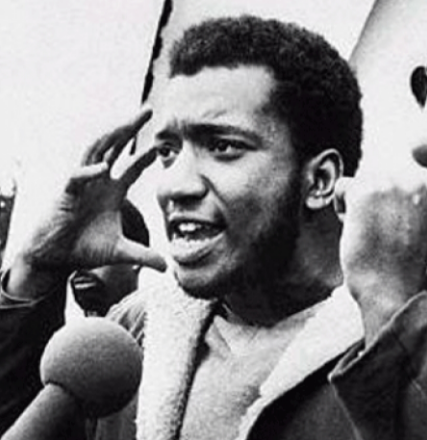
Fred Hampton, leader of the Chicago chapter of the Black Panther Party, delivering his 1969 speech, ‘Power Anywhere There’s People’
By 1980, the Black Panther Party had
largely dissolved due to COINTELPRO, an FBI program designed to prevent the
unification and success of various black power coalitions. Several hundred
Panthers were imprisoned or jailed in each year that the party remained active,
and many of the leaders in the party had been executed by local and federal law
enforcement, including Fred Hampton, who was killed in an FBI raid of his home during
his sleep. The Black Power movement, emerging in the early 1960s and the consequent
Black Panther Party, founded in 1966, were both greatly influenced by the
speeches and ideas of Malcolm X, whose assassination in 1965 was said to have ‘ignited’
the Black Power Movement. They were a response, one could say, to Malcolm’s
message to the grass roots- the call for revolution.
Malcolm X and CLR James are inventors-inventor of a world that is
a safe haven for Black folks. It is the world where the black man can walk with
dignity and claim his place proudly. It s a place where he is not reduced to
the colour of his skin- to unchanging essences. It is a place where curly hair,
full lips, wide nose, dark complexion is not equated with “cruel, barborous,
halfhuman, treacherous, deceitful, thieves, drunkards…cowards.” The black face
is not the face of the untouchable .He is as human and deserving of respect as
the white man. Malcolm X and James then continue to reinvent and imagine a
future where the Black people have dignity and place.
Malcom X emerges from the streets, leaves his prison life,
connects with Muhammad Elijah, disconnects with him, perceives the white man to
be “blond-haired, blue-eyed
devils,” fixes his perception of the white men after Hajj to his potential
allies in his struggle for black liberation, refuses to beg for civil rights
dished out by Uncle Toms, internationalizes the black question, and aspires
towards human rights which are inalienable rights. His life was constantly a
life of reinvention. If there is anything constant in his life that is his
ultimate purpose: to see Black people as dignified individual living their lives
on their own terms not on the terms of the white man. He thus specialized in “de-niggerizing
Negroes.” These Negroes “scratched when it doesn’t itched; they laugh when it
aint funny.” By de-niggerizing them, he stripped them of the shame, intimidation
and submissiveness that they felt towards the white man. He took them out of
the life of indignity into the life of dignity and pride.
James is also seen resuscitating this
same dignity and pride for his black people from history. From being just a
footnote to French revolution, The Haiti revolution is presented by him as a
true revolution which is not just a slave rebellion but one that marks the inauguration
of the history of revolutions. This time, however, history is not originated
from Europe but from the Caribbean. This revolution is understood not from the perspective
of the French but from Haiti itself. James overturns the idea from where
history is originated and in doing so he ingeniously reimagines the entire past.
And in doing so, James turn our
attention to the Malcolm X’s claim that the black man is not indebted to the white
man. He is a dignified man in himself. He doesn’t need to beg Uncle toms to
have his rights granted. He doesn’t need
to be at the mercy of white men to have their share of history. The black man,
then, doesn’t need the white man.
This is
only done through an astounding display of language. James makes use of his
imagination and describes the minutest of details of the happenings of the
Black individuals. He paints vivid pictures of the black slaves at the ship,
which otherwise could not have been imagined with such precision. Malcolm words
have a sonic quality to them. Transmittive in nature, his speeches ring so loudly
in our ears primarily because he has once lived the life of a common black man,
living in streets. His words appear more visceral and immediate which resonates
with black folks. He has played the role of both the trickster and the
minister. While he has defied the norm of decency, he has redeemed souls from the
abyss of the white torture.
Hence it can be said that in the
end , both Malcolm X and James look for dignity and place, as the latter stated,
“one could trap them like animals,
transport them in pens, work them alongside an ass and a horse and beat both
with the same stick…they remained, despite their black skins and curly hair quite
invincibly human beings.” And these
humans very much deserved their place and dignity in this world. Through their
prophetic gaze, they saw what is otherwise not seeable. They were able to tear
apart the veil of ignorance and envision a world where the white man sits with
the black man but this time with both their plates filled.
In the preface for Toni Morrison’s book Playing in the Dark, Morrison uncovers a certain ethic or as she
calls it an “imagination” in writing that produces works which “invite
rereadings”. Her formula requires one to don the hat of a reader and the writer,
an imagination that is painfully aware of what it can contain and what it is
unable to contain. Once the reader and the writer acknowledge these
restrictions and freedoms, the act of understanding or creating that work opens
up more possibilities.
Morrison places this responsibility mostly on the reader of
such works as she teases out the secondary black characters from white washed
literary texts such as Henry James’ What
Maisie Knew and points out their significance in the texts despite the
writer’s ignorance towards them and their presence in the story. But if one
were to glance at the speeches crafted by Malcolm X, Malcolm’s status as a
writer and a reader or, to be more specific, as a listener and a speaker is
constantly in flux. Malcolm’s imagination as a speaker is accompanied with his
imagination as a listener which enables his speeches to have a vitality that
has kept them reverberating across history. Much can be said about the tiny
nuts and bolts that piece together his speeches. The anaphora, the tone of
urgency, the camaraderie, the pauses, the imagery, and the analogies are all
parts of the journey that Malcolm experienced along with the listeners of his
speeches. His words descending towards the audience invited them or nestled
amongst them and made listening a collective activity for example when he said:
“Three hundred and ten years we worked in this country without a dime in return
– I mean without a dime in return. You let the white man walk around here
talking about how rich this country is, but you never stop to think how it got
rich so quick. It got rich because you made it rich” he speaks of a collective
memory that cuts across time and reminds himself and the listeners of the
centuries of hard work that has gone unnoticed.
However, there is one aspect in his speeches where his
imagination as a speaker or as a writer reigns over the imagination of the
reader. And those are the instances where he dares to say something despite it
going against the larger narrative. It is where he breaks away from the
comfortable and crippling illusion and speaks his truth. In his speech titled “Message
to the Grassroots” he even admits “I know you don’t like what I’m saying, but I’m
going to tell you anyway. Because I can prove what I’m saying”. It is also
important to note how at times Malcolm X rebelled against his own imagination
to put forth the cold hard truths to the people as his wavering support towards
Elijah Muhammad or his other ideological changes would denote. All of this
shows how powerful and cognizant Malcolm X was in his capacity as a listener
and a speaker
Toni Morrison’s purpose in “Black Matters” is to highlight
the lack of presence of African American characters in the American literary
canon. She suggests that this absence occurs either because “silence” over
matters of race imply an inclusion of black people in the collective or because
racism is defined asymmetrically by looking at the black person as a victim. Morrison
argues that this exclusion of black characters and black literature signifies
an erasure of black history. It either does not represent black people at all
or it shows them as minor characters that are stereotyped as victims. Black
people thus fail to recognize themselves in the stories they read. In her
preface to Playing in the Dark, she
praises Marie Cardinal’s work because her language helps the black reader
recognize himself. Morrison advocates for inclusion of such literature into the
canon in order to prevent the black reader from feeling like the other. She
also adds later in the book that the little representation of black people is
based on binaries between them (uncivilized) and the white American
(civilized), and explorations of the white self in comparison to the black
self. This can also be read through the lens of Oriental discourse.
Examples of stereotyping are plenty in the Oriental
discourse. In the Arabian Nights, the
base tale presents prince Sheheryar as a selfish and insecure despot who is too
involved in his personal matters to care for the nation. This stereotype of a
despot is associated with the orient. The notion of antinationalism is also
oriental and created in comparison to the nationalist Europeans. The
promiscuous women, Sheheryar and his brother’s wives, are also presented in
opposition to the European ladies. Murad, an Orient slave with whom the prince’s
wife has an affair, is supposed to look ape-like and yet is described to have
animalistic sexual appeal which adds to the animalistic character of the
orient. These particular descriptions show up in other literary works as well.
Their purpose is to build stereotypes that reduce the orient
to his baser instincts so he is built in comparison to the civilized European.
Even the oriental translations of Eastern works reorient the way they were
meant to be read. Thus in oriental discourse, there is selective representation
which is political and has a great impact on those that read these texts. The
fact that these texts became extremely popular and were replicated time and
again shows how the orient was turned into an exotic character, existing purely
for the Europeans’’ entertainment.
When Oriental discourse was brought to India with the East
India Company, Warren Hastings began a bigger project of translations and
writings. This led some local Indian writers to write in the same way and they
too began to use the oriental stereotypes. Again, the purpose of these
characters was to create complacence. If the literature too attested to the
notion that the white man wanted to impose, it became easier for the colonized
to internalize these ideas. This shows how literature works to build identity
as well.
Morrison seems to be diagnosing a problem similar to that of Oriental discourses. It is a problem of representation which has previously made the orient into the other that is seen as a binary of the European and is attributed negative characteristics which are stereotyped and popularized. The similar can happen if black history is eroded and black identity is either not represented at all or is represented selectively. It is essential to make efficient use of literature in order to highlight the history of black struggle as well as to give black people characters that they can recognize and identify with.




 Decoloniality and Decolonization