Dignity

A central theme to decolonization is the reclamation of a humanity denied. This is what every thinker strives for – in outlining a humanity specific and special that is the sole prerogative of the colonized; in envisioning the world race-less and truly decolonized; in reclaiming the existence of a history – and not just a history but a great history.

On the last note, CLR James is not so different than, say, the envisioners of a great African past. He too makes a claim for the importance of a certain people based on primacy of history. In placing the center of the narrative squarely on Haiti as an agent, a definer of change and revolution in the world he inverts an accepted trope – that no revolution is not white somewhere, that all revolutionary ideas stem from Europe.

The trope is not unimportant – in some sense its the underlying theory of colonization: that the world is merely a stage for the European to act out his great destiny and all other people, cultures and history are but two dimensional props and faceless scenery -people that only become animated as the Europeans, the protagonists of their own histories, start to interact with them.

Thus CLR James takes the story and upturns it. The props are no longer window dressing, they’re the stage. The background actors are the stars. The previous protagonists – the ones that went through a crisis arc and gained a better understanding of humanity over the tragedy of millions – are mere villains – their character arc is no longer about redemption.

And in doing it he owns the stage.

The world is reformed. He claims the narrative as his – and claims in doing so, a history not of the fumbles and indulgences of the colonizers, but a history of revolution. For a moment the world is Haiti – and Haiti claims the right to be the entire world in that instance. It claims pride of place and all of history is rendered in relation to it.

This capacity of – owning oneself, not as incidental but as human, as protagonists of their own story, perhaps, is the element that Malcolm X, in all his incarnations seems to never compromise on. Its the reason he’s talking, really – he isn’t really a preacher of Islam, however that may be defined.

Malcolm X talks of the ‘house negro’ and the ‘field negro’ – and the difference between them is the amount they adopt another’s narrative as more important than their own. The house slave is a prop in the story of his master and has thrown himself into that role wholeheartedly. His story becomes his master’s. The field slave has never had that privilege, if privilege it is. He owns his own existence out of pure stubbornness, impossibly harsh as it is. This story isn’t about celebrating the field slave, though. No, that would be in very different vein.

Malcolm’s story is about the house slave. It’s about the person who has lost his person-hood in favor of his subjugators’ – and it is about redeeming this person. He reclaims his own humanity. Preserve your life, he insists, because it is worth something. Fight back – be people in your own right. Don’t be second rate people in your own home, among your own people. His anger is emancipatory, his speeches revolutionary: ‘When our people are being bitten by dogs, they are within their rights to kill those dogs.’ There. He has inverted the narrative – his people are those marching determinedly towards a bright future, and are hounded by basic dogs.

This, then, is the hope – the need. To be people of the same level as all others. History doesn’t begin and end with the white man – humanity doesn’t begin and end with the white man.
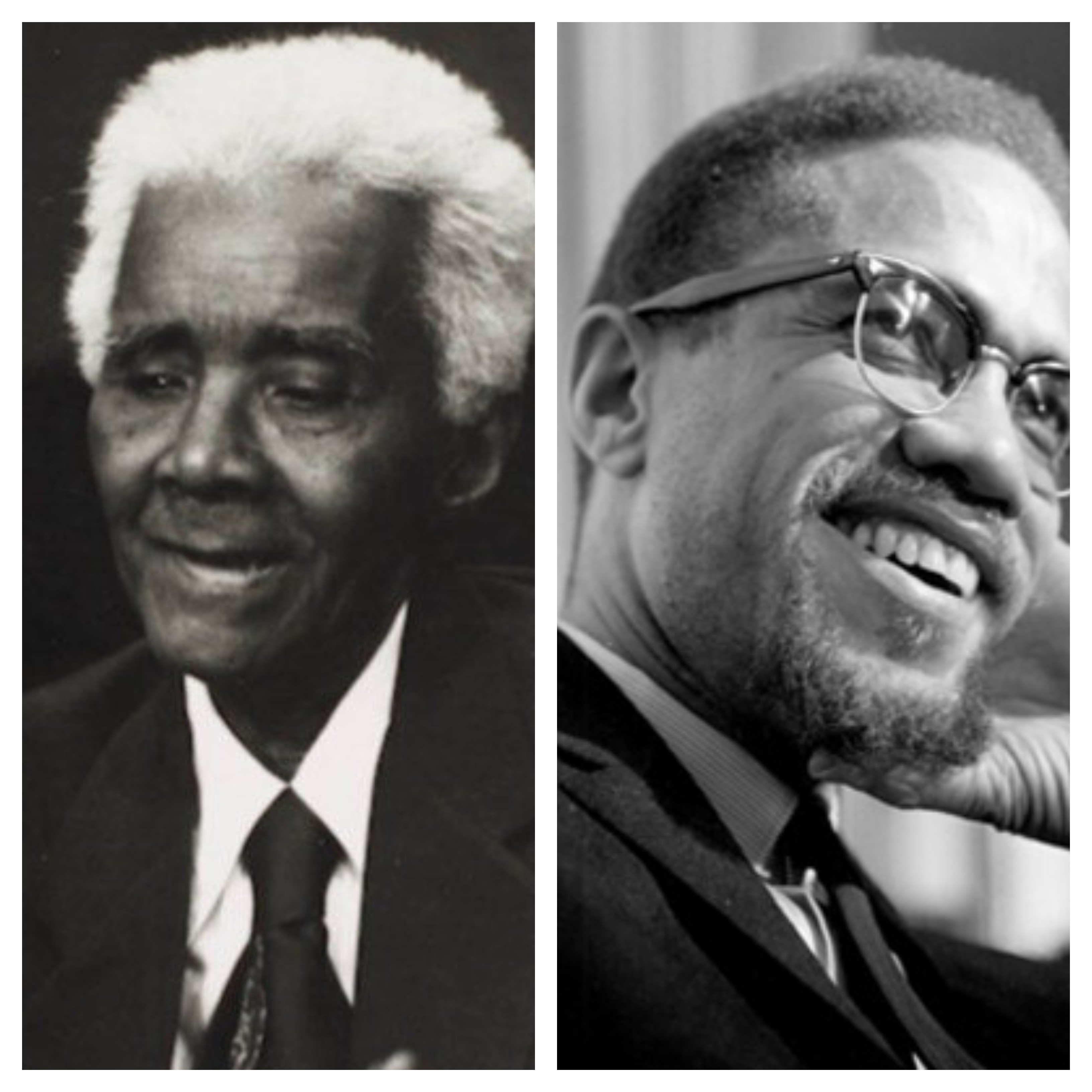
Viewing James and X through each other(?)

The question of whether Malcolm X and C.L.R. James can be viewed in the same light is an interestingly complex one. I would use ‘rays’ of light in the attempt to understand one through the other and try to find one’s reflection in the other, for ‘light’ in itself is what they both were, and are. I have only, so far, reached the rays.

In his work called “The Black Jacobins”, James begins with the chapter called ‘Property’. What an intelligent, provocative and tragic word in the sense that he uses it. Needless to say, a purpose and an intent can be derived from it. The word ‘property’ alone, immediately evokes a sense of emotion and anger, uneasiness and discomfort. A necessary discomfort and unease, i would say. And this is primarily what Malcolm X did when he spoke. He invited discomfort, strain and sweat, he invited the truth that some realized and others didn’t or perhaps were forced not to. In this sense, both James and X are holding out and urging everyone to see and to recognize the torches of truth.

In Malcolm’s speech titled as “The house Negro and the field Negro”, the ‘property’ in James’ “The Black Jacobins” is perhaps what Malcolm is referring to when he speaks of the ‘house’ Negro. The Negro, the human being, who was made to be considered a property of the slave master, a debt to the master, answerable to the master, and indebted to feel a sense of pride by denying themselves agency, own will and independence for the sake of being in close proximity of the master. In other words, when James recalls the physical torments faced by the ‘property’, Malcolm brings into attention the psychological impact and its manifestation in the minds of many Blacks who were made to live as property for hundreds of years. While James sees the slaves through the lens of what was imposed and forced upon them, Malcolm also takes into account how some slaves reacted to that imposition by submitting further to the masters and perhaps deriving some sense of pride from it. Here one might sense a complementary relationship between James and Malcolm, while, of course, appreciating the uniqueness of both in viewing and expressing the question of slavery and the then present condition of the black people.

When James speaks of the dark past, he is vivid. Painfully vivid. He narrates the journey that every slave would have embarked on when they were taken away from their land, their home. He tells how they lived, and how they died. How they protested, even in their deaths. Perhaps James is more inclined towards the journey undertaken by the slaves, and their sufferings that made them what Malcolm could classify as the field negro and the house negro. James is probably setting the stage for Malcolm to build his classification on, and to give his voice on. It feels like both are standing at different stages of the same history which has been cruel, unfair, unjust and agonizing for the Africans. They are both talking about the same thing, but the tones, the lens, the emphasis is unique to each. There is tragedy, and a very close association to the on-going tragedy, in the words of both. They choose to speak about it.

In terms of expression, both occasionally use sarcasm and wit to express what they strongly feel about. Maybe wit was their way of balancing their emotions, when repeating, recalling and re-identifying the sufferings that had penetrated into their present. This is especially true for Malcolm. No matter how much he and his audience laughed during some of his speeches, he knew and they knew what he was saying and what he meant even behind the veil of the laughs. Similarly, when James starts his work with two ironic sentences about the hypocrisy of Columbus, what is his ironic style doing. Why is there an impactful use of irony, strong language and wit. The answer is simple, and it lies in the beautiful fact that they were both artists. They knew art, they recognized art and they spoke art. It is their words embedded in art and the language of art which has given immortality to them, their imagination and their extraordinary audacity.

The story that James is narrating, Malcolm is directly addressing the sufferers of that story, urging them to bring their suffering to a halt. He is telling them directly to know their rights and to change their conditions. His work does not end at narrating and recounting the miseries and pains, the blood and deaths, the homelessness and injustice of the past, but his work and his voice are dedicated to bring an end to the past, on his and his people’s terms. The past does not stop or blur his imagination. Malcolm is thinking present. Malcolm is thinking future. He is taking James’ story ahead. Malcolm is thinking hope, however his hope is neither theoretical nor imaginary, and neither utopian nor effortless, his hope is one which requires effort, action, determination and the compulsion of proudly ‘knowing’ what is one’s right as a human being.

Both him and James are also interested and deeply invested in the question of location, of situating the black people, making them visible out of the racist boundaries confining their existence, their imaginations and their potential. To address the question of location, they use what they own in abundance. Memory.

When going through the words of both, one may occasionally recognize the distinction between a historian and an activist. However, i will not confine the two to the prefix of either being a historian or an activist. They were obviously, undoubtedly and evidently much greater than the two or three labels or professional titles attached to their names. They were artistic existences. And art does not belong to a definition or a title.

Other than the aforementioned (sometimes abstract) commonalities and complementary reflections of Malcolm in James and James in Malcolm, perhaps the most striking and bright point of convergence, which brings them into the same rays of light, is the ‘courage’. Their courage, their audacity and their choice to recall, to speak, to make known what darknesses and veils were holding within themselves. If James was telling history, Malcolm was seeking to overpower that history while keeping its memory alive, and taking direction from the memory.

It is this memory, this courage and this voice that bring C.L.R James and Malcolm X together under one light, illuminated from one source and spread in both overlapping and distinct rays.

More than a footnote: History and Struggle of the Blacks in the Black voice

“I’m not going to sit at your table and watch you eat, with nothing on my plate, and call myself a diner. Sitting at the table doesn’t make you a diner, unless you eat some of what’s on that plate. Being here in America doesn’t make you an American. Being born here in America doesn’t make you an American.”

I was grappling with the idea of the urgency of the black/white divide in Malcolm X’s speeches. His absolute opposition to joining hands with the white man in any way and his arguments against integration seemed counter productive when I first read him. I understood the need to claim one’s own identity, and the fact that the white Civil Right leaders would obviously dilute the agendas of the movement by propagating compromise and negotiations. I also understood the argument about the House Negro and the Field Negro, the latter a figure too familiar as the moderator, or the native elite, we’ve read so far. However, why was it that he did not even call himself American? I questioned if there was not something to gain by being both American and African? Until I realised that blackness is only given a status of a footnote, an afterthought in white history, European or American.

When I read CLR James’ The Black Jacobins and Malcolm X’s speeches again after discussing the notion of ‘pride’ in class, I realized that perhaps the reason the latter insisted on a complete doing away of anything American and identification only with blackness was to emphasise the existence of the black individual as a human, as someone who had their own history. It was about remembering what the whites deemed so important to forget, or to claim to not exist at all.

In order to define this alternative history of the New World, CLR James goes to lengths to describe the torture that the slaves went through in the plantations in Haiti. He gives the slaves a face that was taken away from them in mainstream, Western history.While the fact that plantations were extremely tortuous and dehumanizing was not new, he also identifies the constant recognition of the slaves’ own humanity. For example, when he talks about how a traveller noted the difference of attitudes when the slaves were before their masters and when they were on their own, or that despite the fact the masters would “work them alongside an ass or a horse and beat both with the same stick”, there was still something invincibly human about them. He recognizes them more than just numbers, more than pawns in an entire system of economic and human exploitation.

Two of the most potent paintings I recently came across on the Middle Passage by an Haitian artist, Keith Morrison, captures what I mean by when I argue that CLR James shows the slaves’ perspective of this entire history:

The paintings show the middle passage from the eyes of the slave. The slave that was human more than anything else. We know the accounts of the journey, we know the conditions of the ships through accounts kept by merchants and ship captains. But these paintings evoke so much more because it places one inside and eyes of the slaves as they looked outside. It shows the suffocation, the claustrophobic conditions, the lack of light, and the ever present outside. When CLR James writes about the plantations in Haiti, he takes this vantage point as well. He shows history through the vantage point of those who were enslaved when he does not gloss over the details, or when he shows the sides of them that make them human.

When I read Malcolm X’s speeches in light of this perspective, the need to bifurcate the blacks and white became clearer. In one of his speeches, he points to the importance of the need to realize the ultimate goal behind any revolution: land. Blacks needed their own land, their own black nationalism, and they could not be made to sit on a table and reach a middle ground. They needed their own identity, their own humanity, which they defined themselves without any involvement with the whites. He seems to rejoice when he reflects back on the Bandung Conference, when he say that the only one who was kept away from the conference was the white. He brings together all of the colonizers and says that they are always Europeans, always white. The white, the European, who chartered the course of history and then presented it as the only history, the white history.

As CLR James draws a history of slavery and revolution from the black perspective, Malcolm X keeps the white at bay within that history. He does not want shackles that come with integration, he does not need limits that come with it. So much so that he does not even want the movement to be for civil rights, but for human rights. Because the black is also human. And this is the fact that white history did not emphasise. And this recognition comes from no one, but people who are consciousness of their blackness, of black history, and their black nationalism only. Malcolm X cannot be American because the American does not recognize him and his history existing in and of itself. In order to be recognized, he needs to carve out his own self, a self which is only black. And this is what CLR James and Malcolm X both do.

The House Negro: a Revolutionary or a Pacifist?

This essay will explore the similarities and differences in the analysis of the “house nigger” or the “privileged class”, in the words of Malcolm X and C.L.R. James respectively. Both Malcolm and James explain the same phenomena but arrive at different implications. James reasons that the privileged class fosters the leaders of the revolution. On the other hand Malcolm holds the house nigger, his expression for the privileged class, to be a detractor of the revolution.

James highlights the extent to which the privileged class aped their masters; the French:

Dressed in cast-off silks and brocades, they gave balls in which, like trained monkeys, they danced minuets and quadrilles, and bowed and curtseyed in the fashion of Versailles.

Malcolm similarly illustrates this point:

He identified the master’s house as his own. If the master said, “We have a fine house here,” the house Negro would say, “Yes, our house is a fine house.” Whenever the master said, “We,” he said, “We.”

The class they describe lives comfortably and wishes to emulate the white class. They blind themselves to the oppression that the field niggers face. Instead they herald the vast improvements that the white man has brought.  They do not empathize with the less fortunate, more overtly oppressed classes, and instead wish to become like the oppressor.

But in this class, James also sees potential. Their unique position allows them education, awareness and inevitably the tools needed to lead a revolution. C.L.R James states:

But a few of these used their position to cultivate themselves, to gain a little; education, to learn all they could. The leaders of a revolution are usually those who have been able to profit by the cultural advantages of the system they are attacking, and the San Domingo revolution was no exception to this rule

Here we see the utility of the privileged class, amongst them some eventually become self aware, leading them to become the perfect leaders of the revolution. They use the skills they acquired through their special position to the detriment of those that oppress their people.

Malcolm however sees this class as completely harmful for the revolutionary cause because they derail the revolution by trying to pacify the masses. He views the actions of the “big six” as indirect attempts by the Kennedy administration to control the African American revolution. He sees traces of the “old Negro” who begs for his civil rights. The revolutionary field Negro would understand that they already have human rights. They instead need to hold Uncle Sam accountable for trying to deprive them of what is fundamentally theirs. Integrationist approaches, according to Malcolm X, fall into the trap of begging for rights. This pathway, he reasons, comes from the leadership of the privileged, who have colluded with the oppressors. In this way all revolutionary zeal is sapped from the movement.   

The question that is raised by an inter-textual reading is; If the privileged class can truly be revolutionary? C.L.R James would argue it is inevitably revolutionary, while Malcolm X would show their pacifist nature.  

Malcolm, a high school dropout who took to the streets, hustling, had his personal renaissance in prison. C.L.R James on the other hand was certified as a teacher and worked for The Guardian. Malcolm is the leader from the streets, from the field. One who did not need doctoral degrees. C.L.R James and Toussaint, a leader he holds in high regard, illustrate that privilege does not lock you in apathy and betrayal.  They are the leaders who abandon privilege. Both leaders can co-exist in this world, there is revolution in everybody.   

An act of reading: Malcolm

To read is to be haunted. But to read Malcolm is to be transformed. It is to be touched to your very core by the chilling vibrations of his words. It is an evocative art. You cannot read Malcolm without reacting to him; without  standing (by him) suddenly, nodding (at him) ferociously, talking back (to him) with such intense affirmation and laughing (with him) freely. He reads like a symphony, beautiful and melodic, moving you to tears. Each word is heavy, each word cuts through the silences woven between time, like the cracking of a whip; leaving behind a searing pain so strong that it ignites a fire within, and forces out a cry. He is relentless, he pushes against the edges, tests how far he can go, and he goes very far, beyond the point of no return. There is no return when you read Malcolm, it is as if each time you begin anew.
But there is an ethic involved in reading Malcolm. He is undeniably angry, enraged by the state of things and while his speeches are often read as sermons of rage,  still, one cannot be estranged from the reality that shaped this man’s life when assessing his position. There is a sense of urgency defined in his tone, in his choice of words:
You bleed when the white man says bleed; you bite when the white man says bite;
and you bark when the white man says bark. I hate to say this about us, but it’s true. How are you going to be nonviolent in Mississippi, as violent as you were in Korea’!
and here we can see his method to the madness. Malcolm speaks in front of the white man but never addresses him. Instead, he is speaking directly to his audience – Black Americans- and gives power to their truth. He weaves himself into his speech, making himself apart of his audience, placing himself among them and not above them. He is not speaking to them, rather, with them. And he does this deliberately, integrating the personal with the political; he has a personal stake in what he says and this gives it more life:
This is the way it is with the white man in America. He’s a wolf-and you’re sheep. Any time a shepherd, a pastor, teaches you and me not to run from the white man and, at the same time, teaches us not to fight the white man, he’s a traitor to you and me. Don’t lay down a life all by itself. No, preserve your life, it’s the best thing you’ve got. And if you’ve got to give it up, let it be even-steven.
This is why it is important to read Malcolm generously and not sparingly as limited to the role of just the reader, but also as a writer, as Malcolm himself. In breaking down this glass between reader and writer, one can uncover the many interpretations of Malcolm. The subject of his dream is the dreamer, but not just one. He is the light; prophetic in his message. Although he speaks in reference to the Black struggle, he can be read to inspire change for any struggle. He is the preacher, guarding his parish and leading the way to the righteous path. He is the artist, in his seemingly effortless dance with words, he paints a masterpiece of memory. Reconstructing the point of focus away from the individual and towards the collective. He is a brother and a friend, someone you can trust blindly to be saying all the right things. Malcolm is you, he is me, he is all of us because his message is universal. And this is a choice. His choice. Malcolm’s words do not come from a formulaic sense of the world. He is raw and unapologetic, he does not conform, no. Malcolm destroys the norm, he tears it apart and transforms it, constantly. He reinvents it and exposes the lie in it, when he says:
Let the world know how bloody his (the white man) hands are. Let the world know the hypocrisy that’s practiced over here. Let it be the ballot or the bullet. Let him know that it must be the ballot or the bullet.
Malcolm is human. He speaks from his soul to the souls of others, establishing an incorporeal connection, reaching the depths of humanity. With the force of an uncontrollable fire that consumes everything in its path, even the air, Malcolm spares nothing. He lays it all out to the world, as if he has understood and given life to each person’s pain. He is not static, he creates space for his kind and his kind is not just Black America, it is anyone who recognizes Malcolm’s anger in their own life. To read Malcolm is to speak truth to power in no other way, it is to feel pride and restore dignity to oneself. To read Malcolm is to feel his desperation, to understand his constant reinvention of himself to understand more people and give voice to more pain. 
But above all, to read Malcolm is to witness the extent of his affliction and experience the fierceness of his love. 
‘El-Hajj Malik El-Shabazz
I know he’s gone… but he’s not forgotten.
I know he died just to set me free… yes Malcolm’s gone, but he’s not forgotten,
he died just to save me, give me back dignity.’

Rap Mixtape: Personifying the Post-Colonial/Third World

Bibighar Well (Monument)

The demo mixtape that I aim to present for my final project, will consist of a collection of tracks recorded by myself. The concept behind the tape is to give the Post-Colonial State/Third World a voice. It seeks to explore its different nuances, internal struggles, issues with identity, grief and lost sense of pride. The mixtape will hence be in first person and each track will end with a narration of different writers from our course e.g: Cesaire’s Journal of a Homecoming and the crux of that narration will inform what the following track will address. Hence, as listeners you will be aware of whats to come next but where its eventually leading to is this very question of “what is there left to redeem?”.

By personifying the Post-Colonial/Third World I intend to explore its different personalities through the African/American/Indian experience. The sonics of each track and the instruments etc used will represent that very locality, trying to transform the listener into the heat of that particular situation.

Lastly the picture used above is Bibighar Well which during the final stages of the Siege of Cawnpore 1857 (India) was filled with both bodies of Indian Sepoys (Colonized) and British Soldiers/Families (Colonizer). I aim to design and use this particular picture as the artwork for the tape as it (in my opinion) perfectly captures the dual effect of colonization in terms of dehumanizing the colonizer and the colonized. It shows that in the end both lay collectively in a dark pit.