DENIED REPRESENTATION

The question of representation in a colonial/imperial context is a crucial one, one that must be asked, addressed and reminded of, over and over again. Guaranteed new revelations and consequent anger every time it is readdressed, not merely as a purpose of revisiting the past, but more so as a protest in recognition of what the deprivation of representation meant, and still means. How it has evolved with time, yet manifests itself until today in various ways, each new to the last but inevitably tied to the one common past. The echo must reach one ear and the next, because it matters. It mattered, and it will matter. History is never without consequence, and the kind of history in discussion here is one of immense pain, deprivation, force. A robbery of representation. Of the many victims of colonization, representation is one; making one’s voice non-existent, unimportant, deprived of the need to hear, to speak and to demand. What was the cost then? The cost was the identity of the ruled, the voice and words of the systematically oppressed, the alienation of the ‘subjects’ in deciding, rather living, their own lives. The lives of their people, land, crop, values, labor and knowledge.

The very simplistic, derogatory view of the colonized or the ‘other’ as savage, uncivilized, non-progressive is a question of representation too. How they were, and are still recognized, is also a concern of representation. What comes to mind here is, when were the ‘savages’ ever allowed to represent themselves, their cultures, and contexts. When were they even asked. Was there ever a dialogue, or was their part of the story heard while they were being ‘civilized’. The answer(s) is in the negative, for they were robbed of the very right to represent themselves from the day the colonizers set foot on their land. Or rather, the moment they ‘decided’ to. This tragedy becomes even more manifest when the very people sometimes did not understand what they were being deprived of, and some who did, were silenced. Others wrote, some spoke, some sang, hence the reason we discuss it today.

How representation was denied becomes clear in many a speech, plays, testimonies and texts. All coming from different contexts, but one reality. The reality of being colonized, not free, not important. Not represented. Why else would Nehru feel the need to say “India discovers herself again” in his famous speech on the 15th of August, in 1947. What did his words promise, except the voice and agency to the Indians, something so fundamental, and yet so deprived, inaccessible, robbed. The “ill fortune” that he mentions could have been avoided, or moderately speaking, reduced, had the people been given representation. In other words, had they not been made to suffer from representational oppression, one that not only was rigid, but also penetrated into the time that is today and the minds that live in today, tangled in the tyrannies, forced complexes and anxieties of the past.

The tyranny of (non)representation is evident in the play called ‘Death and the King’s Horseman’ by Wole Soyinka, based on real life events in Nigeria during British Colonial rule. The year was 1946, Nigeria was not free, neither were her people. In the world of today, certain practices are considered unfair, barbaric, unjust and inhumane. However, who gets to decide what is what. Why has it always been the colonizer to simply announce the verdict. The King’s horseman, Elesin, is stopped from performing a ritual of death, in the honor of accompanying the King in the afterlife, by the Englishmen. The question here is not about right or wrong. It is about why the people were deprived of their right to represent themselves and their culture, why the decision(s) was not at their disposal and why was their say not important. Elesin could not complete the ritual and was imprisoned, but was the problem solved there? Could the Colonial District Officer, Simon Pilkings, and his comrades pride themselves in stopping a ‘barbaric’ act, when in fact, that intervention led to catastrophe; the death of Elesin’s son, Olunde, and Elesin himself, the shame, sacrifice, disorder for the Nigerian people, the realization of their fears. For them, it was not a mere intervention in saving a life, but one that intervened with the cosmic order, their world view and their values. How would a people react to such an intervention ending everything for which they were expecting celebrations, pride and honor. Olunde sacrifices himself to redeem the ‘failure’ of his father. One should ask, what led to the failure, except the Englishmen’s decision. Can we blame Elesin’s ‘weak will’ alone, or was it that he was denied to go beyond the will in the first place. How would the debate of what is morally right or wrong make sense to them, if they are deprived of their side of the contribution to the debate.

Soyinka addresses the lack of representation in his work through subtly stressing on the need of interaction and appreciation between the cultures of the ‘ruler’ and the forcefully, tactfully (and wrongfully) ruled. He demonstrates the result of the forceful intervention as utterly catastrophic in the eyes of the people, a destruction of the universal order, because it mattered. It mattered to the Nigerians that their values and culture be taken into consideration. It mattered to let them decide and distinguish. It mattered for them to be responsible for themselves, and their customs. Most importantly, it mattered that they received the ‘representation’ they rightfully deserved, but which came under the weight of tyranny, force and indifference. It is, therefore, understandable why the Praise-Singer said, “Evil strangers tilted the world from its course and crushed it.”

The question as to whether the Nigerians in specific, or the colonized in general, have completely defeated the representational tyranny, or is the legacy of the “ghostly ones” still far from leaving the fate of today, remains unanswered sufficient to the magnitude of the concern.

“Where are our heroes and ancestors?”

A statue which can be seen as a depiction of an epistemic conquest, was removed over the crisis of representation. The removal of Cecil John Rhodes was initiated by students of the University of Cape Town, as an attempt to decolonize education, in a struggle to rewrite history to suit their own sensitivities.

The “poo-protest” uncovered buried remnants of a past that barely exists in the consciousness of those who were subjugated by the colonizer. A one-dimensional perception of the statue harboured in the minds of the students, which presented it as a beacon of hope. The statue, however, represented far more than a ticket to higher education on the promise of a Rhodes Scholarship. Though ironic in essence, the existence of a concrete figure represented an otherwise blank state, a form of deliberate omission in the stories of the past. It represented the colonial modality of knowledge and rule, through an erasure of history – not accidental, but effectively deliberate, by the consolidation of a colonial figure who played an instrumental role in the epistemic conquest in Africa.

The question, “where are our heroes and ancestors?” alone carries a mass of cultural baggage, and calls to attention the need to uncover history which is representative of those whose identity it seeks to form. The statue stood for an extension of British will, and its removal represented the reintegration of the present with an acute understanding of the past. It represented the Eurocentric curriculum of a leading African university; the representation of a population which was majorly black by a government body that was predominantly white, and the lack of financial and mental health support available for black people in a key learning centre. 

This crisis of representation places credence in the theory that colonization was an epistemic conquest, in which the problem in the representation of the colonized was not just limited to a difference in the ethical orientation between the colonized and the colonizer, but also extended to the idea of non divergent representation. The statue, which embodies the essence of the colonizer as an entity that demands respect, represents the concealment of a past that has denied the colonized their historical agency. In order to subvert the colonial domination which seeps into the identity of the colonized, it is imperative to gain consciousness of one’s own identity which ought to be extracted from the archives of history. As Macaulay advocated in his Minute on Education (1835) that non-European literature did not hold the same value as European literature, this statue was representative of the notion that certain kinds of knowledge are tagged with a certain kind of privilege. The African literature is considered useless, irrelevant, and is deemed nonexistent because there is a preexisting value attached to the kind of literature the colonizer produced.

The defacement of the statue was an act of defiance against a system which places individuals into a framework wherein certain kinds of knowledge is considered superior to other kinds. It was an act of resistance, against a preexisting notion of having exposure to a selective understanding of history, one which was presented to the students with deliberate omissions. It represented the duality of existence that the colonized is forced to experience. An existence which creates a dichotomy between the subject, and the ruler; between colonized, and colonizer, and between white, and black. A student who engaged in protest against the removal of the statue of a man who was an architect of segregation, mulled over this blatant denial of agency by wondering if the gaps that existed in the curriculum were there because there was “something somebody did not want me to know.” John Cecil Rhodes attempted to create a perception of the particular entity, that of being black, in the collective imagination, and the defacement of his statue represented an act of resistance against that formation of identity.

This “poo-protest” attempted to represent a different perception of an identity that has previously been defined as the ‘other’, in relation to the identity of the white colonizer. While Nelson Mandela championed for the cause of black emancipation under the slogan of “what is verby is verby!” (what is past, is past) – the question of “where are our heroes and ancestors?” represents not only the entrapment of black identity within a mould of the colonized subject, but also poses a challenge to a western culture pervasive in UCT which justified colonial control, domination, and an erasure of history.

Lastly, this statue represented the fears of the black people who had lived through testing times, and did not want the next generation to grapple with a form of racism that was disorienting for them to experience. Perhaps, they did it to protect the next generation from a crisis of identity. Was this act of protection undertaken in hindsight, or in retrospect? Maxwele’s “poo-protest” was an act of resistance, against a crisis of representation that rendered the past of the black people a blank state. It represented an awareness that black people have come to nurture: we are not tabula rasae, and that being black is an identity that can be defined independent of the existence of another.

Convenience

“Whom were they talking [to], in a language most of you do not understand”  

Bakayoko in Gods Bits of Wood speaks Ouolof instead of French even at meetings with their French employers. When he does speak it he clarifies that it is “as a courtesy”, but one “ … that will not last forever”. Bakayokos stance is nothing new; decolonization efforts included a struggle to reestablish equality of culture and language. What slipped under the radar is the continuation of epistemic colonization through the “convenience” of colonial languages.

 Previously epistemic colonization took place in relegating the knowledge of the colonized as inferior, the present day has a more subtle form of domination: monopolization and gate keeping of knowledge through the guise of convenience and representation. The negotiations that are held between the workers and the employers In Gods Bits of Wood illustrate the implicit and justifiable methods that the French use to promote French against Ouolof. There is a linguistic hierarchy that existed during colonization however even during liberation and equality, the dominance of one language over the other continued through the guise of convenience; just as Dejean justifies using French in the negotiations due to the lack of an “intermediary”. It is this tactic that is still employed in the modern day.

Colonial academias (e.g. English) are the “inclusive” and “premier” forums for discourse and intellectualism. They are profitable, prestigious and global. After the creation of an “equal” world there was now an onus (market) for representation, which was fulfilled by reaching out to knowledge producers around the world. What was problematic however was that “inclusivity” redirected efforts of now “free” writers and thinkers into existing colonial academic institutions, incentivizing them to produce in colonial languages like English. Through the idea of “representation” they once again hold the reins of knowledge. This foray into inclusivity also redirects efforts that individuals of colonized nations would make into their own academic institutions into the systems of mainstream colonial languages. The convenience of utilizing the forum of pre-established colonial systems, due to the lack of “intermediaries” allows the retention of epistemic control. Authors from around the world thus produce with the paradigms and myths that the colonizers systems have. “Representation” and “convenience” of existing systems stunts the growth of independent knowledge systems in the language of the colonized. This means that profitable and visible production of mainstream knowledge still has to take place through English forums as opposed to Urdu ones.

Bakayoko understood this sinister guise of convenience and by his denial he rebuffed the manipulation of the colonizer. He chose to speak in the tongue that his people would understand, a quality that is not shared by our knowledge production. By denying equal space to all languages, knowledge is made further inaccessible through the linguistic monopolization of it. The knowledge is thus restricted in the “languages of intellectuals” and denied to natives to whom it belongs. This question is raised in Gods Bits of Wood, when the Governor General, Governor and Mayor address the public in Dakar in French, prompting questions to why the widely understood Ouolof is not being spoken.

True representation would have been independent institutions of knowledge in all languages, given equal space to grow and create without having established systems become gatekeepers through the excuse of convenience and the absorption of representation. We can still strive to build the required foundations of knowledge in the languages of our people by forgoing the allure of money and prestige that existing institutions and academies bring.

 “There is a great rock poised in our path, but together we can move it

The the Spirituality/Colonization Dichotomy in Death and the King’s Horseman

‘Death and the King’s Horseman’ is Wole Soyinka’s extraordinary piece which deals with keeping alive a deep and complex culture in the backdrop of colonial rule. In the play’s preface, Soyinka urges the reader to focus of the play’s spiritual aspects than to reduce it to a mere ‘clash of cultures’, though there is much attention paid to both aspects. This antagonism echoes Gandhi’s understanding of the conflict between religion and modernity in ‘Hind Swaraj’. Using Gandhi’s understanding of spiritualty, one can reconcile the friction between Spirituality and Colonization using Soyinka’s efforts to represent both the indigenous and colonizers. This can be done through the understanding of spirituality within the play, the variation of characters and the question of representation without understanding.

In ‘Hind Swaraj’, Gandhi laments the encroachment of modernity (not English culture) on what he sees as an inherent religiousness in South Asia (pg. 15). But, the conversations between the native characters show that in their world spirituality remains undeterred by colonialism. In scene One, the Praise-Singer articulates that the tribe’s devotion to spirituality protects it by giving the people within an identity (pg. 309). This is not just in contrast to the white man, but their own superficial desires that could distract them from the ultimate goal of connecting with their ancestors. Elesin himself falls victim to this when he delays his death in order to marry a beautiful woman. The inevitability of Elesin’s death is reiterated in Scene three as something a white man cannot prevent (pg. 337), and that prophecy is fulfilled when Elesin kills himself in the final scene.

However, Soyinka takes pains to give his characters different identities in an effort to express different relationships with colonialism and spirituality. Elesin rejects the colonizer but indulges in worldly affairs, the officer Amusa works for the colonizer but has not let go of his beliefs, Joseph the convert does not believe in “black man juju” (pg. 329) altogether and Elesin’s son Olunde serves as a bridge between modernity and his culture/beliefs. In contrast, the white characters have more or less the same views on the natives. This is meant to illustrate the unifying violence of the colonizer who in Olunde’s words, “have no respect for what [they] do not understand” (pg. 353).

This begs the question of representing the Other without necessarily understanding them. At various times, Pilkings and his wife depict an inability and insensitivity while interacting with native customs, such as using the masks of dead egungun ancestors as costume pieces. Pilkings intervenes in Elesin’s death not because Pilkings likes Elesin but as a way to show The Prince that this colony is “safe” from conflict (pg. 350). They also genuinely want to support Olunde’s dreams and wish to show him the best of their culture (pg. 358). But as Olunde points out (in ways which mirror those of Gandhi), the colonizer is unable to reconcile with their own culture. They lament their countrymen who are dying in WWII but also throw a party to forget that a war is occurring in the first place. Over emphasizing the Pilkings’ intervention as a culture clash would risk committing the same kind of violence as they do by failing to understand the spiritual importance of Elesin’s journey in the play. Soyinka frees himself from the epistemic violence of colonialism by creating vivid and succinct representations natives who exist in and interact with a colonial environment. But, just like Gandhi evokes, the true struggle for freedom hinges on a more internal and meaningful struggle for one’s beliefs and one’s identity within their own selves.

Cited:

Death and the King’s Horseman, Wole Soyinka, Contemporary African Plays, edited by Martin Bahman and Jane Plastow, 1999

Hind Swaraj or Indian Home Rule, M.K. Gandhi, Printed & Published by:
Jitendra T Desai, Navajivan Publishing House.

Representation of the ‘Savage Mind’

The ‘European’, white, logical, rational, civilized, liberal, male, was everything that the rest of the world was not. This image came from a myth model which defined the European in relation (opposition) to the ‘Other’, the ‘Native’. Therefore, European colonizers understood their thought process in opposition to the thought process of the indigenous people and since they regarded themselves as logical, rational and civil, this automatically rendered the thoughts and actions of the natives as illogical, irrational and savage. Hence the myth of the European was constructed in terms opposing the myth of the native. Colonialism relies on this idea of inherent and essential difference and so, can be seen as not only as a form of civilizational dominance and economic extraction but as an epistemic conquest which impacted the colonized beyond the economic and material level.

We find that the crew aboard the ships voyaging to places like Polynesia and the Americas consisted of men from various occupations and fields of study, like scientists, artists and anthropologists along with sailors and their captains. These men were engaged in gathering information about the natives and the production of knowledge which directly gave them the power to represent the people and land who were the subject of their study. Ethnographies, diaries, accounts of the Europeans were the only sources of information which presented the image of the native, as irrational, pre-logical, too caught up in ritual, passive and overly determined by signs, back in Europe and consequently the rest of the world and it is against this image that the image of the European was reaffirmed.

What is considered a pragmatic response differs between people and it is this difference which classified the native as the other. The act of knowledge production, gave the colonizers the power to determine which belief and knowledge system to privilege at the expense of the other. This epistemic conquest placed the European above the native. Therefore, the image of the savage is constructed based on the assumptions of the Europeans, de-personalization of the indigenous people and is through the European lens. So when voyagers like Cook describe themselves as gods in the natives’ eyes or their lives being governed solely by signs and ritual, they are presenting their own interpretation of the natives’ actions which ends up representing them- rather misrepresenting them.

The image presented by the Europeans, through their knowledge production along with the absence of native sources, is then taken up by academia and scholarship which continues to propagate the European bias and misrepresentation due to which the voice of the indigenous people is silenced and the European self-image continues to be strengthened at its expense.

The British claim to gratitude in India

The age of Empire saw the establishment of a new moral and social order. An understanding of the sort of violence that comes with colonization and imperialism is incomplete without an understanding of the epistemic conquest that took place, resulting in the colonizer gaining a monopoly over knowledge, and its varying forms, and the development of a constructed framework within which our understanding of what constitutes as superior and inferior knowledge is grounded. This construction is the reason that Naraoji can make his confident claim to gratitude with regard to the implementation of English education in India, because he too operates within this created universe.

Naraoji’s text is a perfect illustration of the sort of violence that has been referred to, and the corresponding crisis of representation that emerges from it. He talks about the many benefits that British rule has brought to India, mentioning its “humane influence” and the “civilizing” quality that English education carries. These assumptions stem from constructed notions of a non-European other, one that is essentially stuck in ritual, stuck in the past; stagnant, and without the ability to evolve. It is an Other that requires this “elevating, civilizing” power that the colonizer has claimed for himself. It is therefore an other that is in need of outside intervention, and here rests a justification for non-divergent representation.

Naraoji also speaks about the establishment of law and order as another one of the benefits of British rule. He does not expound upon how this system of law and order sought simply to solidify colonial rule  It changed conceptions of space by making it more rigid and fixed. Less fluid conceptions of space meant stricter control and supervision. The Criminal Tribes Act of 1871 was one of the measures taken in order to otherize and ostracize a specific type of lifestyle – the nomadic peasant was difficult to monitor and control and therefore was to be “criminalized”. The number of people that fell under the umbrella of criminal increasingly rose; effectively anyone who divulged from the existing order became criminal, while the Others were the Civilized. This civilizing trait attached to colonial rule, therefore, can better be understood as the enforcement of an entire framework that centers on the West, with the rest of the world seen only in relation to it.

There is a very clear acceptance to the claim and legitimacy of Empire, which shines through in Naraoji’s text. This is logic that argues that the primary issue is that of intention; were the aims of Empire “faithfully and conscientiously fulfilled”, the issue would be resolved. It ignores, however, the fundamental and inevitable problem of representation that unfolds within such a system. This problem cannot be solved through changes in approach or through new figureheads. It is a problem that is rooted in the imposition of a constructed reality onto the “non-civilized”, a problem that stems from that very construction and the unquestioned assumptions that are inherent within it.

European Apotheosis and ‘The Savage Mind’

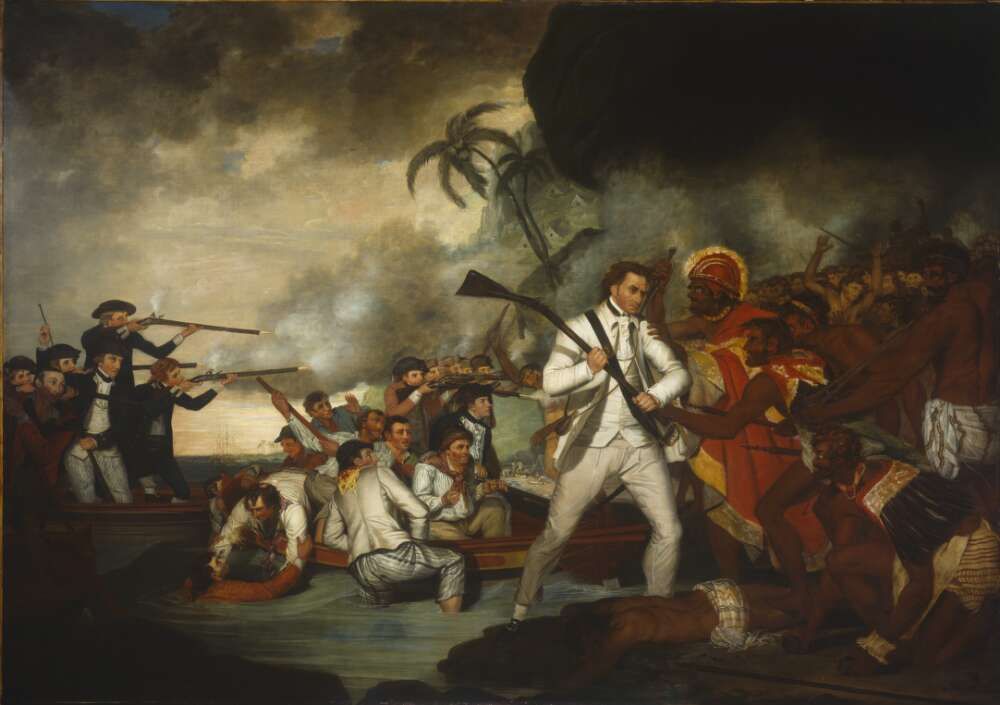
George Carter, ‘Death of Captain James Cook’, 1783, now at the Bernice P. Bishop Museum in Hawaii.

In The Apotheosis of Captain Cook, Obeyesekere challenges the notion presented as fact in all accounted histories and documentaries of Hawaii and of Cook’s voyages, of Cook being perceived and welcomed by the Hawaiian natives as the returning Hawaiian god Lono. Obeyesekere expresses doubt over the idea that Polynesian natives would deify a European foreigner, and endeavors to prove that this widely accepted idea was merely a construct of the European imagination, dubbing this phenomenon ‘European myth-making’. The representation of European explorers and discoverers in art and in writing as god-like figures is not a new occurrence; an example being the almost century old bronze statue of Columbus situated in Central Park’s Literary Walk in New York City, which is described to have a very godlike, almost deiform, feel to it. Historical accounts often seem to perpetuate the idea that native peoples saw the arrival of European foreigners as the return of their own mythic gods. Popular media seems to reinforce the same idea; in the 1992 film, 1492: Conquest of Paradise, we hear Columbus’s character say, “Because of our appearance, we have been mistaken for gods, and are treated accordingly.” A well-known example of European apotheosis, mentioned by Obeyesekere, is that of Hernán Cortés, who according to documenters, was mistaken by Mexican natives to be the Toltec demigod Quetzalcoatl. Whether these writings and depictions speak any truth about native perceptions of European foreigners, or whether these are simply European presumptions attributed to natives they know little to nothing about, is something Obeyesekere sets out to answer, but it leaves us with a question about the way Europeans, and the natives of the lands they conquer, are represented.

Referencing Todorov’s The Conquest of America, Obeyesekere describes how European explorers are often depicted in contrast to an ‘Other’; where this Other is the ‘savage’ or ‘uncivilized’ native population. Naturally, little effort is made by European explorers to understand the intricacies of the native cultures they encounter, and instead, they end up superimposing their own ethnocentric interpretations of native behaviors unto the native peoples; many of which could be largely incorrect assumptions. When writing about these expeditions, the primary source referred to by historians are the travel logs of the European explorers themselves, and hence, it is not uncommon for the uninformed and biased views held by these explorers to slip into the texts and contribute to popular misconception. When Todorov references quotes from Spanish texts describing the brutality towards the Aztecs, he is by default contributing to promoting the stereotypic Otherness of the Aztecs. There is yet another contrast between the way Europeans and natives are represented; that is, the complete lack of individuality attributed to native populations. Inhabitants of the conquered lands are often depicted not as individuals, but as ‘merely the constitutive element of that other totality’. In both Bernal Diaz’s writings, which Todorov used as a reference point for his own work, as well as Beaglehole’s accounts of Cook’s voyages, which is the main source Obeyesekere consistently refers to, the Aztecs and the Polynesians respectively are only ever referred to as a collective whole, with almost no mention of the individuals making up that whole. This depersonalization is in stark contrast to the way Europeans in these stories are always named and granted individuality, instead of being grouped by religion and caste.

There is the persistent view held by these European explorers, that they are the ‘white civilizers’ who are to rescue the ‘savage barbarians’ from their animal-like ways. The word ‘barbarian’ is so often used to describe natives in the firsthand accounts of these explorers, that it contributes to popular misconceptions held regarding native peoples, and adds to the European-created myth referred to as the ‘savage mind’. Even Cook’s choice of words in the mapping and relabeling of the islands’ localities reaffirm the natives’ savage culture.

Part of the reason why native cultures and perceptions are so susceptible to misrepresentation is that anthropologists are the ‘outsiders,’ and in trying to interpret native cultures and beliefs, discrepancies become difficult to eliminate. Even while exercising caution, there is always uncertainty as to whether the anthropologists’ conclusions about native peoples are in truth or misconceived. As Obeyesekere points out about the Hawaiian perception of Cook as the god Lono, even the nature of divinity, as thought of by native groups, differs from popular Western conceptions of divinity. The problem lies in the fact that these native ‘uncivilized’ groups cannot represent themselves; they need to be represented. Hence, there is bound to be some degree of misunderstanding.

Focusing his efforts on the documentation of Cook’s voyages and his onshore as well as offshore personality, as recorded by members of his crew, Obeyesekere reveals that much of the information about Cook’s conduct towards his crew members and towards the native people, particularly that of his third and final voyage, is left out of the history books. The severe lack of context and missing information contributes to misrepresentations of the native people and of the Europeans. For example, it is not mentioned that European ships circled the Hawaiian islands for seven weeks before landing, which could help to explain the way the natives reacted to the arrival of the Europeans. It is also not mentioned the irrational measures Cook resorted to, such as plundering and destruction, in response to thievery on the islands; nor is it mentioned the odd punishments Cook reserved for his crew members who refused to eat walrus flesh out of disgust. Cook’s increasingly violent and erratic behavior, as well as what his crew members, including Beaglehole, perceived as the weakening of his grasp on reality, is completely unheard of when one reads about these voyages from secondary source documentations. Instead he is seen as a great navigator and decent human being with ‘a real feeling for human rights and decencies’.

The Mythmaking of Australia Day

On every 26th of January cars, streets and buildings will be covered in national flags all over Australia. People will gather for barbecues, sports events and concerts to “celebrate” being Australian. Australia Day as the official national holiday of Australia is marking the day Captain Arthur Phillip arrived at Port Jackson in New South Wales in 1788 and raised the British flag at Sydney Cove. This was 18 years after Captain James Cook claimed to discover the eastern half of today’s Australia in the name of the British Crown. This historical day and these two historical figures are shaping a certain understanding of the history of Australia which is putting a European perspective into the centre of story telling of what Australia is and being an Australian means. This perspective does not just neglect the existence of aboriginal history and culture before the “discovery” and settlement of Australia by the British but is also trivializing the brutal actions against the indigenous population throughout the past centuries until today.

Gananath Obeyesekere is demonstrating in The Apotheosis of Captain Cook – European Mythmaking in the Pacific that the narrative around Cook as the “true open-minded scientist without preconceptions” and therefore a humanist image of Cook is rooted in the European imagination and construction of “the self” in contrast to “the other”. Cook has often been portrayed as the idealistic representative of enlightenment who’s actions were based on rational thought and science which is put in contrasting comparison to the construction of the “irrational native” or the “prelogical savage” who is acting on the grounds of spirituality and myths. By the definition of Obeyesekere that a myth is “a sacred story about gods and founding ancestors or stories about ancestral heroes” one can argue that the image of Cook as well as Phillip as “the ancestral heroes” of today’s Australia can also be seen as a paradigmatic myth which is the basis for the symbolic performance of Australia Day today. Beside questioning the constructed rational self of the European he also states that “preliterate societies can and do act rationally in terms of their own cultural values” but that the colonial and imperial act of deciding what is considered of value stays with the oppressor.

Invasion Day: the tide is turning | Green Left Weekly
Protesters at the Invasion Day rally in Melbourne 2018

The struggle of which voices are heard and which perspectives are seen as valuable is a struggle that is not set in the past but continues and can be seen in the debate around Australia Day every year. The right of having a history that is “celebrated” stays solely with European history or one could also say with the European myth. Therefore Australia Day does not just show European mythmaking but also a crisis of representation of what is seen as “the non-European”. For the aboriginal community this day symbolizes oppression, murder and suffering and is more often referred to as Invasion Day or Survival Day to put the indigenous perspective in the centre of recalling history. Even people who argue that Australia Day is not so much focusing on the historical event it is based on but is trying to embrace the cultural diversity of the present and is therefore a day that tries to connect rather than divide are neglecting and not recognizing the painful implications that it has for the indigenous population. While trying to be well intentioned this interpretation of Australia Day is pretending that the past is isolated from the present while the aboriginal community is continuously confronted with lack of representation and recognition.

Voices of resistance have always been there but are just given more space for expression and attention within the past few years which is shown by the annually growing Invasion Day rally all over Australia. While some protesters and activists are calling for changing the date of the national holiday to a date which is inclusive and sensitive towards indigenous history, culture and experience others are questioning the concept of a national holiday as a whole.

Beside these different views everybody who is taking part in the protests from aboriginal as well as non-aboriginal communities are demanding that the 26th of January should in the future not be a day of celebration but of remembrance of loss and suffering and a reminder that the brutal past has not been acknowledged and the equal representation of indigenous perspectives has not been reached yet.


Cape of ‘Renewed’ Hope

The casting of the first lasso

Reflex. When one hears “South Africa”, mental images of lush green hills, vineyards and, most significantly, the voyage of Bartolomeu Dias passes through one’s mind. It is not the indigenous people of South Africa, or the fact that its inhabitation dates back many millennials. It is not the horrors of the Apartheid regime or the struggle of Nelson Mandela and his people. No. It is the scenery and the ‘magical’ story of its discovery without the implications that one thinks of. The state’s monopoly over historical narratives is one major reason for the glossing over of the true story of South Africa that transcends its significance in the pages of history as a British colony. This legacy from the colonial era is steeped deep into education and the arts in all forms. To Chumani Maxwele, South Africa had still a long way to go in terms of complete emancipation. To him, the statue of Cecil Rhodes in the University of Cape Town represented not just bigotry but a tragic and unjust history of the people of South Africa. The desecration was more than just a protest, it was a sign that South Africa was overdue from behind the Union Jack curtain.

            The statue right in the middle of an educational institution in South Africa meant more than it would have any other place. The epistemic takeover of the British in South Africa from their days as colonial masters crept into the present as well. If it had not been for the “born free” generation, these seemingly insignificant signs would have gone on unnoticed. The hush hush conducted by the preceding generation with regards to the horrors of the Apartheid rule meant well but implied a continued existence for the South African people under intellectual, if not physical, slavery which would amount to the same thing in the long run. So, when the born free’s broke free of one shackle, it was only natural for them to not only turn on the ‘immortalized’ Cecil Rhodes representing all white masters, but on their parents as well for the delay in this realization. The election of Nelson Mandela in 1994 after the countrywide enfranchisement of indigenous South Africans was merely the beginning and perhaps a means to an end which one would envision after lying crushed beneath the colonial jackboot for centuries.


Khoisan (indigenous to South Africa) men making fire

They have inhabited the region for more than a hundred thousand years

            The subsequent movement that took off after Maxwele’s desecration of the Cecil Rhodes statue at his college in Cape Town was prudent, to say the least. The presence of foreign domination influencing every act of his people, shaping their future and shaping their past had to stop in order to pave the way for the true representation of South Africans, in every sphere of life, for the entire world to see. It was meant to change aforementioned reflex musings regarding South Africa. To show the native South Africans, this time without the white influences in their lives, culture, historical narratives and intellectual forums.

Representation: Wale Soyinka’s “Death and the King’s Horseman”

Certain features of colonial governance seem to be common across the board whether it is French, Belgian, Spanish or in Nigeria’s case, British. These features include ignorance of local culture and norms, divide and rule and economic extraction. This piece however will focus mainly on the aspect of representation in colonial Nigeria through the lens of Wale Soyinka’s “Death and the King’s Horseman”.

Representation may be understood in both legal and informal/social terms. Wale Soyinka’s play contains both these elements even though they may not seem explicitly obvious. As soon as the play opens, we are introduced to Elesin, the deceased king’s chief horseman, entering a marketplace where he has a public dialogue with Iyajola. Wale Soyinka labels Iyaloja as the “Mother of the market” and this is evident as she is the only one confronting Elesin among the flock of people gathered around to chant and praise the horseman as he prepares for a ritualistic suicide to join the king in the afterlife. Now the first instance of public representation stems from Iyaloja’s character herself as she is the only one who seems to be communicating with Elesin on behalf of the people gathered at large. These people strongly believe in their rituals and Iyaloja seems to represent those very traditions at well. She constantly reminds Elesin of his duty while praising him at the same time. When Elesin asks for a young woman who was already married to Iyaloja’s son, she sends her forth without even asking the woman if she wanted to do so. Hence, representational tyranny seems to exist even among the woman in the text. But question is whether it is safe to consider it a “tyranny” when the people generally conform to the belief system as they fear the catastrophic results of failing to do so. So maybe the culture justifies the “tyranny” itself.

Furthermore, there is extreme lack of representation in Simon Pilkings residence as well. Throughout the play his only source of information regarding the civilians seems to be Sergeant Amusa. Amusa is a policeman who despite his conversion to Christianity still sticks to certain former beliefs, for instance, attaching misfortune to the clothes of the deceased. Also, even though what Simon Pilkings orders goes against his traditions, he still obeys obediently. Therefore, Simon Pilkings is extremely detached from the people he rules over and fails to comprehend the role rituals played among the society he administered. As we move further up the hierarchy, local representation seems to vanish all together. For example, when the Prince visits Simon’s district he attends a ball which seems to be highly exclusive as only the administrative government including Simon are invited. So taking that into consideration, representational tyranny is evident at both the center and above as the Prince’s only source of information are the ignorant officers themselves.

In conclusion, lack of representation in colonial governments and failure to take local contexts into consideration is a theme one can take away from Wale Soyinka’s play even though it revolves more around the latter.

IQBAL 20020096