
The most striking part of Dada’s memoirs for me was when he was bidding farewell to the Soviet Union on the eve of his return to India. When Dada compares his last night in the USA with his last night in the Soviet Union, he remarks that “this parting was in a different context entirely.” Dada goes on to explain that despite some material comforts of life in the US, he had never felt like a part of that society because of how he was treated as a second-class citizen and constantly taunted because he was a “foreigner”. In the Soviet Union on the contrary, he had never felt like an outsider or inferior in any way.
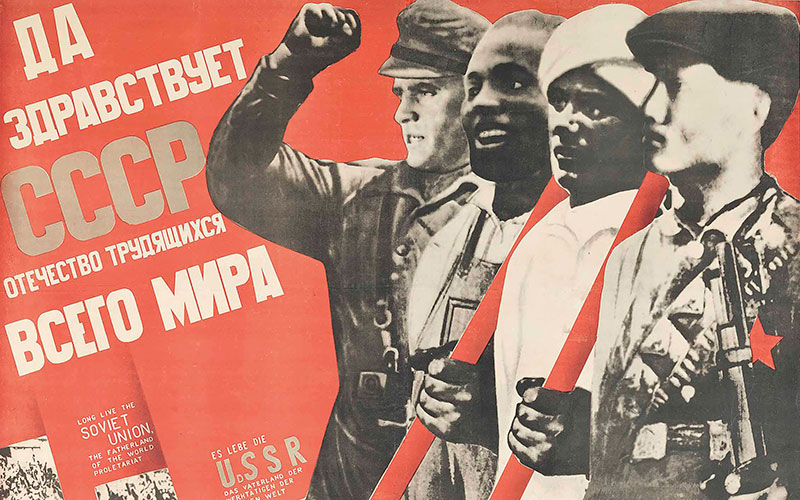
No one had ever told him to “go back” or judged him on account of his race or class. The recognition of his humanity in the Soviet Union made him fall in love with that world and urged him to create a mirror image of that world in his own “politically slave nation”. When he begins reflecting as to how his brief stay in the Soviet Union completely transformed him as a person, he realizes that he has become “socially aware” which is accompanied by the understanding of his role in creating the classless society that the Soviet Union promised. A world that includes all, and where no one is made to feel small, unwanted or burdensome. I think these two posters do speak to the sentiments that Dada was trying to convey.
The first poster essentially feels like a global comradely struggle for a world that is no longer confined within the realm of imagination and the most important part, which was inconceivable at the time is how there are no racial barriers in this struggle. There was no superiority or inferiority for they were all comrades and I suppose that’s just the beauty of comradeship and the struggle is not a solitary one and maybe that’s why Dada felt so at home in the Soviet Union.
The struggle for a classless society, for a world where there are no hierarchies was more than anything a struggle for reclaiming one’s humanity and therefore the revolution could never be contained or reduced to certain geographical localities because it spoke to the human spirit. Dada also mentions in his memoirs that in the US “individual motive had dominated every aspect of American social life” which again was in direct contrast with the Soviet Union where you were identified with the collective and in Dada’s case his Indo-American group. The revolution again was all about uniting people across the world and making people not only fight for themselves, but for each other.
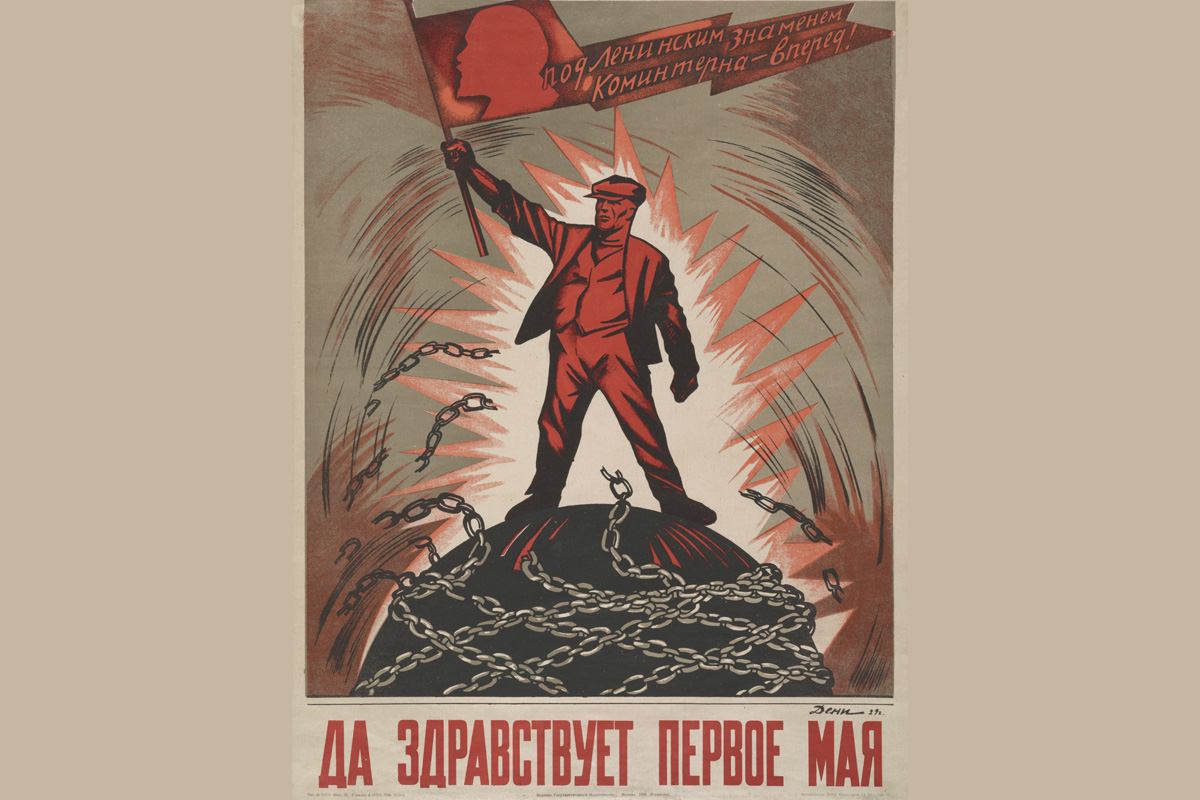
This was a completely different ethical outlook of inhabiting the world which was based on love for each other and perhaps that is why Dada felt the responsibility of carrying the revolution to his birth country which had certainly not given him anything except his birthright. He chose to carry that burden and sacrifice his life in pursuit of a better world, a world he could call his own. I chose the second poster because it reminds me of Dada himself and all he stood for. By freeing himself from the chains of oppression, he reclaimed ownership to his world as well; he was no longer an object to be acted upon by historical forces but a very conscious subject and as cliched as it sounds a maker of his own fate. He was truly, incredibly remarkable.
Dada Amir Haider Khan ko lal salam


