
“In their early childhoods they were taken by public minded or conscientious people from adverse circumstances and placed in different children’s home which the Party and Soviet authorities had set up throughout the USSR for such children who had no parents or guardians”
In Dada Amir Haider’s narrative, the world he portrays is rose tinted. As he fondly recalls his time in Moscow, many characters populate his account, not least of all Noora, the young girl who “was actually not an abandoned child”. Noora is one of many children who left the restrictions of their home for a world which promised above all else to be nothing like the past they had known. The “conservatism” of Noora’s mother causes conflict not only in the microcosm of the relationship between parent and child but in the macrocosmic struggle between the shackles of the past and the free future envisioned through communist doctrine.

Anyone who is even slightly informed about the world they live in would easily recognize the first poster. But in case you don’t (or in case you think I don’t) its title, which roughly translates to “Children, What Do You Know Of The Fuhrer?” says it all. Now, I am not entirely sure about the history of the piece, but for my argument I am going to read it as a challenge to the image shown. As he holds up the little girl, Hitler is the picture of benevolence. Yet, he is framed by a question that haunts— “What do you children know of the truth that lies behind the smiling figure in front of you? Do you, or will you ever, know of the destruction he leaves in his wake?”
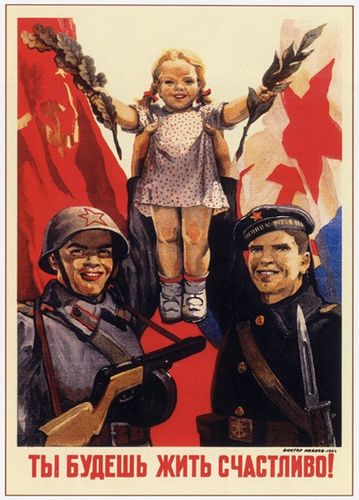
The second poster couldn’t be more different from the first in terms of the place from where it originated. And while the former attempted to promote fascist agenda, the latter has as its central premise, the aim of propagating communism. Yet, in terms of aesthetic, the two are frighteningly similar. Both have flags, happy people, and most importantly, a child being supported in the air by the ideology of the land they live in. So why is Noora’s story important in context to these two posters?
What does it mean to let go of the past? On a national level it is clear that this is no easy task. Yet, what Dada Amir Haider fails to mention, except for in his innocent account of Noora, is the impediment caused in this transition between past and present, by the very fact of it not merely taking place on the level of the macrocosm. When Noora goes home, her mother says, “please leave me alone”. Noora is hence, abandoned by her mother till she lands in the hands of the state, and in the arms of the men lifting the little girl up in the poster.
Letting go of the past comes at a price. But Noora’s story has more concerning undertones than merely this to it. She, and other children like her, are to all extents and purposes prey to the whims of the State. And even more frightening, is the fact that like the little girl in the poster, these children become pawns in a chess game of politics. They smile, and to men like Dada Amir they seem happy. After all, like he says, they have been “taken in” by those who are “public minded”. It is important to work for the mutual benefit of society at large, but this too comes at a cost when the needs of the individual merge into those of the collective till the two are indistinguishable from each other.
The little girl in the second poster probably knows next to nothing about communism. As she hangs suspended in the air, perhaps she smiles because she thinks she’s flying. Or maybe she smiles because she has been told to do so. There is a cost to involving children in grownup matters of politics— their childhood. It may be argued that the way things were before didn’t really ensure that childhood was a privilege available to all children. Yet the chains that bound them down in the past, haven’t really been lost. They have merely taken on a new shape— that of two men holding a smiling girl up in the air.

 Decoloniality and Decolonization