Half and Half

Over the span of this course one of the things we have repeatedly come face to face with are boundaries. Boundaries of admission, of colour, of gender. Boundaries that seek to separate the self from the body, the ghetto from the white man’s world. And woven into the stories of these walls, both literal and metaphorical, are the stories of the people who tried to find ways around them, through them and sometimes even over them. Malcolm Little broke through the wall separating him from the life he knew he deserved by becoming Malcolm X. Martin Luther King dealt with his boundary through a policy of non-violence. Fanon found that his freedom “was…given to… [him]… in order to build the world of the You”. For Toni Morrison language was the answer. For these figures the act of breaking through the boundaries confining them is a way of reckoning with the scars and wounds that history has inflicted upon them. They are looking for home.

 For Gloria Anzaldua, her home is the borderland, an open sore created at the point where “the Third World grates against the first and bleeds”. And what I find most remarkable about her is the way that she finds home in discomfort so that the power of the word is nullified. In a way, like Morrison, her way of being directly conflates with language. After all, what is discomfort when you’re used to it? How can a “thin edge of barbwire” hurt you when it is your “home”? It is important to realise that Anzaldua is not propagating a life where pain is second nature to you, nor is she promoting passive acceptance of your fate. Home means more than that. It is more than that.

There are borderlands within the borderland. The sexual politics of the world Anzaldua inhabits threaten to estrange her from her home. Living in the borderlands is not easy. It “means you fight hard to resist the gold elixer beckoning from the bottle, the pull of the gun barrel, the rope crushing the hollow of your throat.” It means living in conflict with your self because you realise that it doesn’t exist as a singular entity— you are a composite of all the worlds that collide to create the borderland you live on. And when that collision creates a wound— as all collisions inevitably will— living in the borderlands means growing up in the midst of broken things, half things. It means living in the realization that it is not always the third world or the first world that chafes against the scar tissue that is your home, causing it to burst open— it is your self.

A border signifies the beginning of one thing and the end of another. And as Fanon says, “no attempt must be made to encase man, for it is his destiny to be set free”. But for Anzaldua the borderland can be liberating because it allows for a transformation of self— it allows her to become a crossroads. And this is what makes her work truly remarkable.

Violence and Non-Violence

“We will not blame you if your reach exceeds your grasp”— Toni Morrison

The debate on violence and non-violence is essentially a question on what it means to live an ethical life. To Martin Luther King, non-violence is a philosophy of being. It calls for faith in the “amazing potentialities for goodness” in all humans, where the means must justify the ends— indeed, they are the ends. In his speech on “Unfulfilled Dreams”, King preaches a philosophy whereby action and doing can exist merely within the realm of the internal self. If the act of fixing your heart is all you can find it in you to do, it’s enough. Non-violence is a “technique of action” involving intention.

But can the “boat of faith” get you through the storm on its own? After all, what does it really mean to do the right thing in the face of great wrong? First, we need to identify the wrong. For Malcolm X, the African-American problem, or as he would call it the “Negro problem”, is about a continuous investment that has been poured into the American landscape. It is an investment of blood. And if we are to take King’s conception of the means justifying the ends, then it is clear that this investment can only be made good in one way. Earlier in this course we talked about how if decolonization is a story of triumph, it is also a story of cracked skulls, broken bones and disappearances. Malcolm and King are both telling true stories— different, but true.

The stories of violence and non-violence do not need to exist in a binary; Malcolm X does not advocate needless violence in his speech, nor does King proposition passivity. But we must question what violence really is. If it is the intention to do harm, what happens when the underlying intention of a violent act is to reclaim what has been stolen from you? As Malcolm says, “how can you thank a man for giving you back what’s already yours?” An investment of blood has to be repaid in the same. And a belief in the “amazing potentialites of goodness” necessitates a recognition of the potentialities of evil. To me, the difference between non-violence and violence is not in the means through which the end is achieved, but in the site of action.

For Malcolm, there are physical, and therefore external, threats that must be recognized. It is a question of the ballot or the bullet, and this physical response of hitting back is an affirmation of his humanness, an inalienable quality. The struggle between good and evil is happening in front of his very eyes and he cannot turn the other cheek. To King, non-violence is a way of being. It transcends the colour line and manifests itself in the “story of life”. It’s a struggle, but one that happens within the self. He is not advocating a philosophy of turning the other cheek. Evil is real, but its also closer to home than you might think.

In Toni Morrison’s story of the blind woman, the children ask a very relevant question— “Is there no context for our lives?” Both Malcolm and King gave their lives to the struggle to build this context. And while Malcolm’s fiery speeches and luminescent persona reek of courage, there’s a lot to be said for the person, who, standing in the wake of unspeakable wrongs remains steadfast in one simple belief— the belief that, at the end of the day, goodness, and only goodness, will prevail. The philosophies of violence and non-violence discussed above do not exist in a parallel state to each other. They stretch through the constraints of the temporal into a time when Malcolm and King can turn to each other and say:

“Look. How lovely it is, this thing we have done – together.”

An Appreciation of Malcolm X

 “Instead of airing our differences in public, we have to realize we’re all the same family.”

I loved reading Malcolm X’s autobiography. His words carry an insistency. Its almost as if he needs to be believed, and upon reading Alex Haley’s foreword it is clear that this is the case. It is Haley who finds himself in the position of coercing details regarding the events of Malcolm’s life out of him. They do not flow on their own. This is the Malcolm I was first exposed to. I understood him, I admired him, but I didn’t realize quite how magnetic his personality was.

Then I heard him speak. I felt an urgency throbbing like an undercurrent beneath his words. It didn’t seem like an impromptu speech, but it is precisely this quality of being an “off-the-cuff chat” that makes what Malcolm has to say so appealing. He speaks to the people not at them, and this can be heard through the laughter and shouts of approval when he says something that has an especial resonance. When he talks about the field negro and the house negro he does not separate himself from his argument. In fact, his words form an embrace into which his listeners are gathered. He is the “same man” as those in front of him are— he is under no pretense as to who he really is. He is “man enough to tell” it as he thinks it is and this attitude is carried forward into his narration of his own life.

Yet, Malcolm X is also more than just a man. He is an idea. While reading his speeches I couldn’t help but remember one of my favorite stories growing up, The Velveteen Rabbit. I won’t go into the particulars of the plot, but one particular sentence kept replaying in my head as I listened to Malcolm X speak:

“Once you are Real you can’t become unreal again. It lasts for always.”

Whether he imagined himself into being or not, Malcolm X was real. And that is a quality that makes him “last for always”.

The Glass Between Us

My grandfather married my grandmother in England. Both were far away from their homes and families. Their wedding was a small affair— my grandmother’s sister was the only representative from both their families combined. They were both warned about the folly of marrying a person who was ultimately the other. But for the most part they proved their naysayers wrong. My final project is about all the times they couldn’t.

Interracial love is born from a contradiction. Both possible and impossible, it exists as an antithesis to itself. And what better way is there to address contradiction than through fiction? My project will take the form of a short story through which I will aim to address the interplay between history and the individual.

The story will attempt to construct a decolonial aesthetic through the lens of a marriage between two people of different races. Fiction gives me the space to not only tell the story of my own history but to take liberties with it that I wouldn’t be able to do in a non-fictional piece. I am greatly inspired by James Baldwin’s If Beale Street Could Talk while working on this project. In particular, it is this sentence upon which the crux of my story rests: “I hope that nobody has ever had to look at anybody they love through glass”. My grandparents spent much of their life together doing just this. If nothing else, my project is an attempt to pay homage to their struggle.

Negritude and Universalism

“The call is not the simple reproduction of the cry of the Other; it is a call of complementarity”

Upon first reading Senghor’s “Negritude” back in freshman year, I must admit I thought he was presenting a theory that had no room for diversity. I found this text very reactionary, an extreme response to an extreme state of world affairs. I couldn’t fault him with this response, but I most certainly wasn’t able to see a future in which this theory of negritude could be implemented for the common good of all. Upon reading this text again my opinion of it has softened, although I would be lying if I said that I wholeheartedly agree with Senghor’s vision of things. Perhaps I am still under the influence of Fanon’s parting words in Black Skins, White Masks to give Senghor and negritude a fighting chance.

But the two texts may not be as different as they may at first seem. Which is just another way of saying that there may be room for universalism in Senghor after all.

Negritude is about potential. It is a way of paying homage to the simple yet complex act of being. And so, while it is a literal celebration of blackness, negritude is also an idea. And it is this idea which houses the universal. To Senghor, it is evident, that understanding the meaning of negritude cannot be separated from understanding the meaning of meanings in general. So, while negritude is the very specific celebration of “African personality”, it is also “a network of life forces… a network of elements that are contradictory in appearance but really complementary”.

Negritude as a way of being paints its image of man as a “composition of mobile life forces”. It contains movement. How can binaries exist in a philosophy which believes in the flowing nature of the world? At times it seems like Senghor is overtly praising black culture as inherently superior. But it must also be remembered that, negritude is first and foremost a way of seeing the world— a way which, to quote Fanon, allows the individual to “touch the other, to feel the other” and perhaps, most importantly “to explain the other to” their self.

To ask if Senghor’s version of negritude has space for universalism, is another way of asking if the particular can contain the universal. Cesaire answers this more succinctly than I ever could:

“There are two ways to lose oneself: walled segregation in the particular or dilution in the ‘universal.’ My conception of the universal is that of a universal enriched by all that is particular, a universal enriched by every particular: the deepening and coexistence of all particulars.”

Re-Africanisation and the Problem of Identity

Re-Africanisation is a term that promises a lot. It promises a return to a stolen culture, to the very state of being African. To Cabral culture operates on an “ideological or idealist plane”— a plane on which resistance is made possible through the affirmation of a “physical and historical reality” existing alongside that which the present suggests.  Cabral is clearly on to something here.

 But what are the implications of Re-Africanisation? What are the assumptions upon which this reclamation of history is based? And to what extent is this possible?

Culture is “the product of history” and simultaneously its creator. Re-Africanisation is not simply a promise to return to a mythic anti-colonial past, but also an affirmation that this past did indeed exist— that it was real. And if we think about this further, it’s clear that this is really just another way of Cabral saying that he exists— that he too is real. To me, Cabral’s speech is not important merely in terms of content. His words resonate into the present. They are laced with hope, and this is not always easy to come by. “History allows us to know the nature and extent of the imbalance and conflicts (economic, political and social) which characterize the evolution of a society”. But it also allows us to do something else. Through narratives of culture, history “allows us to know the dynamic syntheses which have been developed and established by social conscience to resolve these conflicts at each stage of its evolution, in the search for survival and progress”.

Re-Africanisation is a struggle for just that— survival. It infers that progress can occur at multiple levels, and that is not unidimensional as western culture seems to suggest. But it must be realized that this idea of a unified culture comes at a cost. How do you create just one definition for what it means to be African? The problem here is one of identity. If identity is going to be defined through the quality of being resistant to domination, then what will it mean to be African in a time when there is no need to resist? The term Re-Africanisation is based on an assumption— the prefix “re” suggests a return to the past, which Cabral insists can only happen through an enforcement of popular culture. Yet in a land which is so diverse, to whose past will he be returning. Can multiple cultures really be collapsed into one that easily? Will they not also resist?

Cabral puts the need for national liberation via cultural resistance very succinctly when he says the following: “it may be seen that if imperialist domination has the vital need to practice cultural oppression, national liberation is necessarily an act of culture”. This is true insofar as it suggests culture as a weapon against imperialism. But who will decide which culture in Africa is the one which justly represents all its people— which culture takes on the shape of a weapon best?

According to Cabral, while “it is true that the multiplicity of social and ethnic groups complicates the effort to determine the role of culture in the liberation movement… it is vital not to lose sight of the decisive importance of the liberation struggle”. Yet of what use is this struggle if it robs the very people it exists for, of their individual cultural identities?

Re-Africanisation promises the answer to a fundamental question— Who am I? Yet, Re-Africanisation also threatens to merge the possibilities of that answer into each other until the question itself changes from ‘Who am I?’ to ‘Who are we?’.

Who Wears the Chains?

“In their early childhoods they were taken by public minded or conscientious people from adverse circumstances and placed in different children’s home which the Party and Soviet authorities had set up throughout the USSR for such children who had no parents or guardians” 

In Dada Amir Haider’s narrative, the world he portrays is rose tinted. As he fondly recalls his time in Moscow, many characters populate his account, not least of all Noora, the young girl who “was actually not an abandoned child”. Noora is one of many children who left the restrictions of their home for a world which promised above all else to be nothing like the past they had known. The “conservatism” of Noora’s mother causes conflict not only in the microcosm of the relationship between parent and child but in the macrocosmic struggle between the shackles of the past and the free future envisioned through communist doctrine. 

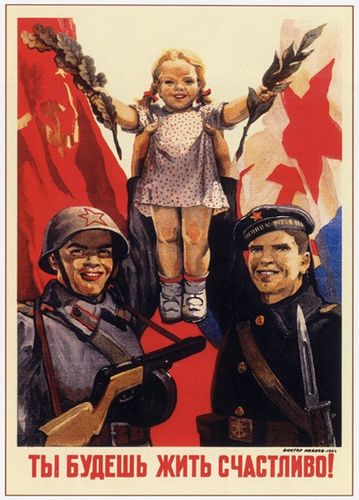
Anyone who is even slightly informed about the world they live in would easily recognize the first poster. But in case you don’t (or in case you think I don’t) its title, which roughly translates to “Children, What Do You Know Of The Fuhrer?” says it all. Now, I am not entirely sure about the history of the piece, but for my argument I am going to read it as a challenge to the image shown. As he holds up the little girl, Hitler is the picture of benevolence. Yet, he is framed by a question that haunts— “What do you children know of the truth that lies behind the smiling figure in front of you? Do you, or will you ever, know of the destruction he leaves in his wake?” 

The second poster couldn’t be more different from the first in terms of the place from where it originated. And while the former attempted to promote fascist agenda, the latter has as its central premise, the aim of propagating communism. Yet, in terms of aesthetic, the two are frighteningly similar. Both have flags, happy people, and most importantly, a child being supported in the air by the ideology of the land they live in. So why is Noora’s story important in context to these two posters?  

What does it mean to let go of the past? On a national level it is clear that this is no easy task. Yet, what Dada Amir Haider fails to mention, except for in his innocent account of Noora, is the impediment caused in this transition between past and present, by the very fact of it not merely taking place on the level of the macrocosm. When Noora goes home, her mother says, “please leave me alone”. Noora is hence, abandoned by her mother till she lands in the hands of the state, and in the arms of the men lifting the little girl up in the poster.  

Letting go of the past comes at a price. But Noora’s story has more concerning undertones than merely this to it. She, and other children like her, are to all extents and purposes prey to the whims of the State. And even more frightening, is the fact that like the little girl in the poster, these children become pawns in a chess game of politics. They smile, and to men like Dada Amir they seem happy. After all, like he says, they have been “taken in” by those who are “public minded”. It is important to work for the mutual benefit of society at large, but this too comes at a cost when the needs of the individual merge into those of the collective till the two are indistinguishable from each other.  

The little girl in the second poster probably knows next to nothing about communism. As she hangs suspended in the air, perhaps she smiles because she thinks she’s flying. Or maybe she smiles because she has been told to do so. There is a cost to involving children in grownup matters of politics— their childhood. It may be argued that the way things were before didn’t really ensure that childhood was a privilege available to all children. Yet the chains that bound them down in the past, haven’t really been lost. They have merely taken on a new shape— that of two men holding a smiling girl up in the air.  

A World Within a World

“There is only one home to the life of a river-mussel; there is only one home to the life of a tortoise; there is only one shell to the soul of man; there is only one world to the spirit of our race.”  

Only one. As I read Death and the Kings Horseman, I can’t help but focus on these words. The Praise Singer’s speech has a stilted, almost other-worldly quality— a world which Soyinka purposely shrouds in a certain mystery. It is a world to which the reader (or audience, if you are lucky enough to be watching this on stage) cannot gain access, however much they may want to. It is a private world, made public only through necessity. And it is the Praise Singer who presents us with the wisdoms of this world. 

Why do we tell stories the way we do? Whether consciously or not, as story tellers we continuously make choices to represent things the way we see them, or rather, the way we believe them to be. Representation is a loaded word. And Soyinka himself, in his decision to portray his characters the way he does, commits a certain violence against them. Although each character has been written with care and detail, none of them can claim for themselves the status of being complete— they are representations of Soyinka’s view of the world, and in turn they too, bring their own stories of representation to the table.  

The Praise Singer is the thread connecting the dead king to Elesin. Through him the community is prevented from going astray. The human equivalent of an alarm clock, the Praise Singer’s words hearken back to pre-colonial times when matters of life and death were in the control of Elesin and his contemporaries. He is the voice of history— of what Soyinka portrays as a timeless past which cannot wholly be erased. The words of the Praise Singer are heavy— they bear the weight of representation of a world. I have used the word ‘a’ deliberately here, for this is not the world you and I know. It is one of seeming contradictions, where death is the pathway to life, and the “soul of man” is a fact and not a philosophic debate. 

But what makes this world important enough for me to neglect all other aspects of the play and focus merely on this one line? After all, the Praise Singer is not the character driving the plot forward. He is a mere spotlight through whose light Elesin is made visible. The answer to the question above does not lie in the nature of the world itself, but in the words “only one”. The Praise Singer speaks of a world saturated with “the spirit of our race”. It exists in singularity and is not just specific to his people but has remained despite the “white slavers” attempts to wrench it of its “heart”, “mind”, and “muscle”. The world that the Praise Singer represents is alive— death is merely a method of affirming the vitality of this life. This representation of the world does not only conflict with that of the colonizers but in a way confirms it as well. There is a clear agreement that there exists “only one world”. The struggle arises over what that world should look like.  

However, if we analyze the words of the Praise Singer a little further, it soon becomes clear that perhaps he is arguing something else entirely. To him, the struggle may not be one of claiming the world through ousting the other. It almost seems as if his words hold the potential of the presence of multiple worlds coexisting side by side. If one is to focus on the spatial layout of the play this theory holds. Pilkings house is near enough to the market place for him to hear the beating of the drums, yet to the space he occupies may as well be another world for all its similarity to the one outside. What makes Pilkings’ world different from the Praise Singer’s is the fact that he does acknowledge the presence of the latter in it. This presence exists in his shadow, and Pilkings’ purpose in this world is to fashion men like the Praise Singer in his own image— a white image. The Praise Singer’s world on the other hand does not preclude the existence of the other. His words are simple— there is “only one” world in which the “soul of man” can be free, in which the “spirit” of his people can be. And this world, if nothing else, is safe from Pilkings through his sheer inability to understand it.