home, let me come home

Blood on the leaves

And blood at the roots

Black bodies swinging in the southern breeze

Strange fruit hanging from the poplar trees

This is the voice of those who were silenced, murdered, maimed, and those who were supposed to be forgotten. It is the voice of those who were never meant to be survive. The only history that they inherited was a history of violence, of murder, of abduction yet those who suffer are the only ones who can comprehend the sheer force of the gross injustice of power. They are the only ones who can show us that this is not the way things are supposed to be. They carry a burden which shouldn’t be theirs to carry; the burden of explanation should not fall on them.

The black radical tradition is the vantage point of those who suffer and those who refuse to accept the “thingification” the world imposes on them; those who refuse to be reduced to the “nigger”, those who refused to be reduced to degraded sex objects. They demand only to be recognized as human. Their’s is a history of unfathomable horror but theirs is also the history which is radical; which promises change; which envisions a new world; which rejects a Manichean, despot duality and in that sense, they are the bearers of the future.

Those who have not been given a place in the world are the ones who speak truth to power. “Death may be the meaning of life, but we do language. That maybe the measure of our lives.” Morrison challenges the belief that language may be neutral; language within itself conceals the power which forms it and that is why it must be constantly exposed and those who were robbed of their language must constantly reaffirm their narrative through taking ownership of the language at their disposal and calling it out for the kind of violence that it embodies.

The tradition, when seen through this lens makes us understand how the oppressed comes home to him or herself. Someone who is always told that they don’t deserve a space on earth for they have no history of civilization is overjoyed by all that their glorious past has to offer and that is the story of negritude. It gives them a chance to see themselves from new eyes, however, they must not remain trapped in the luring of the past for that fixation makes them blind to the reality of the present. They must not insist on their identity as natural for they will again be viewing themselves from the gaze of the oppressor.

 One can never be free if one keeps reacting to the oppressor. What sets them free, then is knowing that they may not be able to see or conceive a world that completely recognizes them and does away with all oppression but they can certainly strive towards it by speaking truth to power, for the bird, which carries the burden of the past, the toxins of the present and the hope of the future, is truly in their hands. Freedom, then, requires an acknowledgement that we can never fully comprehend the forces that shape our lives, but we refuse to accept the absoluteness of these forces for they always weren’t such and they always won’t be such. In the words of Gloria Andaluza, “so don’t give me your tenets and your laws. Don’t give me your lukewarm gods.”

The tradition, essentially, places a responsibility on all of us to bear witness to and to reject all forces of oppression, discrimination and marginalization that the lukewarm gods of those who benefit from this systematic dehumanization legitimize. The struggle, then becomes a very personal one and the moral burden is very real for those who were never meant to survive haunt us and question us: have we done our part?  

Questions on non-violence

“Non-violence is the relentless pursuit of truthful ends through moral means.” The means must be as pure as the ends because the argument is that if the means are corrupted so are the ends. Fanon asked all the colonized people of the world to envision a new world which is unlike the European model for if Europe is to be taken as the model, the world that will be created will be in Europe’s image. The image of death, destruction and disease; all for the sake of profit. Oppressive means will never produce a just end. I don’t know much about the philosophy of non-violence or MLK’s and Gandhi’s politics for that matter, but it is, perhaps, possible to place both of them within the framework that Fanon was talking out.

The oppressor can never be defeated with the oppressor’s own tools and the only way we have understood colonization and the African American experience is through the language of violence. The oppressor is created in the process of colonial violence and we have understood oppression, in itself, to be anti-human. In that sense, non-violence, is a strategy of the oppressed to expose the anti-humanness of such a system to the oppressed and the oppressor. Within the philosophy of non-violence, of what little I understand, there is also the argument that the oppressed redeems himself and his humanity by differentiating between himself and the oppressor and gaining a sense of moral superiority and that is perhaps all the oppressed can afford to have too. There is also the idea of how the oppressed can be free from fear because through non-violence they know that they have nothing to fear for it is only pain.

My problem with the idea of non-violence and the claim that the oppressed can redeem himself through this moral superiority from the oppressor is that it, perhaps, downplays on the antagonism that the oppressed feels towards the oppressor. Fanon argues that whenever the colonist calls the colonized “savage”, “inhuman”, he roars with laughter for he knows that is untrue. Despite the colonist’s efforts to destroy and reduce the colonized to the status of a thing, the colonized knows he’s human for he despises the colonizer, he despises his oppression for he knows “this ain’t it.” Fanon’s argument is that when this idea comes to the collective consciousness, the colonized know they can break their shackles. The oppressed know that they are human, precisely because they loathe their oppression.

Pain and violence are all they have known since infancy. The moral framework, the objective framework is defined by their negation, then what are “moral means” for the oppressed? If one’s entire life is a trajectory of violence, and “morality”, itself legitimizes that violence, then perhaps the only answer is smashing that very morality through the violence it legitimizes. But then again, perhaps, another way of smashing that morality is through creating one’s own morality but that “morality” itself is a reaction to the framework already in place for the existence of the oppressed is a product of the violence of the oppressor, so in other words there is no way to free yourself of the oppressor for your existence itself reeks of the violence of the oppressor. And that is where Fanon comes in and says that the whole house must be burned down if there is to be any redemption.

Another question that bothers me when it comes to non-violence is the gender question. Society operates by legitimizing violence against the bodies of women. If women are to resist by this strategy of non-violence, do they continue to let themselves be exposed and abused by the unique forms of violence that they are subject to for the “means” must be as pure as the end? That does not resonate with me, at least, at all. I understand that for MLK and Gandhi, against the oppressive, racist nation state and colonial regime, there was no other way of confrontation possible, and non-violence was a political necessity for it was impossible to carve Malcolm’s black nation in the US but non-violence as a philosophy and ethical movement, from my limited knowledge at least, I am not convinced with.

Live sin fronteras

As soon as a child is born, the world decided whether the child will be male or female. Andaluza argues that from the very beginning a despot duality is imposed on us which divides us in realms of either/or. This duality is oppressive because it is totalizing and leaves no room for any other conception of the self. Andulaza is Mexican, she is a Chicano; she is black and Indian; she is a woman; she is queer.  She has lived on the borderlands her entire life, juggling all her identities all her life.

 She speaks Tex-Mex; that’s her favorite language of the eight languages she speaks. She can instantly switch from Spanish to English in one sentence, in one word. She loves listening to Mexican music, her music, even if they make her feel ashamed for doing so. She can see the Serpent mother, even when they tell her she doesn’t exist. She is Mexican for being Mexican is a state of soul and she is American too for there’s an Anglo within her too. This plurality is what she has inherited, and she can’t possibly be asked to shred one part of an identity for another for within that plurality is home. Home, the smell of “woodsmoke, perfuming my Grandmother’s clothes, her skin. The stench of cow manure and yellow patches in the ground, the crack of a .22 rifle and the reek of cordite. Homemade cheese sizzling in a pan, melting inside a tortilla.” Home is perpetually tied to all her identities, how can she run from one and turn to another when all are home for her.  

She is a woman, she is queer. She believes in the shadow beast within her, the one that refuses to be quiet, the one that refuses “orders from outside authorities. It is a part of me that hates restraints of any kind, even those self-imposed.” She refuses to accept the heteronormativity and misogyny that her culture imposes on her. She refuses to mold herself by the image the world prescribed for her. She calls them out, the Anglos and the Chicano, all those who injure her. “Not me sold out my people but they me.” The mother culture refuses to accommodate her for her culture too remains strangled by the despotic duality she has been calling out her whole life. Home is no longer home.

The world is not a safe place for a woman; a woman is alien in her mother culture and alien to the dominant white culture; men of all races are free to make her their prey. She is pushed to the spaces between the worlds she inhabits, and such is the fear that she cannot move for that is the price of refusing to settle for less than recognition of herself. The dominant culture keeps telling her to lose the accent or “go back to Mexico”. Her own Mexico doesn’t accept her either so where is she to go.

“I have no country because my homeland cast me out; yet all countries are mine because I am every woman’s sister or potential lover. I am cultureless because as a feminist, I challenge the collective religious/cultural male derived beliefs of Indo-Hispanics and Anglos yet I am cultured because I am participating in the creation of another culture, a new story to explain the world and our participation in it, a new value system with images and symbols that connect us to each other and to the planet.”

Andaluza, much like Fanon and all the other thinkers we have studied in the course, invites all of us to think of new ways of inhabiting the world so that we can think about constructing a new human subject which rejects the despotic dualism the world imposes on each of us. Andaluza, through her writing and conception of borderlands explains fully how despotic this duality, which we almost take to be natural, is and the only way to see its despotism and its unnaturalness is if we view the world from Andaluza’s vantage point, Black, Indian, Mexican, Anglo, Woman, Queer, someone who cannot be contained, who cannot be reduced to this or that, someone who is only at home with her pluralism.

“I want the freedom to carve and chisel my own face.” The freedom that any woman can ask of is this, if she is denied home, let her be free to create her own home.     

Me, We

“And when they appear to destroy me, it will not be long before they appear to destroy you.”

Audre Lorde said that an oppressed group cannot afford to combat oppression on one front. If one is to believe that the right of freedom from intolerance belongs to only one group, that belief, in itself embodies discrimination and exclusion and it won’t be long, before the same forces oppressing others come for you because those forces function on the same belief. Lorde argues that attacks directed against lesbian and gay communities are also anti black because the oppressed mirror one another and of course there are differences in the degree of oppression but the basic principle that they must be excluded and discriminated against applies across the board. In this scheme of things, politics of intersectionality is not only liberating but a necessity.

The Combahee River Collective aimed to establish a political framework that is both anti-racist and anti-sexist. Their main argument being that there can be no emancipatory politics which is not inclusive, and which does not acknowledge those who suffer the most because of inter-sectional oppression. Black feminists supported the Civil Rights Movement wholeheartedly, because the belief was that it was everyone’s fight but if black men refuse to acknowledge their internalized misogyny and continue to marginalize and abuse women, rather base their politics on the patriarchal claim that men are to be leaders and women followers, then they cannot claim to speak for black people. The speak only for black men. If white women are to speak of a universal sisterhood but do not address their internalized racism, against black women, they do not get to claim that speak for all women. They speak only for white women. And if black men and white women do not acknowledge the inadequacy of their politics, they are also guilty of excluding, discriminating and making totalizing claims, the very things they claimed to rally against.

“We reject queenhood, pedestals and walking 10 paces behind. To be recognized as human, and levelly human, is enough.”  The politics of intersectionality, from this lens is a politics of recognition and that is liberating, for there is a refusal to accept the deadening, oppressive silence the world imposes on one’s self. The critique against intersectional politics is that if oppressed groups start seeing their identities as natural and cannot see themselves beyond their fixed identities of black, women, lesbian and so on and so forth, but black feminism is a very wholesome reply to this critique.

 Within their statement, the Combahee River Collective, reiterates that men are not enemies because of their biology but because of the maleness they have been socialized to conform to. Bell Hooks said that being an oppressor in just as anti-human as being the oppressed is; men, themselves are victims of patriarchy. Within that statement the collective also argues that they are Marxist because they understand how freedom can never be divorced from the class question and that capitalism, in itself, promotes a certain kind of masculinity. Hooks argued that the masculinity that the capitalist-patriarchy nexus created derived its power from exercising violence on the bodies of women. Similarly, white women are not inherently evil but if they don’t actively acknowledge the racism that they have been socialized with, they can never form a sisterhood with black women.

These identities are not natural, but they are very real, and, in that sense, emancipatory politics is much more complex and will miss out on what it claims to represent, which is an end to marginalization and discrimination, if it continues to do single issue politics. Oppression has no hierarchy when the ideal is a place for Everyone on the rendezvous of victory.

Any place is better than here

“We swear to destroy the whites and all that they possess; let us die rather than fail to keep this vow.”

It was this intelligence that refused to be crushed and the potential of this intelligence frightened the white colonist and plantation owner to the core. CLR James argues that regardless of whatever torture of humiliation the slaves at the plantations were subjected to, the master was unable to completely subdue him, the master was unable to kill his potential. Malcolm X is coming from the same tradition.

“If someone came to the field negro and said, “lets separate, lets run”, he didn’t say “Where we going?” He’d say, “Any place is better than here.””

I think what both of them are saying are that the field negro never completely gave up on attaining their subjecthood. CLR James mentions in quite some detail how the slaves used poison methodically to combat the master. If one of the masters robbed a slave’s wife, the husband would poison him. Most children of slaves that were born on the plantations were poisoned to keep the slave population low but also to rid the children of the terrible fate. This methodic use of poison was a way for the slaves to take some sort of control of their lives which again goes to show that they never fully became slaves.

Malcolm is speaking with this tradition of resistance in mind when he mocks the integrationists as uncle toms. How can you speak of love and integration with the white man when the oppressor even refuses to acknowledge your gory past, the blood of which is on his hands? And how can you speak of this “integration” when the white and refuses even to acknowledge this burden of history that you always carry as black people? When you have a history and present marred with brutality and murder, why do you want to rub shoulders with the white man? How is being “peaceful” even an option in face of such blatant hate?

“Blood running down all your jaw and you don’t know what’s happening. Because someone taught you to suffer-peacefully.”  

This sums it up perfectly. The black man owes nothing to the white man, and the black man is certainly not obliged to suffer “peacefully” for the sake of white validation. Malcolm says that “our religion teaches us to be intelligent. Be peaceful, be courteous, obey the law, but if someone puts their hand on you, send him to the cemetery”. He goes on to say that is a good religion and that is the force of his truth which refuses to subdue itself to the power that has murdered, oppressed and exploited the black man for centuries. Malcolm says he is a field negro and the black masses are field negroes and the forces of his truth ties in perfectly with the slaves in the West Indies who refused to let the master kill their intelligence. Despite the use of every form of torture and oppression, the master was unable to pacify the “wicked” slave and he kept on singing, hymning, yelling, “any place is better than here.”

half baked but interesting

For my project, I want to focus on how popular post-colonial films/poetry can be thought of in terms of the aesthetics of decolonization. I still have to think about the list of films I want to specifically focus on but for now I am thinking of “rang de basanti” and how I can make an argument on de colonial aesthetics using that film and also relate it to ideas we have been discussing throughout the course of laying claim to the past and in this case a very revolutionary past and tracing it very much within the present. For the poetry, again I need to think of the list that I want to finally work with but for now to convey the idea, I was thinking of trying to understand Amrita Pritam’s poem “aj akha waris shah nu” and Faiz’s “hum k thehre ajnabi” within the aesthetic of decolonization with the foremost question being that of home and where is that home? Also, I want to see how when these poems adapt the musical form, can there be a difference in terms of the aesthetic, that will be interesting to look at.  I don’t really want my project to take a paper form, I think I will make a blog, or an Instagram account dedicated to investigating this aesthetic further. To define what decolonization means and what framework I should use when analyzing these artistic expressions, I want to return to the texts we have been studying in class and explore further texts as well like Biko’s “I write what I like” to have well founded theoretical background. The idea is still half baked but I think it will be interesting to see how some these artistic expressions can resonate with the question of these aesthetics.

But those without whom the earth would not be the earth

Senghor’s arguments about an African “rhythm” and African “conceptualization” are problematic because they are somewhat a-historical and seem more a product of romanticization than a product of genuine historical inquiry. However, considering that Negritude is in effect a product of its time and is essentially a very humane philosophy for the African people to restore themselves to themselves and of course the philosophy was in response to the Enlightenment ideals of a dichotomy of the world and can be understood in performative terms as well which Fanon describes in a lot of detail, but if we are to be sympathetic to something that is essentially a product of its time, it is vital to keep in mind that in a world dominated by white “reason”, negritude promised another way of inhabiting the world.

Senghor goes in quite some detail when he talks about the union of life forms which contribute to a particular rhythm of the world which can be understood as God Himself and of course he’s speaking in the abstract and doesn’t have empirical evidence to back his claims but that was essentially his point or the point of negritude at large, at least in terms of how Senghor explains it. To be one with the world or as Senghor describes it “a call for harmony to the harmony of union” and to not create binaries between material and spirit or man and nature and by such an approach negritude essentially rips apart the Enlightenment philosophy which is centered around dominating nature and conquering the world. In that sense Negritude is similar to many Sufi traditions as well which are also centered around understanding yourself in union with your world; where man is understood as part of nature and if one thinks about it that is exactly what Fanon was saying, “man is a yes that vibrates to cosmic harmonies”.

Senghor claims that this is essentially the African spirit, and, in that sense, there is a difference between the European and African spirit and of course such a claim is more passionate than sociological but at the same time it is understandable. I think when reading about these people, it is an ethical obligation to keep reminding ourselves of the horror that colonization brought about the colored people. In the colonial world, the very body of a colored individual was a reminder of how they are and always will be inferior for that is how the world works; in other words, that is natural.

In such a world, we can’t even begin to appreciate what the philosophy of negritude meant and how liberating it must have been to read Cesaire when he says, “but those without whom the earth would not be the earth”. I don’t think I can even begin to understand the magnitude of what this verse meant for the colonized people, let alone critically analyze it. Fanon also talks about the “liberation of the colored man from himself” which again ties with the fundamentals of what negritude was trying to do and in the broader scheme of things these ideas do really come together, and it is possible to envision a universalism through this particularism, as mentioned earlier, it promises another way of inhabiting the world, and that can be understood as a wonderful starting point for the “rhythmic” world that Senghor envisioned.

For Shabbana Baji

Chandra Mohanty’s main critique of Western feminist writings on third world women is how third world women are described as a monolithic, homogeneous entity divorced from their specific historical and local context. She argues that women are constructed within the realm of social relations, not beyond them and to understand the struggles of these women, their specific social context needs to be examined so it can be determined what the power dynamics of such a social setting are and how womanhood is constructed within that setting.

Reducing third world women to victims and men to oppressors creates a binary which refuses to acknowledge the ways in which women, time and time again attempt to assert their subjecthood, and their humanity against all odds. This mode of analysis then seems like an attempt at homogenizing the experiences of third world women to the realm of “oppression” and yet claiming it is for their “liberation.” However, the irony is that this sort of approach reinstates the status of these women as objects who need to be “educated” along the lines of western feminism.

Reading this critique reminded me of an incredible woman I met a couple of years ago while researching on the Orange Line with a friend. Shabbana Baji was a resident at Mahraja Building in Anarkali. A building that was to be demolished so that the metro station could be built in its place and the residents of the building who had been living there for decades were being offered a measly 100,000 in return for offering their homes up to the state.

Shabbana Baji had moved to the city at a very young age and had toiled endlessly to make ends meet. She had literally built her two-room apartment brick by brick and naturally refused to give it up. She had never gotten married and lived in her apartment alone while supporting her mother and sisters who lived in Mansehra.

The residents of the entire building had accepted her as their unanimous leader and she was meeting lawyers, activists, speaking to whatever media would agree to come there and fighting government officials on a daily basis. To the extent that many government officials and even some of the rowdy men in the building began to fear her; the woman didn’t take crap from anyone.

Baba Mauj Darya, a Sufi saint’s shrine is adjacent to Mahraja Building and Shabbana Baji was a very firm devotee. When we interviewed her, she told us, while sobbing, that Baba Ji had been watching over her ever since she had come to the city and that she had labored day and night to build her home from scratch. She had done everything single-handedly from getting the cement to the bricks to the bamboo sticks and that too in a space where she was constantly told off, harassed and exploited. She told us that Baba Ji had given her the strength through it all and she was particularly proud of the fact that she shared a wall with Baba Ji’s shrine and kept on reiterating, come what may she would let no harm come to her home or Baba Ji’s shrine. A part of Baba Mauj Darya’s shrine was also to be destroyed in construction of the Orange Line Metro Train and a lot of experts believed that the remaining foundations of the shrine won’t be able to hold once the train starts operating.

The Supreme Court has given a go ahead for the Orange Line and the work is ongoing. I am unsure about the status of Mahraja Building at this point, and maybe it would be fair to say that Shabbana Baji was fighting a losing battle, but I have yet to come across a woman as resilient and as fierce as her. And the idea of some academics reducing her to this hijab/chadar clad “oppressed third world woman” who is “religious (read: not progressive) and illiterate (read: ignorant),” waiting for the miracle of “liberation” to come her way, is absolutely, tragically ridiculous and horrifyingly farcical because as much as these analyses claim to be grounded in reality, they are absolutely divorced from real people and how they see themselves and their reality.

And as surprising as it may be, no, no one is looking towards whiteness or the West to teach them how to be a woman who fights for her rights. If these academics really wish to show solidarity to “third world women” and want to show their sincerity, then they best follow Mohanty’s advice: “It is time to move beyond Marx who found it possible to say: They cannot represent themselves, they must be represented.” The analysis of the material reality of these women and how they resist and how that resistance can be expanded within the context of their particular social setting can be the only way forward for the idea of a global feminist movement which has to acknowledge the differences between women in terms of class, race, ethnicity and history and not homogenize all experiences on the basis of shared gender.

And since this is for Shabbana Baji, whenever I think of resistance and strength as a woman, I always think of her and no jargonized, prejudiced, racist and plain ridiculous academic rhetoric can ever take that away from me for such is the strength of third world women.

The struggle for selfhood

How important is culture to national liberation?

According to Cabral, the colonizer is able to oppress the colonized because of the negation of the culture of the colonized. Cabral keeps on arguing that the culture of the colonized is dynamic and a product of the history of the natives and hence is an expression of the continuity of history. The advent of the colonizer “paralyses” the culture of the colonized; makes it static because, essentially colonization ruptures time itself, for the colonized people are trapped in stale ideas of superiority and inferiority introduced by the colonizer.

Therefore, Cabral argues that the rediscovery and reinvention of African culture is pivotal to national liberation. Cabral, however, is clearly cognizant of the fault lines in this thesis. He argues that there is no uniform culture of the colonized people and culture varies across different social divisions within a society. He further claims that the process of cultural alienation deployed by the colonizer successfully creates an indigenous elite which either despises or is ignorant of the cultural values held by the masses. This is problematic because in absence of clear-cut objectives of the national liberation, these individuals adhering to the colonized mindset can become leaders of the national liberation and thereby they will reproduce the same social structures that the colonizer brought.

Cabral essentially talks about the “culture of the peoples of Africa”, which preserved despite massive repression by colonization, as the principle weapon in the struggle for selfhood. However, Cabral again is very conscious of the fact that national culture must not be glorified without keeping in view its shortcomings and that there is a need of a discourse with regards to culture itself and what it means for varying sections of the society from the peasants to the townsmen to the intelligentsia. He is arguing against viewing culture as a static entity, which is first and foremost a colonial legacy. He argues for the transformation and transcendence of various “cultures” into the nationalist culture through the principle of discourse. The discourse must also not be limited to varying sections within society but also needs to consider what the new, evolving culture can learn from other cultures, including the culture of the colonizer as an acknowledgement of what has happened and what needs to be done.

The objective of the nationalist struggle is that it should be free of all prejudice and exploitation and that is why it is necessary to examine what exactly the indigenous elite is fighting for within the struggle for national liberation. Is it the liberation of Africa or a selfish struggle to safeguard their individual interests? Cabral argues that armed nationalist struggle must be very cognizant of all these factors and must constantly try to create engagement within its ranks. He argues that the armed struggle is created by culture, but it is also creating culture. Cabral is talking about the restoration of the dynamism of Africa’s culture, and that is precisely how the nationalist struggle will heal the rupture in time caused by colonization.

Dada’s world

The most striking part of Dada’s memoirs for me was when he was bidding farewell to the Soviet Union on the eve of his return to India. When Dada compares his last night in the USA with his last night in the Soviet Union, he remarks that “this parting was in a different context entirely.” Dada goes on to explain that despite some material comforts of life in the US, he had never felt like a part of that society because of how he was treated as a second-class citizen and constantly taunted because he was a “foreigner”. In the Soviet Union on the contrary, he had never felt like an outsider or inferior in any way.

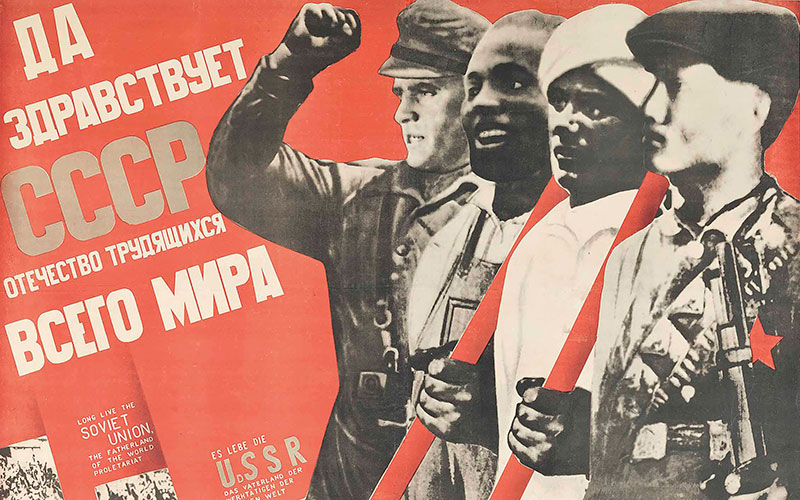
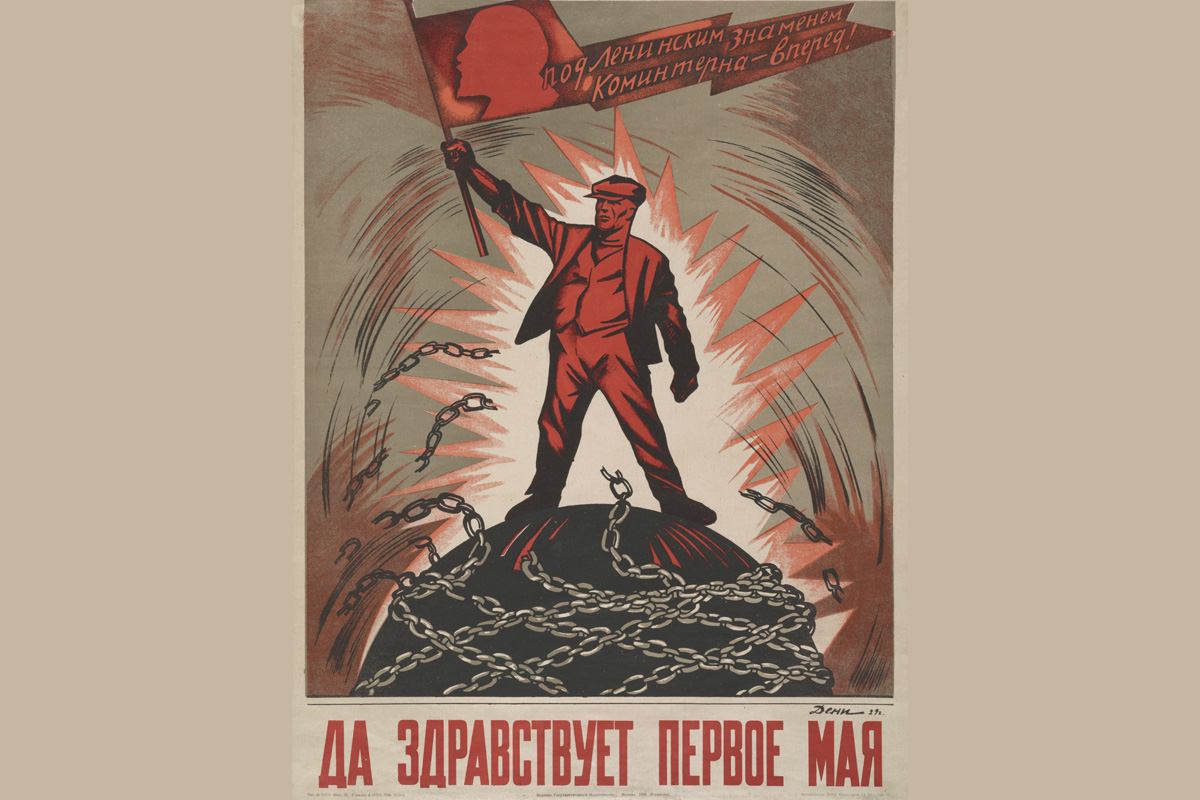
 No one had ever told him to “go back” or judged him on account of his race or class. The recognition of his humanity in the Soviet Union made him fall in love with that world and urged him to create a mirror image of that world in his own “politically slave nation”. When he begins reflecting as to how his brief stay in the Soviet Union completely transformed him as a person, he realizes that he has become “socially aware” which is accompanied by the understanding of his role in creating the classless society that the Soviet Union promised. A world that includes all, and where no one is made to feel small, unwanted or burdensome. I think these two posters do speak to the sentiments that Dada was trying to convey.

The first poster essentially feels like a global comradely struggle for a world that is no longer confined within the realm of imagination and the most important part, which was inconceivable at the time is how there are no racial barriers in this struggle. There was no superiority or inferiority for they were all comrades and I suppose that’s just the beauty of comradeship and the struggle is not a solitary one and maybe that’s why Dada felt so at home in the Soviet Union.

The struggle for a classless society, for a world where there are no hierarchies was more than anything a struggle for reclaiming one’s humanity and therefore the revolution could never be contained or reduced to certain geographical localities because it spoke to the human spirit. Dada also mentions in his memoirs that in the US “individual motive had dominated every aspect of American social life” which again was in direct contrast with the Soviet Union where you were identified with the collective and in Dada’s case his Indo-American group. The revolution again was all about uniting people across the world and making people not only fight for themselves, but for each other.

This was a completely different ethical outlook of inhabiting the world which was based on love for each other and perhaps that is why Dada felt the responsibility of carrying the revolution to his birth country which had certainly not given him anything except his birthright. He chose to carry that burden and sacrifice his life in pursuit of a better world, a world he could call his own. I chose the second poster because it reminds me of Dada himself and all he stood for. By freeing himself from the chains of oppression, he reclaimed ownership to his world as well; he was no longer an object to be acted upon by historical forces but a very conscious subject and as cliched as it sounds a maker of his own fate. He was truly, incredibly remarkable.

Dada Amir Haider Khan ko lal salam