Dada Amir Haider Khan’s travelogue is an indispensable source of first-hand insight into the newly emerging world of communist internationalism. His personal experiences, his aspirations as a fervent supporter of this dynamic New World, his personal history and background, which ironically, in a time where all ideals were turned upside down, granted him the legitimacy necessary to participate in the birth of the New World. In this new utopia, things were, by his account, idyllic.
However, there is some uneasiness, even in this utopia that may be sensed by a particular group of persons; a sort of underlying hypocrisy in the way, and- perhaps more importantly- the intentionswith which notions of fairness and equality were exercised. The claim of equality among people of all races and nationalities was met as far as one could see, indeed, as is made explicit in Dada’s work: “nowhere had I even met people of so many diverse races and nationalities”; yet there is one group whose turn at equality, is not addressed in the same terms: women.
This poster will serve as a way to elaborate what I mean when I question the extent to which women attained- or were granted, rather- equality alongside the opposite sex.
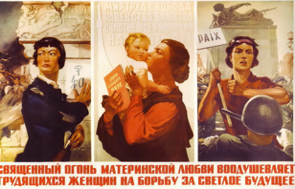
As far as poster making goes, this one does the trick. It serves to evoke strong emotions of maternal aggression and ultimately inspire women to enlist in the communist effort. However, the poster itself, addresses women in their capacity as mothers- not as comrades fighting for the same cause, but as mothers who are bound by instinctand not conscious intellectual discourse, to embrace a cause that promises a better future. The poster also incorporates elements of divinity in saying that this maternal drive is “holy”, and therefore more difficult to cast aside. Of course, women were not passive recipients of this gendered propaganda; Dada Amir Haider testifies that the Young Communist League girls did not “waste time in man hunting or any other frivolous pastime.” In the same account, however, he mentions women who were “all dressed up” and were the “object of much flirtation”. Object. This may not seem like a substantial enough point to go on about, but if one were to contextualize: women were spoken about, in this account, as either “object(s)” of desire or as those who were “like men”; there were also the “women of non-proletarian origin”, with whom any kind of intimate relation was discouraged.
In this New World then, a binary was nevertheless imposed on women, a binary based on distinctions of a superficial nature, such as their physical appearances- their “fascinating feminine faces”- and their dressing style. Why is it then, that in this utopia, stereotypical perceptions of women were still used as the means to achieve a goal, as a means to evoke emotionally driven responses?
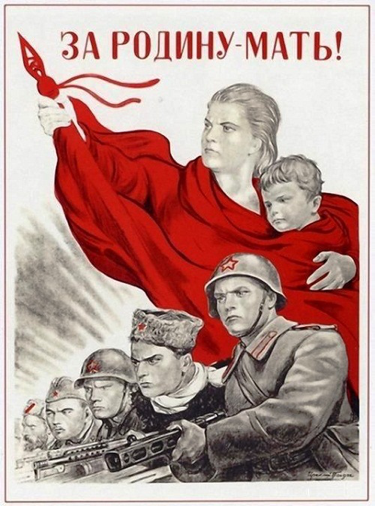
On the opposite end of the spectrum, we see that women are not placed into categories but are generalized to the point where one woman represents the entire female population, as is seen in the poster.
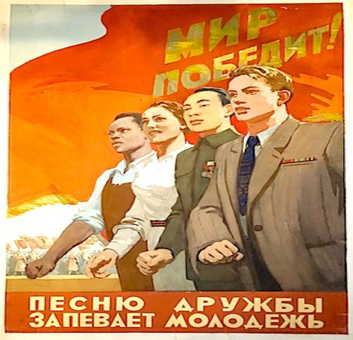
I maintain, and one can probably infer, that the posters, as well as Dada Amir’s travelogue, are not overtly or even, perhaps, deliberately patronizing towards women- they make their own wary attempts at relenting some space for women to enter a stage dominated by men. What I hope to communicate, is that these attempts- carried out by men- detract from the larger fact that what women really need emancipation from are men. Being tied to men through marriage, through children, through social expectations, is what prevents women from embracing their personhood. The same personhood, the same recognition, the same representation that is vouched for in a communist utopia.
If communism truly caters to all voices equally, then why is it that the voices of women are not as loud, or are subdued, if they are heard at all. Why is it that women like Crystal Eastman, who possess immense intellect, are weighed down by that same intellect instead of being elevated to the ranks of great thinkers? Why is their greatness never actualized? Why do their dreams never come to fruition? Because as Claude McKay put it, they are “fettered with a family”. They are crushed by the burden of their womanhood and their subsequent duties to men, leading me to believe that the communist utopia was indeed a gendered experience.

 Decoloniality and Decolonization