
Western history textbooks are not kind to the Soviet Union while describing the events of the twentieth century. They tend to overuse the advantage of hindsight and claim that the Soviet Union was bound to disintegrate because of various reasons such as the absence of democracy and human rights violations. Once again, the west is guilty of viewing history as a linear process in which Western Europe and the United States are at the forefront, the USSR is somewhere in the middle and the ‘backward’ colonies are at the tail end and have barely begun their journey. But once one moves beyond textbooks and archives and explores eyewitness accounts and literature produced during the time, they realize how the Soviet Union really was a life changing entity for some people. One such person is Dada Amir Haider Khan, an Indian from Rawalpindi who attended the University of the Peoples of the East in Moscow during the late 1920s. Dada recounts his experience in the Soviet Union in his memoirs and exhibits immense admiration for Moscow and the Communist government. Through this admiration one is able to realize why for 45 years the United States was worried about Communism spilling over. At a more personal level is able to prevent crass labelling of Soviet literature, rhetoric and art as ‘propaganda’ and starts to understand the appeal it held not only for Russians but the many people living under imperial rule.

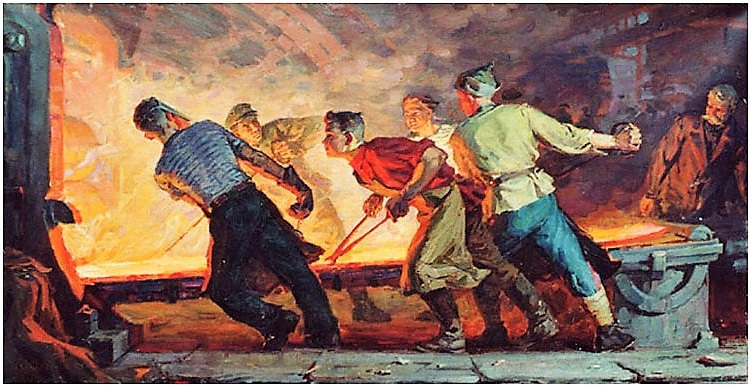
Apart from posters, Soviet artists were also engaged in a movement known as Socialist Realism. It gained popularity with the government and its purpose was to “treat the present as though it did not exist and the future as though it had arrived”. Nowhere is this better exemplified than the soviet posters and art regarding growth and economic success. The Soviets celebrated not only hard work but collective efforts. The painting displays this seems to suggest that every individual must play his role if the state is to prosper. One also notices the absence of anyone regulating these workers and giving them orders, showing that one man does not benefit at the expense of many. Dada discusses this in his memoirs and defends the notion that there is no freedom of expression in the Soviet Union by exclaiming “Yes there is no freedom for a capitalist to exploit the labor of others for personal gain, nor is there freedom for counter revolutionaries to harm the Soviet institutions which have been striving to end the exploitation of man by man!”. The Soviet poster also employs the ideals of Soviet realism and looking at the future by displaying statistics that will supersede the west in terms of production. These posters depict the fact that the USSR CAN take over the west in economic terms, and if the buildings and statistics do not convey this effectively, the predominance of the color red achieves this effect and nurtures hope within the viewer. It is understandable to hear Dada recount how he “felt in the red flag a symbol of victory over the exploiting system”. The Soviet Union had become a new vision of what the future could look like and one had to be in Moscow in order to truly experience the tremendous forces that were being unleashed. Dada succinctly sums up Western biases and their devotion to their own models of development and Laisses Faire by saying that they “could not conceive that economic development could be regulated by a scientific pre meditated economic plan”
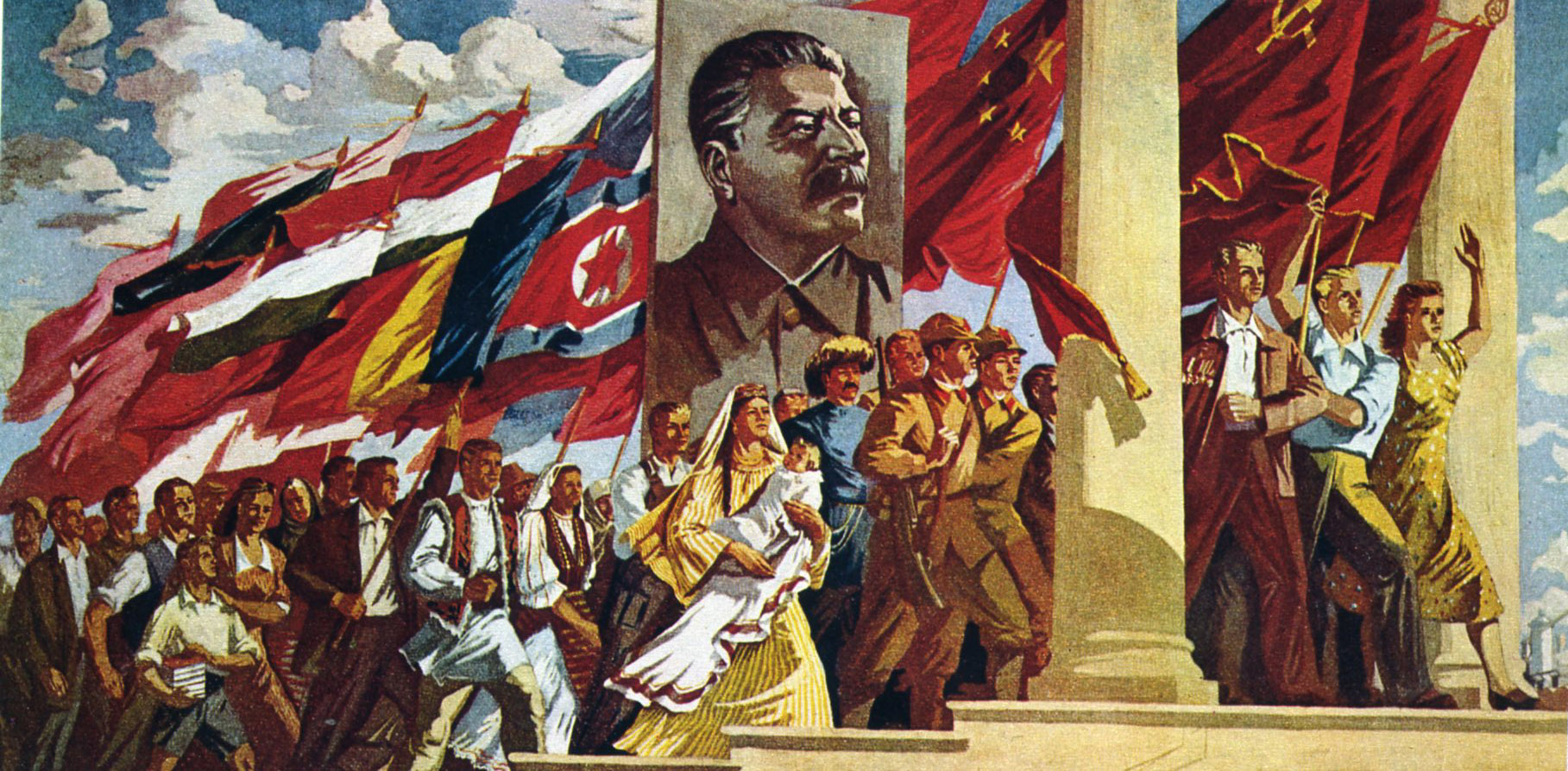
Economic and scientific advancement was something the Westerners would have still understood by the 1960s when the Soviet Union shocked everyone by launching Sputnik. What baffled the more was why people chose to follow to Soviet Union when democracy and capitalism were options. The Western countries never had to experience living lives as second class citizens. They were never made to feel like aliens in their own homeland. To the Soviet Union decolonization was a process that was linked to communist internationalism and Moscow was the capital of the revolutionary world. Through classes on political geography the Soviets made it very clear to their Eastern students that the “reality of colonialism was very real” and that they must overthrow their colonial leaders who had robbed them of a decent lifestyle for far too long. The Soviets propagated this message well before the United States did after the end of the Second World War. And they didn’t leave it there. This poster clearly distinguishes Moscow from Washington DC. It did not “exclude dark skinned people from using the public conveyances, eating places and cinema houses’. It recognized and celebrated differences as is also shown in Dada’s account. This place is a home to these people to the extent that Dada feels immense humiliation when he mistakenly violates traffic laws, as he feels a sense of responsibility for Moscow. The Soviet Union gives its people a leader who is a lot more accessible than leaders of the west as well as leaders Dada had probably heard of back in India. The people who follow communism are given the chance to adore their leader, and this adoration is not restricted to Russian men, as the poster clearly shows people from the global south as well as women. Dada also narrates how people are able to follow their religions freely, a promise that Jinnah also made to the new state of Pakistan but was sadly never followed. In a way Moscow is even friendlier to Dada than the power holders of his own country, showing how the goal of Communist internationalism was bigger than anti-imperialism; it was to eradicate oppressive social relations as a whole and to provide the colonized people with a home and a sense of pride and self-worth. It wanted to do away with the belief that these people were backward and tell them that the moment they were living in belonged to them in the same way it belonged to the white man.

 Decoloniality and Decolonization