Fragments in Time


“I too, for the first time, felt in the red flag a symbol of victory over the exploiting system.”

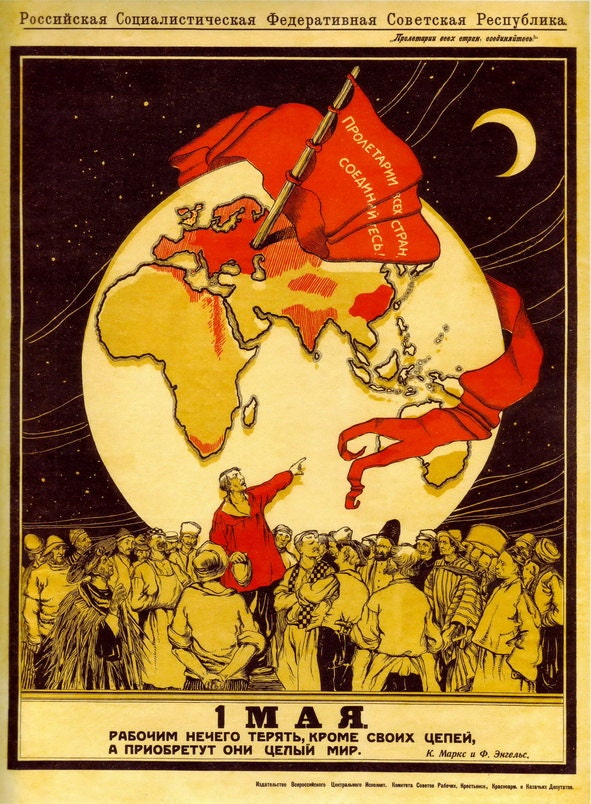
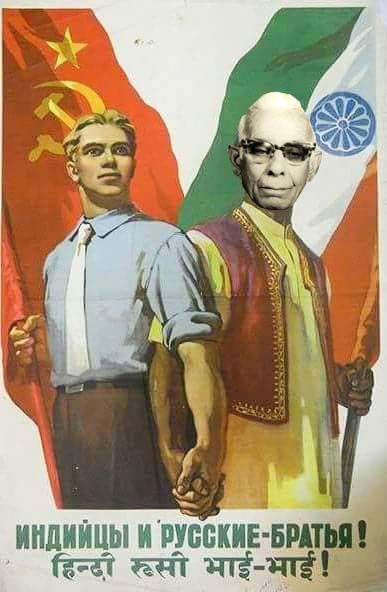
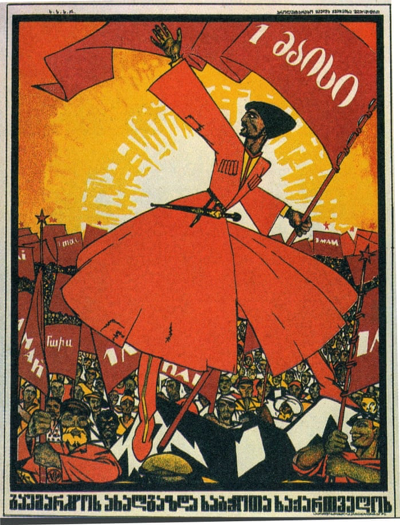
The most striking aspect of this socialist poster is the individual around whom the art is focused. Two things stand out: his garb and the colour of his skin. These prominent features on display are what I will be using to link the poster to the extraordinary life of Dada Amir Haider Khan. This piece evokes a sense of pride that is attached to an individual’s heritage. Dada’s experiences in Moscow can be considered to be an emancipation of a similar ilk. Today we can see that his emancipation was temporary, but that’s precisely not the point. Whilst trying to understand his experiences, we must confine our understanding to the time he spent in Moscow, to get a sense of what that exposure meant to him, not to us. If we consider communist internationalism to be a failed endeavor which channeled elements of tokenism, we are doing a disservice to all those who temporarily regained their individuality in a world in which differences and divisions were rapidly being reified.

There’s an incident over the course of Dada’s university experience which I thought was particularly remarkable. Dada suggested to Comrade Intelginkoff that perhaps the use of one Russian language would be best suited to the interests of internationalism, a parallel being the use of English in the USA. Upon making this suggestion, Dada was criticized for being ultra-leftist. This interaction is what perfectly encapsulates his experience in Moscow. This is what sets you free. A man who had sailed the world twice had finally ended up in a space in which he was not expected to change or alter himself. The university promoted acceptance and tolerance by creating an environment in which you were not discriminated against. In this environment, Dada and his peers from around the world were not robbed of their individuality. Dada can be seen as the vanguard in the poster, representing the South Asian masses and experiencing a break from epistemic domination. This very epistemic domination is what compelled him to undermine the importance of his mother tongue and his identity, the value of was reinstated in this almost utopian spatial imagination that was realized within Moscow. What resulted was both a restoration of pride and a sense of belonging that had been lost since birth, throughout his voyage. His experience in the university was gradually healing the colonial rupture in time that had afflicted many. The body language of the individual in the foreground of the poster implies an existence that is unburdened despite the rupture.

What the poster allows us to imagine is an alternate reality which was very much a possibility, a way out, when Dada was enrolled in the university. This break from time resulted in socio-economic divisions and hierarchies being temporarily negated. While colonial discourse continuously reminded natives that there were intrinsic differences which separated Europe from the rest of the world, socialist reconstruction made an attempt at getting rid of that imposed linearity of time. In this context, language becomes essential component of an individual’s identity. In the background of the poster, we see mobilized masses who can also be perceived to be emancipated. While Dada’s own identity had been healed to a certain degree, this emancipation had eluded his people – the native inhabitants of South Asia. When Dada returned ‘home,’ he was deemed to be a threat to domestic peace and stability. His ‘home,’ instead of being a sanctuary, was plagued by the colonial epistemic framework which did not ascribe any value to native individuality.

Had the ways of communist internationalism prevailed, we perhaps would have viewed Dada as a hero of national liberation. But since it did not happen, his story and his struggles became obscured fragments in time. He dedicated his life to a cause he believed was larger than himself. It’s important to remember his sacrifice. It’s important to remember him.

“So for the first time in my life I began to understand things that had become unknown to me.”

Main Nahein Maanta, Main Nahein Janta..

This piece will broadly shed light upon two different histories and timelines that are so distinct yet so perfectly aligned in terms of their inherent conclusiveness. In other words, it will try to highlight the unparalleled sense of similarity between the anti-narratives of Dada Amer Haider Khan’s struggles and Sukarno Bandung’s sense of expression. In other words, it talks about the inherent similarity between the struggle of freedom from both capitalism and imperialism. In other words, it talks about the idea of ‘nations or people gaining consciousness’ and subsequently internalizing, in Dada’s words, a ‘break with the old world.’


I have tried to pen the following thoughts not on the basis of any prejudices or prior knowledge, but just through the mere construction of thoughts that have infatuated my thinking as I have read both the texts one after the other. Hence, it would be safe to say that after reading Dada’s pleasing description of his time in the hospitable, socially inclusive and collectivized USSR and the pain in Bandung’s speech against the struggles of colonization and imperialism, I can gladly express my thoughts as a compliment to the principles communism upholds in terms of treating a man of color.


The most prominent example of this escape from the western white man’s tyranny, in terms of the social and normative values they so proudly exemplify, is highlighted in a brief two pages in Dada’s excerpts. Dada rather regrettably talks about the idea of individualism or individual survival in American society and how such norms and values corrupt the society by inculcating a sense of ‘other.’ He talks about the assumed western superiority on the basis of their skin color and their religion, and how in essence, this unwarranted sense of pride is contradictory to their own set of beliefs. He gives the example of how the American declaration of independence states that ‘God has created all men free and equal’ yet, they assume the messianic role of civilizing the colored and ‘uncivilized creatures.’ This he believes is ‘nothing but a shameless hypocrisy.’ In other words, he explains how compromised, repressive, discriminatory and full of shit the life of a colored man is in the ‘civilized’ western world.


On the contrary, after reading up on Dada’s experiences and his description of his short journey in the USSR, I can easily discern that such a life exemplifies itself as a counter-narrative to the tyrannical life of the West. Dada explains the inclusiveness and collectivity in the communist society and how it transposes the validity of a human being from judged on the measures of fairness of skin and material value to being judged on the measures of ethics, inclusiveness, and morality.


After reading Dada’s excerpts, in context, Sukarno Bandung’s speech quite simply comes off to me as the speech of a communist leader who has successfully escaped the tyranny of capitalism. In that, he talks about the very errors that typically exist in a capitalist society that communism expells. Bandung in his speech expresses the elements of imperialism that had so profoundly corrupted the colonized world and its normative values.


In other words, at that point in time, the decolonized countries had finally gained a sense of self, a sense of identity, a sense of freedom. These people had finally started to understand the definition of living in a free society. Hence, through his speech, Bandung lays down the generalized principles of how to live in such a newly found free society.


Freedom from capitalism in the context of one and freedom from Imperialism in the context of the other hence, at least theoretically, tries to expound what it is like to live in “a classless society in which there would be no exploitation of man by man.”

Dada’s account as a commentary of Soviet posters

Dada’s account of his educational stay in the USSR was a trans-formative experience in his life, one which ad the effect of ‘breaking him away from the old world’ and immersed him into a utopia which he could have only dreamed of before. Hence, is title of the chapter signifies the difference that he saw between the US and USSR. Inspired by the Soviet realism posters that were a form of media propaganda of the USSR, Dada’s account can be taken as a direct commentary on these posters and shows how he believed it to be true and how he followed in his life in the USSR.

c26c628041511fc66df814b12c50abe3

In this poster, one sees a wide array of people from all races and colours coming together under the picture of Stalin who himself is a symbol of communism, this shows the world population equally marching towards the success of communism around the world and creating a global environment which is free and accepting of all innate differences.

Dada’s experience in the USSR gives words to this poster as he repeatedly mentions all foreigners exemplified there and his ability to form bonds with different people, bonds that he would always remember.

These ideas of unity and freedom further tie in with what Sukarno states in his Bandung speech many years later, albeit his lack of support for communism. He mentions the need to unite despite all differences and rise up against the colonisers in order to create a voice for them.

Another interesting fact about the poster is the Chinese flag right behind the one of Soviet Union, which goes along with the fact that the Chinese comrades present in Dada’s university had a separate cell for matters of education and military training and the communist belief that once china is taken over by communism then it would definitely be on its way to global reach.

These ideals and efforts towards a Utopian setting are seen to come alive and be materialised in Dada’s life in The Soviet Union which leads him to believe that there is truth to the poster and that this freedom can be attained.

A Break with the Past

In the decades following the second world war, the rise of the Soviet Union as a world power not only signaled the decreasing power of Europe but for Amir Haider Khan Dada, represented an alternative to the colonial order and the path to freedom and liberty for all. It represented a break with the past and the beginning of a glorious future for humanity based on unity, equality and justice. Similarly, for Sukarno, the post war period was a time for a new beginning and the time for the third world to lead the way to a prosperous future of unity, equality and freedom.

Writing about his stay in Moscow and his experience at the University of the Peoples of the East, Dada feels as if he has entered the new epoch of history and has left the colonial past behind. At the university Dada saw black men with Russian women, walked in the May Day procession parade and freely interacted with his superiors at summer camp. Here for the first time he felt respected and on an equal footing with the other races and his origins, his brown skin and ‘Indian-ness’ were a source of pride rather than humiliation and discrimination. A complete subversion of what it meant to be respectable.

For both, Dada and Sukarno, in this new era the political geography of the globe had also been inverted since in the past the geographical relationship between different lands had been based on the link between the colony and the metropole. Europe was the center of the world. No longer was this the case since Moscow was the new place of congregation, the center of revolution and offered a promise of alternate governance and self-determination. The Comintern being the biggest example of this. The conference at Bandung too was a reflection of this inversion. Sukarno called it the ‘first intercontinental conference of coloured peoples in the history of mankind’ and ‘a new departure in the history of the world’. This was one of the features of the ‘new order’ where the power of the colonizers was redistributed by decentering them. This was the new way of being in which the third world no longer needed Europe as a platform to discuss their matters.

Dada experienced true cosmopolitanism in Moscow. Moscow’s cosmopolitanism went beyond just having people from different backgrounds around, rather it was the active appreciation of diversity in which each tradition was considered respectful in its own right. An example of this being the vast number of languages in which the curriculum at the university was taught. The students, coming from diverse backgrounds, were given the opportunity (right) to study in their native tongue and no language was given preference over the other- something new for Dada. Sukarno’s speech gives the same message and emphasizes the spirit of unity and tolerance. He acknowledges the diversity, ‘Yes, there is diversity among us… with people professing almost every religion under the sun… Almost every political faith we encounter here… And practically every economic doctrine has its representative in this hall…’. However, for him this diversity is not harmful. In fact, this conference is one of ‘brotherhood’ and the difference has its own place in the new order while the unity and desire for collective well-being is the primary concern.

While at Moscow Dada learnt about Communist Internationalism which tied the fate of the world together and supported revolution all over the world. The belief that everyone’s freedom was linked led to the purpose of politics being the collective freedom and betterment of all peoples. For Sukarno the new purpose of politics is essentially the same. Now it is time for the people of the third world to redefine politics and go beyond self-interest. A ‘fresh approach’ is needed with the aim of ending war and conflict and striving towards peace and stability.

Since the colonial era, the colonized people had been living in the colonizer’s past. They had no present but were stuck in the time of the ‘not yet’. Communist Internationalism, supporting the cause of self-determination for all, called for independence- now. This meant the that time of the not yet had become a time of the now, breaking away from the colonial understanding of time and taking charge of the present. This breaking away resulted in a sort of temporal rupture. For Dada, Communist Internationalist sought to heal that rupture of time by opening up the possibility of a new reality where all people are free and equal and collective well-being the priority. Similarly, for Sukarno, there has been a break with the past. With the coming together of the leaders of the newly freed nations ‘… a New Asia and a New Africa have been born!’. It is now up to these nations to lead the world into a new epoch characterized by unity, peace, tolerance and morality rather than war, greed, discrimination and exploitation. Just as Russian Communism is the opening up of new possibilities of ways of being, for Sukarno the Third World represents a third way. A new alternate way for the world.

20020042

Dada Khan and Dream of Communist Internationalism

In ‘Chains to Lose’, Dada Amir Haider Khan recounts his experiences in the USSR. Around the same time in the 1920s, Soviet Realism began to take shape as an art form meant to inspire and mobilize the masses towards the greater cause of Communist revolutions. While Soviet propaganda posters were supposed to one-sidedly highlight the might of the USSR, Dada’s feelings capture the on-the-ground sentiment of people who experienced Communist Internationalism at its peak. If one uses Dada’s account as a lens to view these posters, one sees a genuine belief in the promise and the hope Communist Internationalism had to offer people of the Third World. The future under communism promised a new opportunity for the lowest echelons of society to become powerful and create a more equal world under Marxist-Leninist principles.

The University of Peoples of the East seems to be emblematic of Dada’s conception of the USSR: comprehensively organized but also egalitarian. It took in people of all ages and backgrounds, including people who belonged to bourgeois families. In order to enroll, race and education came second to social background and political consciousness. From then onwards, each student is given a holistic education -including military training- and is divided simply on the basis of effective communication. Additionally, the university also included periods of reflection and improvement, focusing on the collective action.

“Russians and Indians are brothers” (date unknown, found on Pinterest)
“The Master of the World will be Labour” (1920) (found on Instagram)
(found on communisme-bolchevisme.net) “Working people of all countries and oppressed colonies. Stand up under the banner of Lenin!” (1932)
“Long Live USSR, 1921” – G. Klutsis (found on Christies.com)


Perhaps the most interesting aspect of Dada’s account is the prominence of Indian students in the university (most books often place emphasis on east Asians or Non-Russian soviets as opposed to people of African and Indian descent). They are not without their internal skirmishes, as showcased by Dada’s altercations with M.N Roy or the Indians on the ship but this was the first time I came across someone from this part of the world who was wholly participating for communist revolution on a global scale. But Dada expresses a deep reverence for the Bolsheviks and Russia’s history in Dada’s narration. It is not difficult to understand why someone like him would believe that Russian culture and history should be the medium of revolutions exported abroad. But his instructor offers the counter opinion that in order for values of the revolution to be successful, the people must educate the masses using their culture and language.

That sticks out specifically in the posters; although the proletariat is in equal footing with one another and they are all in traditional clothes. Not only are all workers of the world welcome to join the revolution but also can be accommodated for without letting go of their own cultures. It was these very identities which the colonizer attempted to stifle but communism was ready to accept. But, it was the communist’s duty to export the revolutions to their own motherlands. The last poster specifically depicts the people of the world organizing the revolution. One can notice areas shaded in red (notably South Asia and the Eastern edge of China) which could represent areas already making significant headway in 1919.


“The 1st of May. Workers have nothing to lose except their chains, but they have the whole world to get. Moscow 1919.” — A. Apsit (found on Etsy)

Dada reluctantly decided to return to India as a part of his duty towards the communist cause. Here, the difference between anti-colonialism and nationalism is stark because Dada neither has any connection nor emotion towards the anti-colonial movement. But it seems as though he feels a sense of responsibility towards the USSR in return for the personal growth and education which he experienced there. And there would be many other Dadas of the Third World who shared the same sentiments but do not make it into conventional narratives for their political orientations.

There are some internal skirmishes which the posters hide and Dada only briefly discloses (he only briefly mentions the tension between the Trotskyists and Stalinists as well as the USSR’s economic problems), and indeed the ambitious beginning became overshadowed by violence and suppression. But, one needs to pay attention to the fact that this was a global project which was not only fully realized but also considered a serious threat to capitalist states. It held tight – at least initially – to its principles of equality and emancipation for all peoples of the world.

Who Wears the Chains?

“In their early childhoods they were taken by public minded or conscientious people from adverse circumstances and placed in different children’s home which the Party and Soviet authorities had set up throughout the USSR for such children who had no parents or guardians” 

In Dada Amir Haider’s narrative, the world he portrays is rose tinted. As he fondly recalls his time in Moscow, many characters populate his account, not least of all Noora, the young girl who “was actually not an abandoned child”. Noora is one of many children who left the restrictions of their home for a world which promised above all else to be nothing like the past they had known. The “conservatism” of Noora’s mother causes conflict not only in the microcosm of the relationship between parent and child but in the macrocosmic struggle between the shackles of the past and the free future envisioned through communist doctrine. 

Anyone who is even slightly informed about the world they live in would easily recognize the first poster. But in case you don’t (or in case you think I don’t) its title, which roughly translates to “Children, What Do You Know Of The Fuhrer?” says it all. Now, I am not entirely sure about the history of the piece, but for my argument I am going to read it as a challenge to the image shown. As he holds up the little girl, Hitler is the picture of benevolence. Yet, he is framed by a question that haunts— “What do you children know of the truth that lies behind the smiling figure in front of you? Do you, or will you ever, know of the destruction he leaves in his wake?” 

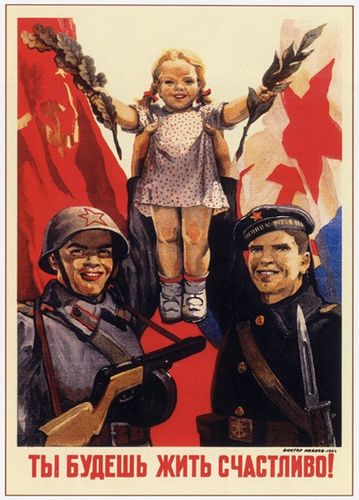
The second poster couldn’t be more different from the first in terms of the place from where it originated. And while the former attempted to promote fascist agenda, the latter has as its central premise, the aim of propagating communism. Yet, in terms of aesthetic, the two are frighteningly similar. Both have flags, happy people, and most importantly, a child being supported in the air by the ideology of the land they live in. So why is Noora’s story important in context to these two posters?  

What does it mean to let go of the past? On a national level it is clear that this is no easy task. Yet, what Dada Amir Haider fails to mention, except for in his innocent account of Noora, is the impediment caused in this transition between past and present, by the very fact of it not merely taking place on the level of the macrocosm. When Noora goes home, her mother says, “please leave me alone”. Noora is hence, abandoned by her mother till she lands in the hands of the state, and in the arms of the men lifting the little girl up in the poster.  

Letting go of the past comes at a price. But Noora’s story has more concerning undertones than merely this to it. She, and other children like her, are to all extents and purposes prey to the whims of the State. And even more frightening, is the fact that like the little girl in the poster, these children become pawns in a chess game of politics. They smile, and to men like Dada Amir they seem happy. After all, like he says, they have been “taken in” by those who are “public minded”. It is important to work for the mutual benefit of society at large, but this too comes at a cost when the needs of the individual merge into those of the collective till the two are indistinguishable from each other.  

The little girl in the second poster probably knows next to nothing about communism. As she hangs suspended in the air, perhaps she smiles because she thinks she’s flying. Or maybe she smiles because she has been told to do so. There is a cost to involving children in grownup matters of politics— their childhood. It may be argued that the way things were before didn’t really ensure that childhood was a privilege available to all children. Yet the chains that bound them down in the past, haven’t really been lost. They have merely taken on a new shape— that of two men holding a smiling girl up in the air.  

جب بلاوہ آئے گا

I wish, for the time being, to suspend the concept of temporality as linear and impose upon us a disjuncture with our past, for there is a haunting among us- an ending that refuses to end- which demands to be heard. For me, it is difficult to locate the spirit in our material present without resorting to our past. And I admit, it would be too reductive to diminish Sukarno and Dada to the transcendental realm, where they may only exist as unfinished dreams. But my recourse to the spiritual is not meant to render them into some less and other-worldly form of existence. They are very much part of the here and now and I need them to establish what I interpret as a reconciliation between the jaggedness of colored time and our own ontology. I find my own existence intermingled with theirs and believe that only by inserting ourselves into the equation, can we finally lay them to rest.

I write with a heavy feeling when I allude to the waiting room of history that we still reside in and find myself questioning the extent of the moral depravity of human beings that both Sukarno and Dada speak to in their writings. As they stand, both of them connect across time and space through the same experience of being colonized and testify to the cognitive damage that has been done by man’s conquest of man. Yet, in their act of questioning;

How is it possible to be disinterested about colonialism?… No people can feel themselves free, so long as part of their motherland is unfree. (Sukarno)

How did the Soviet system come about in the backwardness of Czarist Russia? … Why could we not do the same in India? (Dada)

they represent a resistance to that damage, a complexity which we all possess but do not conjure. In their own, it is exactly this devastating reality, the death of human conscience and the willful ignorance towards it, to which they collectively return.

But when locating this moral indifference, it seems that the problem becomes bigger than ourselves and it is perhaps in that, where we can find the solution. Both Dada and Sukarno long for a moment where the oppressed come together and see past their material realities, skin, religion and language and evoke a common desire to settle their ruptured past. In either of their circumstances, it is not possible to achieve complete emancipation without it.

I will call them my people, which were not my people;

and her beloved, which was not loved.

Romans 9:25

Dada speaks of an urge to go to India; a place that has given him no material or intellectual wealth. But his journey in the Soviet Union marks the coming together of diverse races, classes and genders and the end of the individual. He sees it as his duty to let go of what could have been a comfortable alternative, as a seaman. He forgoes familiarity, when his African American comrades call on him to overcome the humiliating handicaps that come with being colored in America. Instead, he is overpowered by a sense of solidarity towards the place he is only connected to by birth.  Breaking the bonds of class and spreading the communist dream in India become his chosen path.

Similarly, Sukarno celebrates Afro-Asian independence by resonating to a past in which they are held as the natural centers of faith and ideas. He too alludes to an overwhelming sense of solidarity that crosses over distances and differences. For him, humanity is rooted in diversity and Bandung marks the moment the colonized world embarks on the path of self actualization, together. For both of them, although they are divided in their political leanings, their hearts yearn for the same realization; a unity that inspires an image in which the individual can see in him/herself the collective and the possibility of inaugurating a new way forward- a new time.

I do not speak for the many that have been lost in the void of colonialism, but I do write in their memory as their existence has informed mine. In my own being I possess some measure of responsibility to reconciling the circumstances we now live in with the past. And upon introspection I can see the choices that were made and the paths that were chosen inform our consciences of the moral agency we possess. They come back to us again and again, haunting us as we live in the shadows, as we wait for that moment where we take up the reins and embrace our own humanism and embody the change that Dada and Sukarno sought for us. Until then they remain with us, two souls, expunged from physical existence, but inhabiting our social imagination, calling for us to wake up and prepare ourselves to forgo all else at the inevitable call for departure. 

How Dada would have seen some Soviet posters

This piece is an imaginative one. It shall aim to look at Dada Amir Haider Khan’s journey to the USSR, juxtaposed to Soviet propaganda posters of that time, and try to imagine how Dada might have seen each one, and how they would have contributed as a pull factor in Dada’s decision to sail to Moscow. 

The wake of 1900’s brought forth a world that was a cauldron of oppression and exploitation. The First World War was about to be triggered, United States was at the brink of becoming the next world power, Britain was ruling 25% of the world’s land surface and India had been deeply chained by colonial rule. 

In the midst of this, the century also gave birth to Amir Haider Khan, a revolutionary, a communist activist and an unsung hero of the Indian Independence Movement – one who’s words and ideas can be seen physically in Soviet posters.

In 1914, when the First World War broke out, India was naturally a British ally, with most of the Indian army being sent to fight against Germany in different parts of the world. Dada was then overseeing Anglo-Indian trade as a part of the British merchant navy, possibly laying close scrutiny on how exploitative and extractive the relationship of the two countries was. 

In 1917, when Dadabhai Naoroji died, he left behind a detailed insight into Britain as a brutal exploiter and the famous drain theory that put Britain at a questionable position within the colonised country. That same year, while Indian exploitation was being measured for its magnanimity, on the other side of the world, women were marching out of their houses, in the Russian capital, Petrograd, protesting over bread shortages and demanding an end to Tsarist autocracy- an action that eventually gave way to the Russian Revolution. If one looks from the side of Dada, this revolution was probably not only an alien idea, but also a seemingly impossible one, especially for India of that time. 

“This is what October revolution gave to female worker and farmer.”
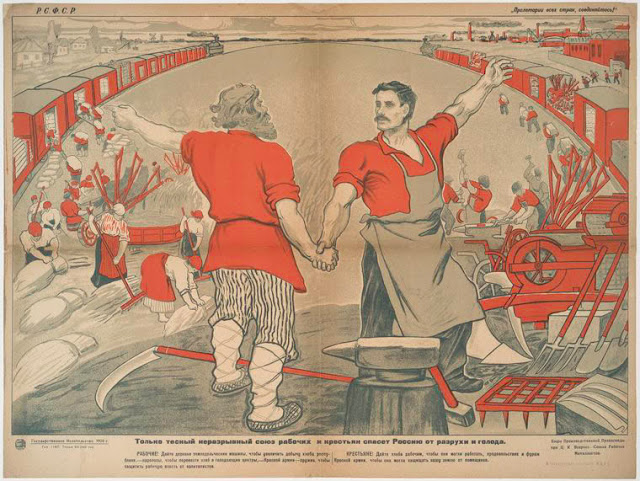
“Only the close union of workers and peasants will save Russia from destruction and hunger.” (1917-1921)

To Dada, these posters could have possibly been a utopia of what an ideal revolution and freedom smelled like- one that was far from India. So far Dada had not seen similar Indian women or peasantry at the forefront of any art, let alone a nation altogether.

In 1918, Dada was posted to the United States Merchant Marine, where he travelled most of the world and met people that eventually could be seen as pertinent in shaping his anti-British and communist ideas. He first met Joseph Mulkane, an Irish nationalist who introduced him to anti-British political ideas, and then some Indian nationalists and Ghadar party members who then also travelled with him to Moscow. 

In 1919, while India was suffering from the trauma of the cold-blooded genocide of Jalianwala Bagh, Dada was distributing ‘Ghadar ki Goonj’ to Indians in sea ports around the world. The following image is what the compilation of ‘Ghadar ki Goonj’ looked like: 

“Ghadar di Gunj – Echoes of Mutiny”

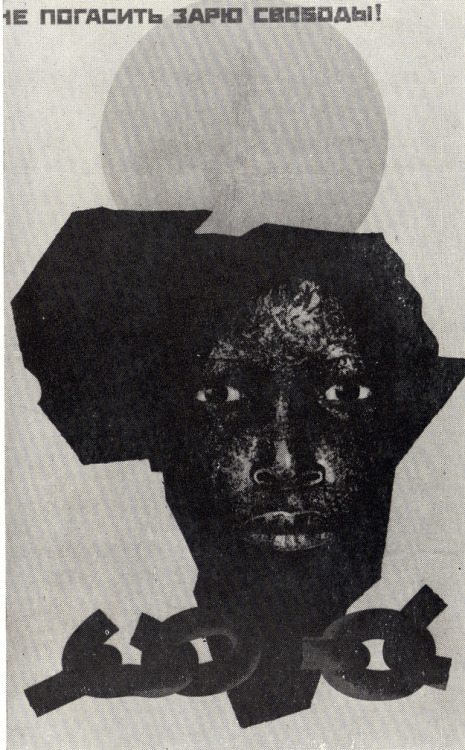
While Dada was distributing these across the world, and sending out instigative messages for Indians to unchain themselves from colonial rule, Soviet propaganda posters were no different. They were too, sending out similar messages- messages of breaking free from the systematic oppression that dictated that time period.

“The dawn of freedom cannot be extinguished”

And hence, it can only be imagined that Dada gained inspiration from the Soviet posters for his own anti-colonial movement.

By this time, Dada had become deeply entrenched in pro-communist and anti-imperialist ideas, and by 1920, he was off to Moscow along with the Workers (Communist) Party of USA. Below are some of the posters that Dada could have possibly seen- posters that signalled all what Dadas idea of Soviet Union was, and posters that sync with Dada’s memoirs and what was so special about Moscow in that tumultuous period.

All Flags Will Visit Us

This poster is closely symbolic of what Dada envisioned Moscow as: the capital of the world. It seemed to be a place that welcomed everyone in their raw skin colours and job descriptions, without waging any discrimination whatsoever. The poster is particularly important in understanding why, after travelling a large part of the world, Dada decided to head to Moscow, and how many others, like Dada, were doing the same.

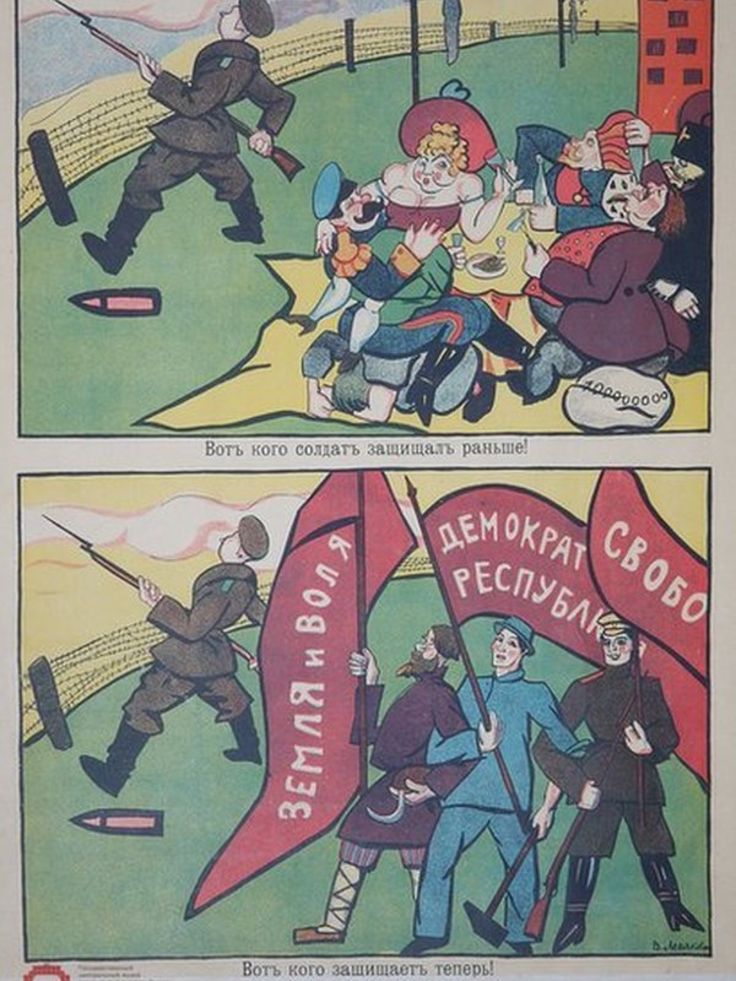
“The changing wind”

The name of this poster is most important for the wind was quite literally changing while taking most people with it, to the Soviet Union. The top image shows a soldier defending the bourgeoisie with the caption “This is who the soldier used to defend”. The second, post-revolutionary, image features banners bearing the slogans, “Land and freedom!”, “Democracy and the Republic!” and “Liberty!” The caption reads: “That’s who he defends today”. This stands particularly in sync with Dada’s ideology for his main aim was to fight the status quo and overthrow the polarised class system in India. When Dada returned to Bombay in 1928, he was seen bringing this poster to life till his last breath.

“Workers of all countries and the oppressed colonial peoples.”

This image can be edited out to morph Dada’s face into Lenins, and the impact it holds might almost still remain the same. Dada, like Lenin, envisioned a free future and one that did not dictate the idea of Indians having to occupy the broiler rooms in ships for they could “bear the heat” or for black workers to be the most exploited and underpaid for the simple reason that they were “black”.


“USSR is the shock brigade of the international proletariat.”

It can be wondered if Dada would choose the entire Indian population or the working class of the entire world. His memoirs suggest that he would choose the latter, for the steering principle of his life was communism and clearly, not anti-colonialism. And hence, the poster above stands very relevant for its calls for the protection of not a single nation, but instead, the working classes of all nations. 

Lastly, here is an edited version of a Soviet poster in an assumption of how Dada might have viewed it. He spent most of his life brining communism to India and bridging the gap between Moscows cohesive diversity and Lahores polarised class system. However, till the eve of December, 1989, he was adamant on believing that the brotherhood he saw in Moscow, with his fellow Soviets, could one day become a reality.

Contrast between Dada Amir Haider Khan’s “Chains to Lose” (Chp. 7) and Socialist Realism Artwork/Posters

Published in 1989, Dada Amir Haider Khan’s “Chains to Lose” is a collection of his memoirs and personal accounts as a revolutionary/socialist/student/traveler during much of the 20th Century. For our purposes we will be specifically focusing on Chapter 7 “Break With The Old World”. Written during the mid-late 1920’s, the strategically chosen name of this chapter itself is highly symbolic of what every young, aged or colored socialist was seeking to achieve back then. This blog will hence highlight certain themes in Dada’s account and place them with actual Socialist Realism posters to depict the variety of ideas that were being both propagated and to a large extent, implemented.

image 0

I had visited and lived in many great cities…But nowhere had I even met people of so many diverse races and nationalities, and been able to share a communal life with them, as in this university.

After continuously mixing and living with innumerable types of individuals I had lost all my religious prejudices.”

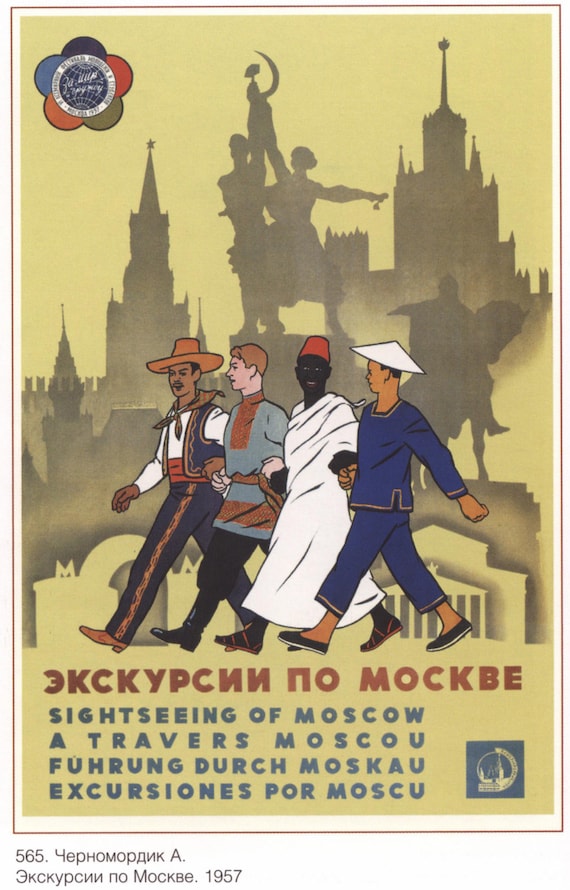
Dada talks about the influx of an extremely diverse group of people into the Soviet Union. These included teachers, authors, artists, ideologues, laborers etc. Dada mentions how several of them were expelled from their countries because they “sympathized” with the Russian Revolution. They mostly consisted of Americans, Africans, Chinese and even Indians. The poster also represents this diverse group literally travelling hand in hand in Moscow. It depicts not only equality but also a shared collective goal.

The teacher of economic geography, with the help of regular maps as well as charts and diagrams, demonstrated to us the economic inter-dependence of various parts of the world. It was for this reason the industrial capitalist countries maintained their political domination over backward agricultural countries.

When describing the university, Dada firstly talks about the curriculum which contains subjects such as politics, history, anthropology and surprisingly enough, comparative religion. He goes on to discuss how this curriculum was implemented at a more practical level as the students were taken to tours of e.g: factories where they were exposed to the rapid industrialization project as part of the Soviet 5 year plan. They were also taken to Czarist monuments, which were preserved specifically to represent historical progress from a “backward monarchy” towards an equitable industrialized society. Activities mentioned under “The Judgement”, where groups critiqued themselves and one another on conduct etc encouraged dialogue among the different groups. In Dada’s opinion this greatly improved cultural understanding and tolerance.

Furthermore, the university also managed to highlight what was common among the students, for instance most of them belonged to colonies and had witnessed exploitation first hand. The university thus attempted to unite them under the anti-colonial banner by demonstrating how socialism could break them free from these very chains. Similarly, both posters aim to demonstrate that very idea.

This image has an empty alt attribute; its file name is soviet-anti-religious-propaganda-posters-6.jpg

In the United States we used to hear that people in the Soviet Union are prosecuted for observing their religious rites. But during this period I went to watch the Easter Sunday procession and other ceremonies in the company of some Russian friends.

Dada attempts to clear this conception of the Soviet Union curtailing religious freedom by discussing how processions and public rituals were common even in Moscow. He himself was able to take part in these openly without any action by the state. However, the posters/artwork say otherwise.

Socialist Realism posters depicted religion as a tool used by the upper class, a means of control/extraction and one of the major hindrances on the path to progress and education.

Soviet anti-religious propaganda, poster 10

Propaganda such as this aims to trickle down eventually, so Dada’s view here might be problematic as it is limited to that initial period only. There are well documented reports of the Soviet state repressing the church and these posters may serve as counters to the claims of the state being tolerant in terms of religion.

This image has an empty alt attribute; its file name is enhanced-buzz-orig-7801-1390245730-19.jpg

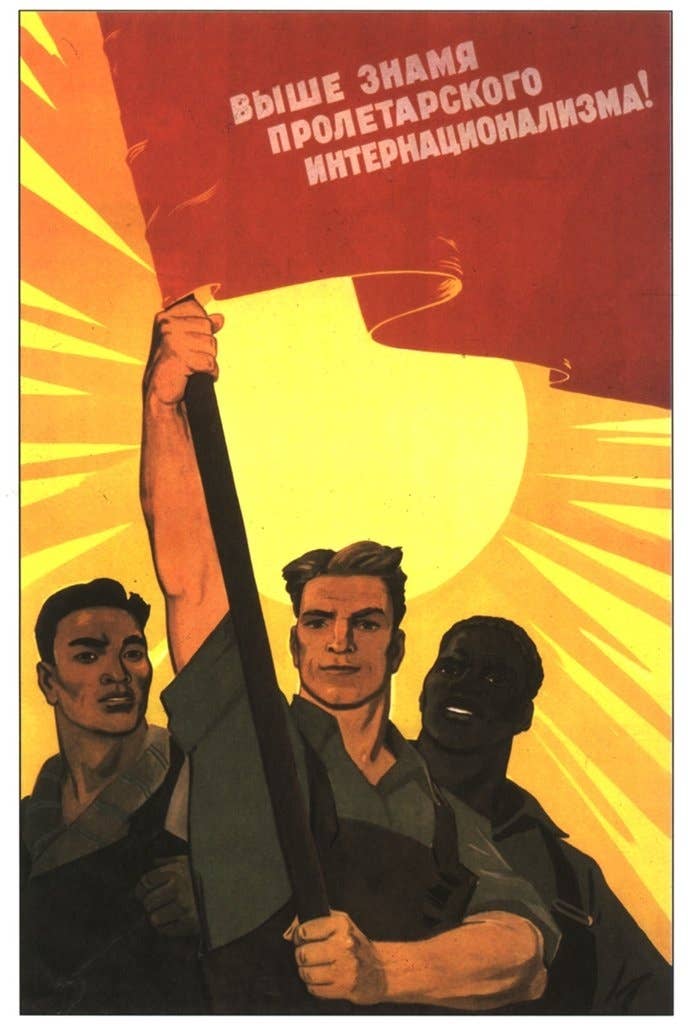
“Raise the flag of proletarian internationalism”

The students who had finished their studies at the university usually prepared themselves for surprise departures that could take place at any moment.

After all India was the land of my birth, and I owed my duty and allegiance to her.

Dada talks about how he opted for India as he felt like he was morally and more importantly, as a socialist, responsible to bring what he had learned back to his native country. It is important to note that the entire notion behind this education/rehabilitation program was to send this diverse group of individuals into other territories (mostly their homelands) to create an international network of socialist groups. The creation of the Comintern was therefore a result of socialist internationalism. Hence, one can safely assume that what Dada felt was common for nearly all the individuals who completed their program at the university. The poster serves to highlight this very internationalism. Depicting all proletarians, irrespective of color, as one.

In conclusion, Dada’s account of his training in the Soviet Union can be placed directly in comparison to Socialist Realism artwork/posters. His practical experience and what was being propagated through the art go hand in hand. Inconsistencies in the artwork in comparison to the social conditions of Soviet Union may be more prominent in other accounts, but in Dada’s case they nearly seem to be absent.

IQBAL 20020096

“Literacy is the path to Communism”

“Literacy is the path to Communism” 1920

It is in Moscow, the new heart of the world, that Dada Amir Haider truly discovered something new after having sailed twice all across the oceans. It was not the new land of the Soviet Union, or the celebrations and pomp of revolution, but a new spirit and education- an emotional and intellectual fulfillment, that gave a true meaning to years of travel and observance. This new way of envisioning the world and human experience obliterated known geographical borders and social limitations. The universities in Moscow, which had always served only the “chosen ones”, now, served people from all around the world, enabling diversity and education as an instrument to spread socialism. Dada was one of many flocking to their new home, breaking with the “old world” every second of their journey. Reaching home, however, was just the first step. Dada’s real journey was yet to begin. It was a journey of becoming literate for not just the sake of the global communist vision, but for the sake of becoming a new person, someone that he himself could believe in- an embodiment of the Soviet Poster “Literacy is the path to communism.” A path that would begin with a “rechristening” of all those who were coming home.

The importance of this path equaled that of its ultimate destination. Dada’s reverential and yet explanatory tone in, Chains To Lose, his travelogue, showed that the journey and its preparation would be sheer hard work, just like that done by farmers, workers and soldiers. The Soviet Union had to “build socialism”- each new human’s endeavors and experiences had to create its reality. Thus, Dada embraced this knowledge, and Lenin’s words, the only way forward-

Hasha Zdatcha Yeat- Do Tichissa, Do Tichissa

“Our task is to learn, learn and learn.”

It is this very thought that “Literacy is the path to communism” reflects, showing knowledge and its distribution as the necessary building foundation for the new world. Education would now be a source of power rather than new technology, territorial control and expansion or class and racial differences. Thus, the red Pegasus, the winged horse, occupies the entire space of the poster, carrying the distributor of knowledge- whose raised torchlight and open book overcome the viewers with a sense of a victory of education and consequently, communism. The creature flies above the industrial land depicted below, the continuity of its buildings and smoke reflecting the continuity of the revolutionary ideals. The hammer and sickle emblem of the communist party is placed below, next to the slogan- the very tools of hard work that would now “build socialism”. Yet, along with the human tools of farming and labor, the presence of the supernatural carrier of the message shows knowledge as a force capable of producing power above any one human or entity- the power of the communist ideology. The poster would have invigorated Dada and his companions, showing them how their knowledge was a means of truly experiencing the revolution and transcending into the new world.

Questions of the nature of this education are overshadowed by the powerful narrative of its victory over the abusive systems of the world, its ability to enable humans to find themselves and a chance to live once again. Pegasus leaves no room for any other experience to be felt- one is almost swept away by the power and strength of its body, wings and flight. Literacy would carry ideals of liberation and diversity as long as it resembles the courses in language, Economy and Geography that Dada studied- the only other way of becoming free of the oppressions of the world. And thus, Dada and many others fell in love with their home, where they had found themselves and each other. After living in America for years, it is here that Dada remembers sobbing at the death of a black female companion. After sailing the world twice and discovering various lands and peoples for years, Dada was no longer a bystander, no longer an observer of the world. He had felt the rushing wind caused by the beating of Pegasus’s wings; he had found a meaning of his existence in the Soviet land. Most of all, he had discovered that he would remember it all, unlike even his childhood and birthplace. With Soviet education, Dada had discovered his own story and was now setting out to change the story of the world.