Dada Amir Haider Khan’s ‘Chains to lose –Life and Struggles of a Revolutionary’ provides insight into the way that an individual’s life was impacted living in Moscow during the 1920s. Dada is an Indian man who carries the chains of the Old World; he is burdened by the remnants of colonialism and the conflicts of identity that arise from it and despite having traveled across the stretches of the globe, it is only in Moscow that he breaks from his chains.
During this period, Soviet Art was in its peak stage. The Bolshevik era had established the iconic symbolism of the red star, hammer and sickle and art played a significant role in portraying the optimistic views of Soviet life. Social realism was differentiated from Socialist Realism and all pessimistic or critical commentary was banned. ‘Agit-prop,’ a combination of the Russian word ‘agitatsiia’ (agitation) and propaganda was set up by the Soviet Communist Party in the 1920s and the slogans of the revolution were sung proud and loud, fanning the patriotic fires of the heartland. The posters circulated during this period show the power of art and how a small group of painters shaped the attitudes of a nation of 150 million.
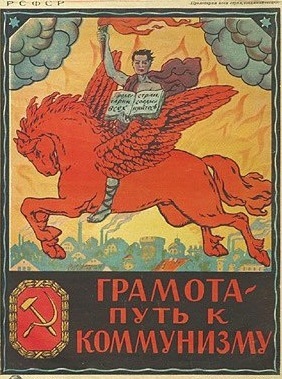
The emphasis on literacy as a means of enlightenment was given great emphasis during this period. Dada’s travelogue shows how his time at the ‘University of the People of the East’ was significant not only because he had international exposure but because of the specific approach that the education had. Dada had traveled the world, however, it was only in Moscow that he found himself engaging with a group of people as diverse as this. The students were from a diverse strata of social classes and admission was based on political engagement rather than social background. The university allowed the students to study a wide variety of subjects, from anthropology to political science. It played an emphasis on collective action and combined it with military training. The most significant feature of the university was that it did not expect all students to be taught in the same medium of instruction. This reminds one of the shackles of colonialism and the way it established a hierarchy of language through erasure of native languages and identities. For the first time, Dada Amir was not expected to erase his own mother tongue to assimilate. This poster depicts the way this message was delivered to the people. The poster ‘literacy is the path to communism’ shows a man holding a torch in one hand and a book in the other, while he rides a Peguses above the city and high in the clouds. The torch represents quite literally the light and the book is the means to achieve it. The Pegasus becomes a powerful symbol as the winged horse from Greek mythology combines strength and flight, becoming a sign for power and mobility. The artists use a bright palette of red and yellow to represent the colors of the Soviets. Finally, the poster bears the hammer and sickle emblem, reminding the viewer of who is leading the path of enlightenment. Dada’s account here depicts the way that the message behind this poster rang true and did, in fact, materialize in the universities in the Soviet Union.
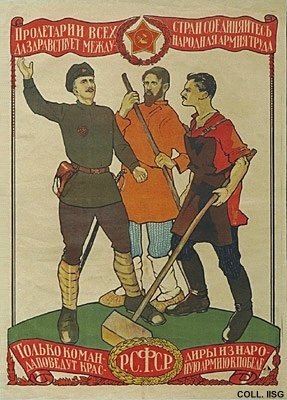
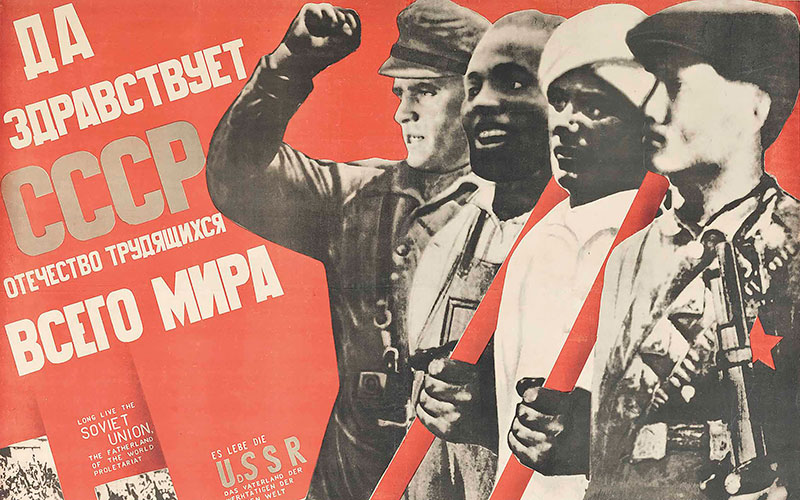
‘proletarians of all countries, unite’ 1919 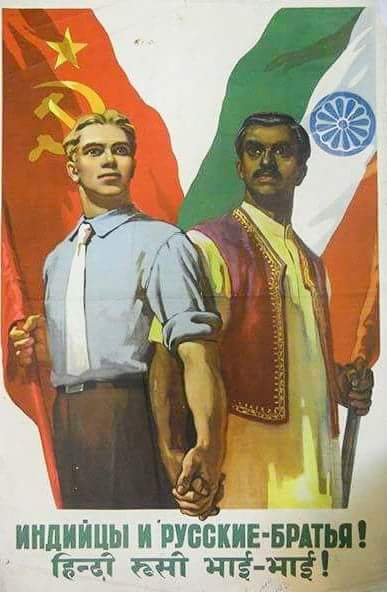
‘Russians and Indians are brothers’ 1962
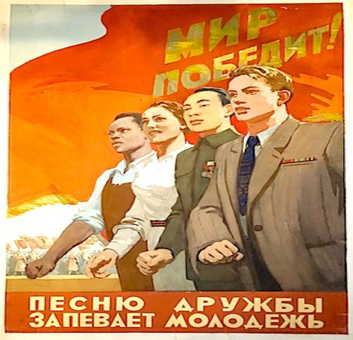
The idea of literacy was not limited just to enlightening the Soviets, there was a central idea of communist internationalism and setting up a network of camaraderie across the globe. Communist International pushed the idea of uniting formerly colonized countries with industrial workers under a new banner. Dada recounts how the university half expected the students to eventually return to their home countries and give back to them the knowledge they have acquired in their time in Moscow. These posters depict the way art was used to embolden the common man and tell him that the soldier, farmer, and worker could all play a role in the way they should be governed. In the poster ‘proletarians of all countries unite,’ three men are depicted in different garb, all with assertive body language and determined faces all at the same level. The ‘Russians and Indians are brothers’ poster has writing in Hindi underneath saying ‘hindi rusi bhai bhai’ showing how one language does not allow for erasure of the other.

“What the October revolution has given to working and peasant women.” 1920
The concept of the ‘new woman’ who was no longer subordinated to the man was emerging which can be seen through this poster. Dada’s travelogue discusses how the girls in the Young Communist League did not waste time in ‘frivolous pastimes’ like man hunting. The new woman was to be indistinguishable from her male counterparts, she was an equal contributor to the struggle and the revolution had emancipated her from the shackles of the patriarchy. This poster then becomes an interesting comparison as it shows the woman holding the hammer with the sickle near her feet, she is emboldened and dressed in red, the color of the revolution, as her face tilts towards the sun. Her arm is extended and she occupies space, she is a new woman who is no longer held hostage indoors by the man. She points towards the library, the workers club, a school for adults and the house. The inclusion of the house within this poster becomes significant as it serves as a reminder of how the new woman is not completely free from the chains of motherhood either. The revolution does not forget its mothers behind but attempts to consolidate taking motherhood and the ‘new woman,’ something that can be observed within the contradictions of Dada’s travelogue as well.
To conclude, Dada’s account presents the extent to which the utopia presented by the posters translated into reality. Dada was able to break his shackles with the Old World by being influenced by whatever extent of the utopia existed in Moscow. In Moscow he found the literacy and mobility promised by the Pegasus and the Torch, the acceptance of his mother tongue among colored faces standing on equal ground and the idea of a new kind of womanhood he had not perhaps encountered before. The ideas of communism his education imparted where the kind he felt he owed to take back to India. In a way, the posters and the reach of art did not stay limited to the heartland in Moscow. The messages of the utopia were deeply imparted in the hearts of the people and one can imagine it is the constant exposure to art just like this that would have shaped Dada’s own views. Soviet posters show the role art played in fueling the spread of these ideas and how the circulation of them all over the world broke the chains of those who encountered them.
References:
https://www.tate.org.uk/art/art-terms/s/socialist-realism
https://www.spectator.co.uk/2017/10/how-i-fell-under-the-spell-of-soviet-propaganda-posters-by-fraser-nelson/
https://www.internationalposter.com/country-primers/soviet-vintage-posters/
https://www.mtholyoke.edu/~heale20k/Propaganda/Soviet_Propaganda_Posters.html







 Decoloniality and Decolonization